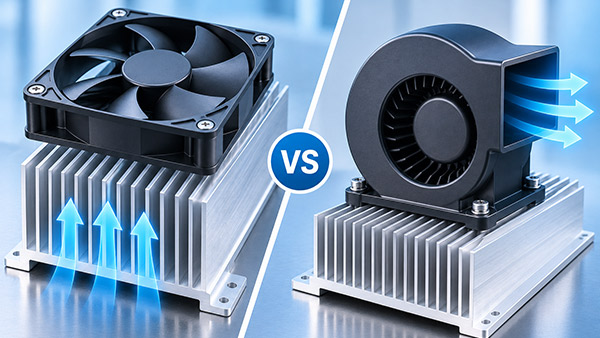
Axial Fans vs Centrifugal Blowers for Extruded Heat Sinks: Which Is Better?
KINGKA
Axial fans are often suitable for relatively open cooling paths, while centrifugal blowers are frequently considered when equipment requires higher pressure capability or redirected airflow. However, fan performance depends on the actual operating point, not simply the fan type.
For industrial equipment using an extruded aluminum heatsink, selecting the airflow device is an important part of cooling system development.
How Does an Axial Fan Work?
An axial fan moves air generally along the direction of its rotating shaft.
Axial fans are widely used in computer cooling, electronics enclosures, and general forced-air applications.
They are available in many sizes and performance configurations.
Their advantages can include relatively simple installation and substantial airflow under suitable resistance conditions.
However, an axial fan selected using only its free-air airflow rating may underperform when connected to restrictive heatsink channels.
How Does a Centrifugal Blower Work?
A centrifugal blower draws air into its rotating impeller and directs it outward into a housing or outlet.
Many blowers are designed to develop useful pressure against restrictive flow paths.
They can be suitable for compact equipment requiring ducted airflow or a change in airflow direction.
However, blower assemblies may require additional packaging space and can introduce different acoustic characteristics.
Axial Fan vs Blower Comparison
Feature
Axial Fan
Centrifugal Blower
Typical airflow direction
Along the fan axis
Redirected through the blower housing
System integration
Often straightforward for open airflow
Useful for defined ducts or side outlets
Pressure capability
Depends on design
Often selected for restrictive paths
Mounting geometry
Circular or square fan format
Specialized outlet geometry
Noise
Depends on operating point
Depends on operating point
Best selection method
Fan curve and system resistance
Blower curve and system resistance
Why Pressure Drop Matters
Air moving through the channels of an extrusion heat sink experiences frictional losses.
The losses depend on channel length, spacing, airflow rate, and geometry.
Additional restrictions may come from inlet grilles, filters, ducts, or nearby equipment.
The selected fan must operate where its pressure-flow curve intersects the resistance curve of the cooling system.
Which Is Better for Compact Electronics?
An axial fan may be suitable when air can pass directly through the fin array and exit the enclosure.
A blower may be useful when the airflow must be routed through a narrow or angled path.
Neither solution guarantees a lower component temperature without testing.
Can the Heat Sink Be Optimized for the Airflow Device?
Yes. Fin pitch, height, profile length, and channel geometry can be designed around available airflow.
In some projects, modifying the extrusion profile may reduce airflow resistance sufficiently to permit a different fan choice.
KINGKA Heat Sink Manufacturing
KINGKA manufactures custom extrusion heat sinks for industrial electronics and other forced-air cooling applications.
OEM buyers can submit the available installation dimensions, airflow requirements, and heatsink drawings for manufacturing evaluation.
FAQ
Are blowers always better for dense heatsink fins?
No. Their suitability depends on the required pressure and actual performance curve.
Is CFM enough to compare fans?
No. Static pressure, system resistance, operating noise, and power consumption are also important.
Should fan selection happen before heatsink production?
Ideally, fan and heatsink selection should be coordinated before the design is finalized.
Axial fans and centrifugal blowers offer different airflow and packaging possibilities.
For custom aluminum heatsinks, the best choice is the device that provides the required cooling performance within the available space, acoustic limits, and electrical power budget.
Kingka Tech Industrial Limited
We specialize in Heat Sink、Liquid Cold Plate、precision CNC machining and our products are widely used in telecommunication industry, aerospace, automotive, industrial control, power electronics, medical instruments, security electronics, LED lighting and multimedia consumption.