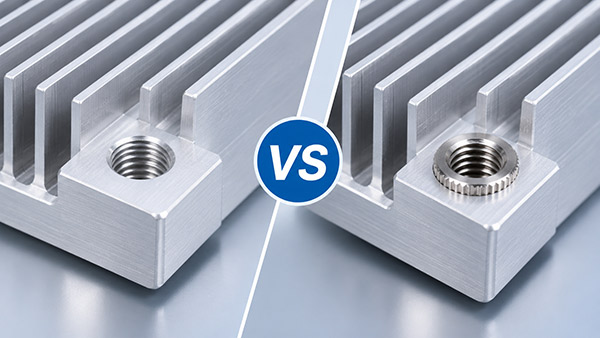
Direct Aluminum Threads vs Steel Inserts: Which Is Better for Extruded Heat Sink Assemblies?
KINGKA
Fasteners play an important role in the mechanical reliability of an extruded heat sink.
They may secure power modules, mounting brackets, covers, or other electronic components.
For OEM manufacturers, one decision is whether screws should engage directly with tapped aluminum holes or with installed threaded inserts.
Quick Answer: Direct aluminum threads can be economical for suitable permanent or infrequently serviced assemblies. Threaded steel inserts may be preferable where repeated assembly, higher retention requirements, or repairability justify additional components. The decision depends on aluminum alloy, thread engagement, mechanical loads, installation conditions, and service life.
Why Does Thread Design Matter?
An aluminum heat sink often performs both thermal and mechanical functions.
Its base conducts heat while also supporting mounting hardware.
If a threaded connection loosens or becomes damaged, the mounting arrangement may no longer maintain the intended mechanical or thermal contact.
Fastener design should therefore be considered during the heat sink engineering process.
Option 1: Directly Tapped Aluminum Threads
This construction uses CNC drilling and tapping to create screw threads in the heat sink base.
It avoids a separate threaded insert and can simplify the bill of materials.
For many applications, direct aluminum threading can provide adequate fastening strength when the material, engagement length, and tightening procedure are suitable.
However, aluminum threads may be more vulnerable to damage from overtightening, cross-threading, or repeated servicing.
Option 2: Installed Threaded Inserts
Threaded inserts provide an additional metal interface for fastening.
Depending on the design, they may offer more durable internal threads for repeated assembly.
However, they introduce additional manufacturing operations and require sufficient surrounding aluminum material.
Insert selection must account for installation method, load direction, thermal cycling, and compatibility with the base material.
Comparison
Factor
Direct Aluminum Thread
Threaded Insert
Component count
Lower
Higher
Manufacturing
Drill and tap
Hole preparation and insert installation
Repeated servicing
Depends on thread design
May offer improved durability
Initial cost
Often lower
Additional material and assembly
Repair options
Application-dependent
Depends on insert type
Main risk
Thread stripping
Insert movement or installation defects
Does an Insert Affect Thermal Performance?
It can, depending on its location.
An insert installed near a thermal contact surface may influence local geometry or available heat-spreading material.
The surrounding structure must also remain thick enough to accommodate the insert safely.
For this reason, mounting features should not be added without considering the heat sink's thermal and mechanical design.
What Should OEM Buyers Specify?
For a custom extruded heat sink, the engineering drawing should identify:
Thread size and depth.
Required engagement length.
Fastener material.
Tightening torque specification.
Expected service frequency.
Mounting load requirements.
Insert type, if applicable.
Inspection and assembly requirements.
The final tightening specification should be established from the complete joint design, not the aluminum material alone.
Frequently Asked Questions
Are steel inserts always stronger than aluminum threads?
Not necessarily. Joint performance depends on insert construction, installation quality, base material, engagement geometry, and applied loads.
Can threaded inserts be installed after extrusion?
Yes. Suitable inserts can be installed through secondary operations when the geometry permits.
Should every removable heatsink use inserts?
No. Direct aluminum threads may be adequate when the expected service conditions and fastening requirements support their use.
Direct aluminum threads and threaded inserts can both provide suitable fastening solutions.
OEM buyers should evaluate assembly frequency, mechanical reliability, available material thickness, and manufacturing cost.
We specialize in Heat Sink、Liquid Cold Plate、precision CNC machining and our products are widely used in telecommunication industry, aerospace, automotive, industrial control, power electronics, medical instruments, security electronics, LED lighting and multimedia consumption.