

An aluminum heat sink extrusion kit can combine a cut or machined profile with selected installation components, such as fasteners, brackets, thermal interface materials or a fan. The term does not define a universal package, so the purchase specification must identify every included item and operation.
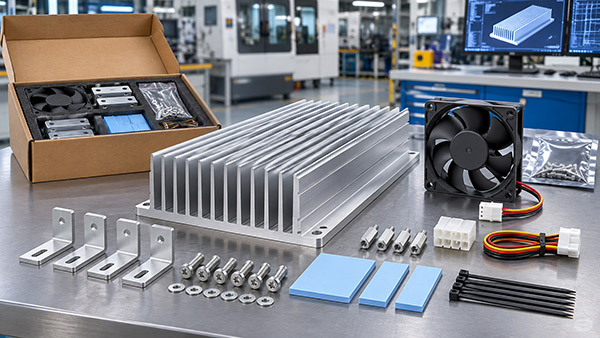
For OEM procurement teams, a kit is worth evaluating when it can simplify installation, coordinate component availability or reduce internal handling. The decision should compare the complete assembly process and the responsibilities retained by the buyer.
1. Clarify Whether You Need a Kit or an Assembled Module
A package containing loose components and a fully assembled cooling module create different receiving and production requirements. Both can be useful, but they should be quoted separately.
| Supply format | Potential scope | Buyer responsibility to confirm |
|---|---|---|
| Finished heat sink | Extruded profile with specified machining and finish | Hardware, interface materials and installation |
| Installation kit | Heat sink plus an agreed list of loose accessories | Assembly process and final verification |
| Assembled cooling module | Heat sink and agreed components assembled by the supplier | Equipment integration and application qualification |
Ask whether the shipment is complete for one installation, contains bulk-packed accessories or requires additional buyer-supplied items. This distinction affects line-side storage, picking and production planning.
2. Create a Controlled Bill of Materials
A kit should have a controlled bill of materials that identifies each component, quantity, specification and approved revision. Descriptions such as “suitable screws” or “equivalent thermal pad” can leave purchasing and assembly teams with different expectations.
Fasteners: thread, length, material, finish and required quantity.
Brackets: drawing revision, mounting orientation and relevant dimensions.
Thermal interface materials: approved product, shape, thickness and handling requirements.
Fans, where included: approved model, voltage, connector and required operating characteristics.
Labels and packaging: identification, component separation and installation instructions.
Define how substitutions will be proposed and approved. A change to an accessory can affect installation even when the extrusion profile remains unchanged.
3. Review Interfaces Between the Included Parts
Component compatibility needs to be assessed at assembly level. Matching a fan's external dimensions to a heat sink, for example, does not establish the installed cooling performance.
Engineering should review the airflow path, mounting arrangement, clearances and electrical connections. For interface materials, confirm the intended contact surfaces and installation conditions using the approved material guidance.
Where the supplier performs assembly, agree on the work instructions and verification records. Where the buyer performs assembly, request the information needed to reproduce the approved configuration.
4. Compare Total Installed Cost
A kit may carry a higher purchase price than the heat sink alone while reducing other costs. Purchasing should calculate those differences using actual assembly and logistics information.
| Cost category | What to measure |
|---|---|
| Purchased components | Heat sink, hardware, interface materials and optional active components |
| Internal handling | Receiving, storage, picking and component movement |
| Assembly labor | Time needed to prepare and install the cooling components |
| Quality activities | Incoming inspection and assembly verification |
| Packaging and freight | Delivered cost and protection of the complete package |
| Inventory exposure | Effects of design changes or mismatched component demand |
The comparison should use the same completed deliverable. If one option includes supplier assembly and another requires internal assembly, add the relevant internal work to the second option before judging the price difference.
5. Define Acceptance and Spare-Part Requirements
Separate kit completeness checks from dimensional inspection and functional testing. Confirm which checks the supplier performs, what records are provided and which tests remain part of the buyer's equipment qualification.
Service requirements should also be considered before combining components into one purchased item. Ask whether fans, brackets and interface materials can be ordered separately, and how replacement parts will be identified after a revision.
A kit can simplify initial production while still requiring clear arrangements for maintenance and replacement.
Discuss the Proposed Package with KINGKA
For a custom aluminum extrusion heat sink, share your assembly drawing and proposed BOM with KINGKA. Confirm which accessories, assembly operations and inspection activities can be included in the project quotation.
Frequently Asked Questions
Does every aluminum heat sink extrusion kit include a fan?
No. Kit contents depend on the offer and approved BOM. Passive installation kits may contain no powered components.
Is buying a complete kit always cheaper?
The result depends on component pricing, assembly labor, handling, freight and inventory requirements. Compare the total installed cost.
Can the kit use an existing extrusion profile?
Potentially, if the profile meets the thermal, mechanical and manufacturing requirements of the complete assembly.