Aluminum Cooling Plate Electrical Isolation: When Is an Insulated Design Necessary?
KINGKA
An aluminum cooling plate can provide effective thermal management for industrial electronics, but thermal performance is not the only consideration when the plate is installed near electrically active components.
Depending on the equipment design, engineers may need electrical insulation between the cooling plate and mounted power devices.
Quick Answer: An aluminum cooling plate requires electrical isolation when the equipment's electrical design calls for insulation between energized components and the conductive metal plate. Insulation can be provided through suitable component packages, interface materials, or engineered mounting structures. The complete assembly must meet both thermal and electrical requirements.
Why Does Electrical Isolation Matter?
Aluminum is electrically conductive.
When a power semiconductor module or other electronic device is mounted on an aluminum cooling plate, the metal base can form part of an unintended electrical path if the component construction does not provide sufficient isolation.
This risk depends on the device package, electrical circuit, mounting arrangement, and protective measures.
For equipment such as industrial inverters, motor drives, converters, and power supplies, electrical isolation requirements should be established before finalizing the cooling plate design.
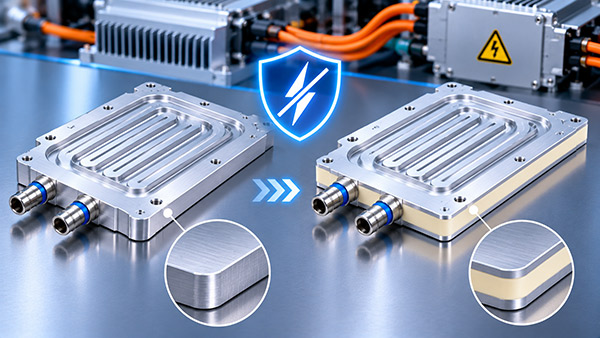
Insulated vs Non-Insulated Aluminum Cooling Plates
A non-insulated mounting arrangement places the heat source in direct or thermally coupled contact with the conductive plate.
This may be acceptable when the electrical potential of the component's mounting surface is compatible with the cooling structure.
An insulated arrangement introduces an electrically insulating layer or structure between relevant conductive parts.
The goal is to meet the equipment's electrical requirements while maintaining adequate heat transfer.
Design Factor
Non-Insulated Interface
Insulated Interface
Electrical separation
Not provided by the interface
Provided by a qualified insulating structure
Thermal resistance
May be lower
Additional resistance may be introduced
Material selection
Thermal and mechanical focus
Thermal, electrical, and mechanical requirements
Assembly
Relatively straightforward
Requires insulation and mounting controls
Validation
Thermal and mechanical testing
Thermal, mechanical, and electrical testing
The appropriate design depends on the actual electronic assembly.
How Does Insulation Affect Cooling Performance?
Adding insulation can increase thermal resistance between the heat-generating component and the coolant.
The thermal effect depends on material conductivity, thickness, contact quality, and operating conditions.
A simplified conduction relationship is:
R = t / (k × A)
Where:
R = thermal resistance in K/W.
t = material thickness in meters.
k = thermal conductivity in W/(m·K).
A = effective heat-transfer area in square meters.
This equation represents ideal conduction through a uniform layer. Actual assemblies also have contact resistance and other thermal effects.
For high-power components, the interface should be tested under representative mounting pressure and operating conditions.
Can Anodizing Provide Electrical Isolation?
Anodized aluminum can form an electrically insulating oxide layer under certain conditions.
However, ordinary anodizing should not automatically be treated as a qualified safety insulation system.
Coating thickness, porosity, damage, edge coverage, environmental exposure, and breakdown behavior can affect performance.
Where electrical insulation is safety-critical, the OEM must validate the complete insulating structure against the applicable equipment requirements.
A general-purpose surface finish specification is not a substitute for electrical insulation qualification.
What Should OEM Buyers Verify Before Ordering?
When purchasing an aluminum cooling plate, buyers should confirm the electrical and mechanical interface requirements with their engineering team.
Important specifications include:
Required electrical isolation characteristics.
Component mounting surface and package construction.
Insulation material and thickness.
Maximum permissible component temperature.
Required thermal interface material.
Mounting pressure and fastening arrangement.
Applicable electrical tests and acceptance criteria.
The cold plate supplier can contribute the dimensional and manufacturing information required to support the assembly design.
The responsible equipment designer must establish the electrical safety requirements.
How Can Thermal Resistance Be Controlled?
Electrical insulation should be evaluated as part of the complete heat-transfer path.
Potential design measures include selecting suitable thermal interface materials, improving mating-surface quality, controlling mounting pressure, and evaluating alternative plate geometry.
The objective is not to eliminate all thermal resistance, which is impossible, but to maintain acceptable component temperatures within the required electrical design.
KINGKA Custom Aluminum Cooling Plate Solutions
KINGKA manufactures custom Liquid Cold Plates with aluminum bases, embedded tubing, and CNC-machined mounting features.
For projects involving electrically sensitive equipment, buyers can provide thermal requirements, component mounting drawings, and interface specifications for manufacturing review.
The electrical insulation design and any required safety certification should be validated at the appropriate system level.
Frequently Asked Questions
Is an aluminum cooling plate electrically conductive?
Yes. Aluminum is a conductive metal and should not be treated as an electrical insulator.
Does every cold plate require electrical insulation?
No. The requirement depends on the connected components and the equipment's electrical architecture.
Can an insulating thermal pad reduce cooling performance?
Yes. An additional layer can increase thermal resistance, although the actual impact depends on its properties and installation.
Is hard anodizing sufficient for electrical safety?
Not automatically. A coating must be evaluated for the specific insulation requirement, operating conditions, and applicable safety standards.
An aluminum cooling plate should be selected according to both thermal and electrical requirements.
Where isolation is necessary, the insulation method should be defined before finalizing mounting geometry and manufacturing drawings.
We specialize in Heat Sink、Liquid Cold Plate、precision CNC machining and our products are widely used in telecommunication industry, aerospace, automotive, industrial control, power electronics, medical instruments, security electronics, LED lighting and multimedia consumption.