
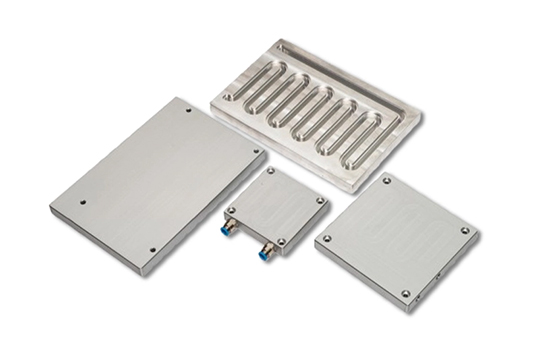
Friction Stir Welding Water-Cooled Plates are advanced liquid cooling components manufactured by friction stir welding (FSW) technology to achieve high-performance thermal management for demanding applications. Unlike traditional brazed Cold Plates or machined liquid Cold Plates, FSW water-cooled plates use a solid-state joining process to create a strong, leak-resistant structure without melting the base materials.
These water-cooled plates are widely used in EV battery thermal management, IGBT cooling, power electronics, energy storage systems, industrial lasers, and high-power electronic equipment where efficient heat removal and long-term reliability are critical.
As a professional liquid cold plate manufacturer, we provide customized friction stir welded cold plates, including flow channel design, thermal simulation, prototype development, and mass production.
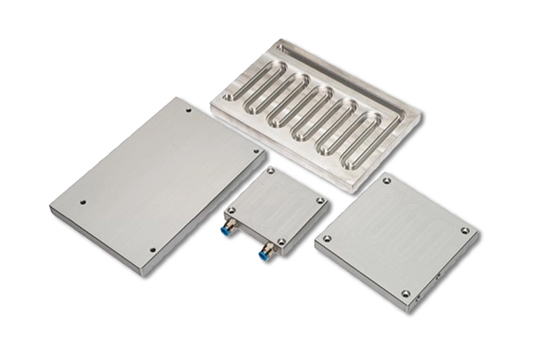
A Friction Stir Welding Water-Cooled Plate is a type of liquid cold plate manufactured by joining two aluminum plates through friction stir welding technology.
The cooling plate usually consists of:
Upper aluminum cover plate
Lower aluminum base plate
Internal cooling channels
Water inlet and outlet ports
Sealing weld area
During operation, coolant flows through the internal channels and absorbs heat generated by electronic components. The heat is transferred from the heat source to the aluminum plate and then carried away by the circulating liquid.
Common materials include:
Aluminum 6061-T6
Aluminum 6063-T5
Aluminum 5083
Copper (for special applications)
Among them, 6061 aluminum water cooling plates are widely used due to their excellent thermal conductivity, mechanical strength, and corrosion resistance.
Unlike conventional welding methods, friction stir welding is a solid-state joining technology.
During the process:
A rotating welding tool moves along the joint line.
Frictional heat softens the aluminum material.
The plasticized material is stirred and mixed.
A strong metallurgical bond is formed after cooling.
Because the material does not reach its melting temperature, FSW avoids many defects associated with fusion welding, such as:
Porosity
Cracking
Thermal distortion
Weak weld zones
The working principle of a friction stir welded cold plate is based on liquid heat transfer.
High-power components generate heat during operation.
Typical heat sources include:
IGBT modules
EV battery cells
Inverters
Power semiconductor devices
Laser systems
The heat transfers through thermal interface materials (TIM), such as:
Thermal grease
Thermal pads
Gap fillers
to the surface of the water-cooled plate.
The cooling liquid enters through the inlet port and flows through the internal channels.
Common coolants include:
Deionized water
Water-glycol mixture
Ethylene glycol coolant
Dielectric coolant
The coolant absorbs heat and transports it away from the heat source.
Typical flow path:
Electronic Component
↓
Thermal Interface Material
↓
Aluminum Cold Plate
↓
Internal Cooling Channel
↓
Coolant Flow
↓
Heat Exchanger / Radiator
↓
Return Loop
FSW creates a strong metallurgical bond between aluminum plates.
Advantages:
Excellent mechanical strength
High fatigue resistance
Reliable long-term operation
Reduced leakage risk
This makes friction stir welded cold plates suitable for automotive and industrial applications requiring high reliability.
The aluminum structure provides efficient heat transfer.
Thermal performance depends on:
Channel geometry
Coolant flow rate
Heat load
Plate thickness
Material conductivity
Typical thermal parameters:
| Parameter | Typical Range |
|---|---|
| Material | 6061-T6 Aluminum |
| Thermal Conductivity | 167 W/m·K |
| Flow Rate | 1–10 L/min |
| Working Pressure | 2–10 bar |
| Heat Load Capacity | 500W–5000W+ |
| Thermal Resistance | 0.02–0.15 K/W |
(Custom designs can achieve higher cooling capacity.)
Because FSW operates below the melting temperature:
Less thermal deformation
Better dimensional stability
Improved flatness
This is important for applications requiring direct contact with batteries or power modules.
FSW water-cooled plates support customized channel structures, including:
Advantages:
Longer coolant residence time
High heat transfer efficiency
Applications:
Battery cooling plates
High-power modules
Advantages:
Lower pressure drop
Uniform coolant distribution
Applications:
Large-area cooling systems
Used for:
High heat flux applications
Compact thermal systems
Raw materials are inspected according to:
Chemical composition
Mechanical properties
Flatness requirements
Common material:
6061-T6 aluminum plate
The cooling channels are manufactured through precision machining.
Parameters include:
Channel width
Channel depth
Flow path design
Port position
CNC machining ensures accurate coolant flow distribution.
The upper and lower plates are assembled and joined through FSW.
Key welding parameters:
Tool rotation speed
Welding speed
Axial force
Tool geometry
Proper control ensures:
Strong weld joints
Leak-proof performance
Consistent quality
Each water-cooled plate undergoes pressure testing.
Common inspection methods:
Air pressure decay test
Helium leak test
Hydrostatic pressure test
Typical requirements:
No leakage
Stable pressure holding
Reliable sealing
Testing includes:
Flow rate measurement
Pressure drop analysis
Thermal resistance evaluation
FSW water cooling plates are widely used in:
Electric vehicles
Battery packs
Battery thermal management systems
They help maintain battery temperature uniformity and improve battery life.
For power electronics:
Inverters
Motor controllers
Industrial converters
FSW cold plates provide efficient cooling for high-power semiconductor modules.
Applications include:
ESS battery cabinets
Renewable energy storage
Grid energy systems
Used in:
Laser equipment
Welding machines
CNC equipment
High-power electrical systems
| Type | Manufacturing Method | Advantages |
|---|---|---|
| FSW Water Cooling Plate | Friction Stir Welding | High strength, reliable sealing, low distortion |
| Vacuum Brazed Cold Plate | Brazing | Compact channels, high efficiency |
| Machined Cold Plate | CNC machining | Flexible channel design |
| Embedded Tube Cold Plate | Tube embedding | Cost-effective production |
FSW is especially suitable for large-size cooling plates and applications requiring high structural strength.
As an experienced liquid cold plate manufacturer, we provide customized thermal management solutions for global customers.
Our capabilities include:
Custom water-cooled plate design
Thermal simulation analysis
CNC channel machining
Friction stir welding
Leak testing
Mass production
We support customers with:
CAD drawing review
Cooling channel optimization
Material selection
Prototype validation
to develop reliable custom liquid cooling plates.
A friction stir welding water-cooled plate is a liquid cooling plate manufactured by joining aluminum plates using friction stir welding technology to create internal coolant channels.
FSW provides strong joints, low thermal deformation, excellent sealing performance, and high reliability compared with traditional welding methods.
Most FSW cooling plates use aluminum alloys such as 6061-T6, 6063, and 5083 due to their lightweight and good thermal conductivity.
Depending on size, coolant flow, and channel design, FSW cold plates can handle hundreds to several thousand watts of heat load.
Yes. Cooling channels, dimensions, materials, ports, and thermal performance can be customized according to customer requirements.

Kingka Tech Industrial Limited
We specialize in Heat Sink、Liquid Cold Plate、precision CNC machining and our products are widely used in telecommunication industry, aerospace, automotive, industrial control, power electronics, medical instruments, security electronics, LED lighting and multimedia consumption.


Address:
Da Long New Village, Xie Gang Town, Dongguan City, Guangdong Province, China 523598
Email:
WhatsAPP: