
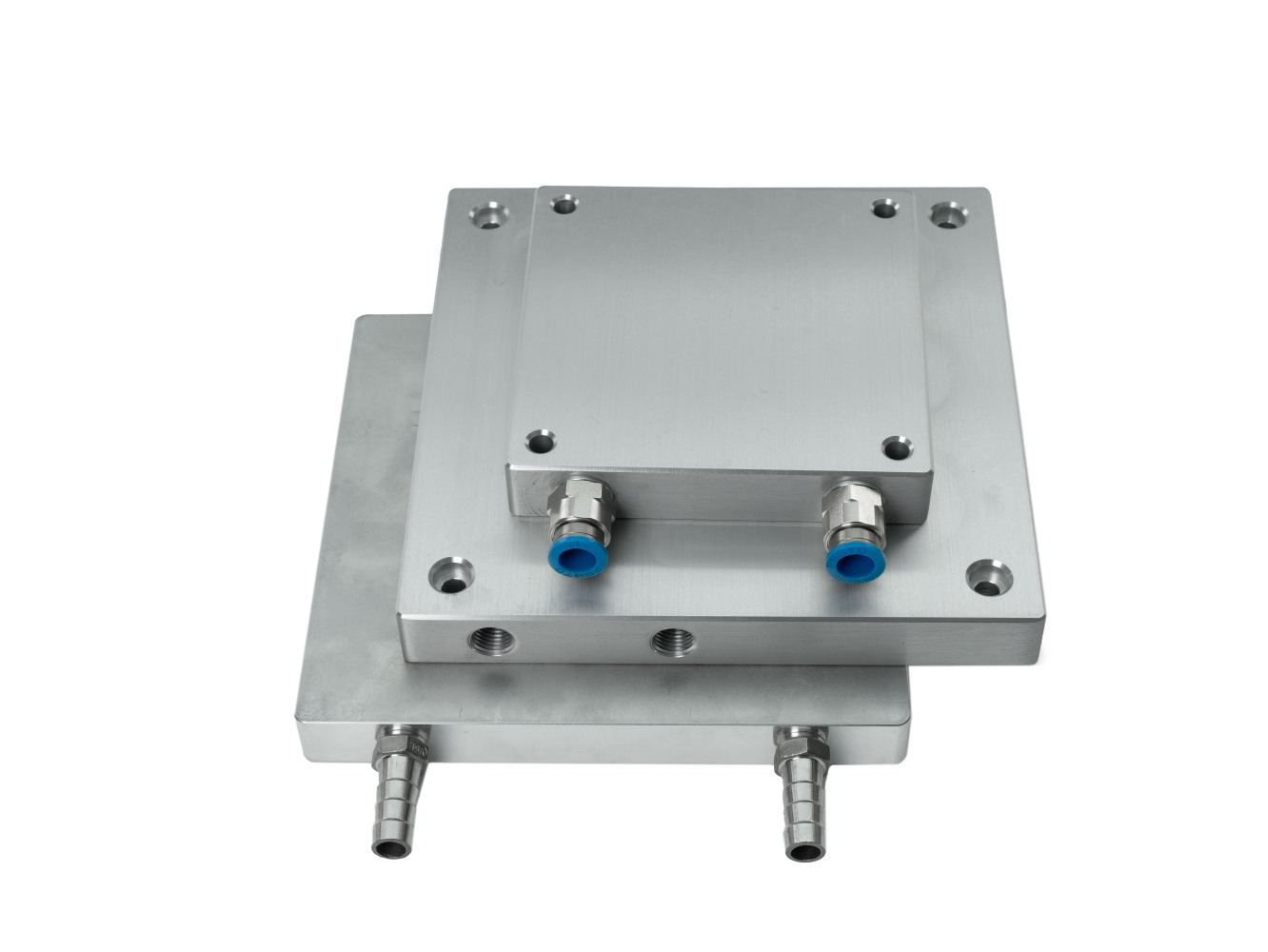
FSW Liquid Cold Plate Parts, also known as Friction Stir Welded Liquid Cold Plates, are high-performance thermal management components designed for efficient heat removal in high-power electronic systems.
These cold plates combine precision CNC machining with Friction Stir Welding (FSW) to create sealed internal coolant channels. Because FSW is a solid-state welding process, the base material is joined without melting, helping reduce thermal distortion while providing strong joints, reliable sealing, and stable mechanical performance.
FSW Liquid Cold Plates are widely used in EV battery cooling, data center liquid cooling, IGBT cooling, energy storage systems, power electronics, inverters, industrial lasers, and high-performance computing systems.
An FSW liquid cold plate transfers heat from electronic components into circulating coolant.
Heat generated by batteries, CPUs, GPUs, IGBT modules, MOSFETs, power modules, or other heat sources is conducted into the cold plate base. The coolant then flows through internal channels and carries the heat away from the system.
A typical manufacturing process includes:
CNC machining of internal flow channels
Positioning the cover plate
Friction Stir Welding along the joint line
CNC finishing and surface machining
Surface treatment
Pressure and leak testing
The FSW process uses a rotating tool to generate frictional heat and mechanically stir the softened material together. This forms a dense, continuous weld without fully melting the aluminum.
| Parameter | Specification |
|---|---|
| Material | Aluminum 6061 / 6063 / Custom |
| Manufacturing Process | CNC Machining + Friction Stir Welding |
| Cooling Medium | Water / Glycol / Custom Coolant |
| Channel Design | Serpentine / Parallel / Multi-Channel / Custom |
| Surface Treatment | Anodizing / Passivation / Nickel Plating |
| Pressure Rating | 0.5–2.0 MPa, Customizable |
| Operating Temperature | -40°C to 150°C |
| Leak Testing | Pressure Test / Helium Leak Test |
| Port Design | Threaded / Barb / Quick Connector / Custom |
| Customization | OEM / ODM Available |
Actual specifications can be adjusted according to thermal load, operating pressure, coolant flow rate, installation space, and application requirements.
Optimized internal flow channels help increase coolant contact area and improve heat transfer efficiency.
The design can be adjusted according to:
Heat load
Heat flux
Coolant flow rate
Pressure drop
Heat source position
Surface temperature requirements
This makes the liquid cooling plate suitable for high-power and high-heat-density applications.
One of the key advantages of Friction Stir Welding is its ability to create strong, continuous joints with low porosity.
For liquid cooling applications, this helps improve sealing reliability and reduce leakage risk.
Because FSW does not fully melt the base material, heat input is lower than many conventional fusion welding processes.
This helps maintain cold plate flatness, channel geometry, and dimensional accuracy.
The solid-state joining process provides strong weld integrity and good pressure resistance.
This is important for liquid cooling systems operating under continuous pressure, vibration, or long service cycles.
An aluminum liquid cold plate provides a good balance between thermal conductivity, weight, machinability, and cost.
Aluminum 6061 and 6063 are commonly used for industrial thermal management applications.
The performance of a custom cold plate depends heavily on internal channel design.
Available structures can include:
Serpentine channels
Parallel flow channels
Multi-channel layouts
Localized cooling channels
Customized CNC-machined flow paths
A well-designed channel structure helps improve coolant distribution while controlling pressure drop and avoiding flow dead zones.
For demanding applications, CFD analysis can be used to optimize fluid flow and thermal performance before manufacturing.
An EV battery cooling plate helps control cell temperature, reduce temperature differences across the battery pack, and support stable charging and discharging performance.
FSW cold plates can be used in direct liquid cooling systems for:
CPUs
GPUs
AI servers
HPC systems
Server power electronics
As computing power density increases, data center liquid cooling has become an important thermal management solution.
An IGBT cooling plate can provide direct liquid cooling for:
IGBT modules
MOSFETs
Inverters
Converters
Rectifiers
Power supplies
Liquid cooling helps control junction temperature and improve long-term component reliability.
Battery energy storage systems require stable thermal control during charge and discharge cycles.
FSW liquid cold plates can be integrated into ESS battery modules to improve temperature uniformity.
Other applications include:
Industrial lasers
Medical equipment
Semiconductor systems
Automation equipment
Renewable energy systems
High-power electronic devices
| Feature | FSW Liquid Cold Plate | Brazed Cold Plate |
|---|---|---|
| Joining Process | Friction Stir Welding | Brazing |
| Base Metal Melting | No | No, filler metal melts |
| Thermal Distortion | Relatively Low | Higher thermal exposure |
| Joint Strength | High | Good |
| Leak Resistance | Excellent | Depends on brazing quality |
| Filler Material | Usually Not Required | Required |
| Channel Design | Flexible | Highly Flexible |
| Typical Use | High-reliability aluminum cold plates | Complex liquid cooling structures |
FSW is especially suitable for aluminum cold plates where joint strength, sealing reliability, and dimensional stability are important.
As a custom FSW liquid cold plate manufacturer, the product can be engineered according to the complete cooling system rather than only the plate dimensions.
Customization options include:
Plate length, width, and thickness
Aluminum alloy
Internal channel geometry
Channel width and depth
Inlet and outlet position
Port type
Mounting holes
Surface flatness
Surface treatment
Operating pressure
Coolant type
OEM branding
Engineering support can also include:
CFD simulation
Thermal analysis
Prototype manufacturing
Flow testing
Pressure testing
Leak testing
Dimensional inspection
FSW Liquid Cold Plate Parts provide a reliable combination of:
High cooling efficiency
Low thermal resistance
Strong weld integrity
Reliable sealing performance
Good pressure resistance
Lightweight aluminum construction
Flexible flow channel design
Precision CNC machining
OEM and ODM customization
They are suitable for customers requiring efficient and reliable thermal management in EVs, data centers, energy storage systems, IGBT modules, inverters, industrial equipment, and high-performance electronics.
For projects requiring customized dimensions, internal channels, mounting structures, port locations, or thermal performance, an FSW liquid cold plate can be developed according to specific system requirements.

Kingka Tech Industrial Limited
We specialize in Heat Sink、Liquid Cold Plate、precision CNC machining and our products are widely used in telecommunication industry, aerospace, automotive, industrial control, power electronics, medical instruments, security electronics, LED lighting and multimedia consumption.


Address:
Da Long New Village, Xie Gang Town, Dongguan City, Guangdong Province, China 523598
Email:
WhatsAPP: