
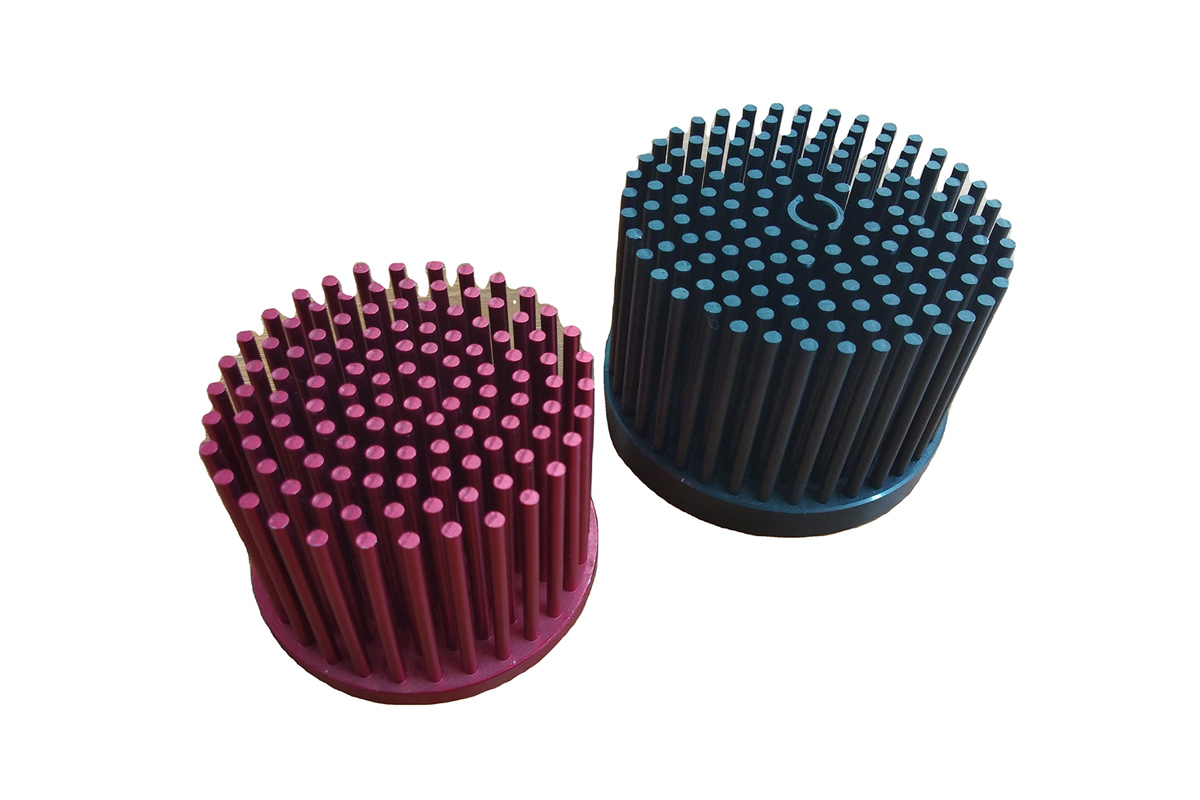
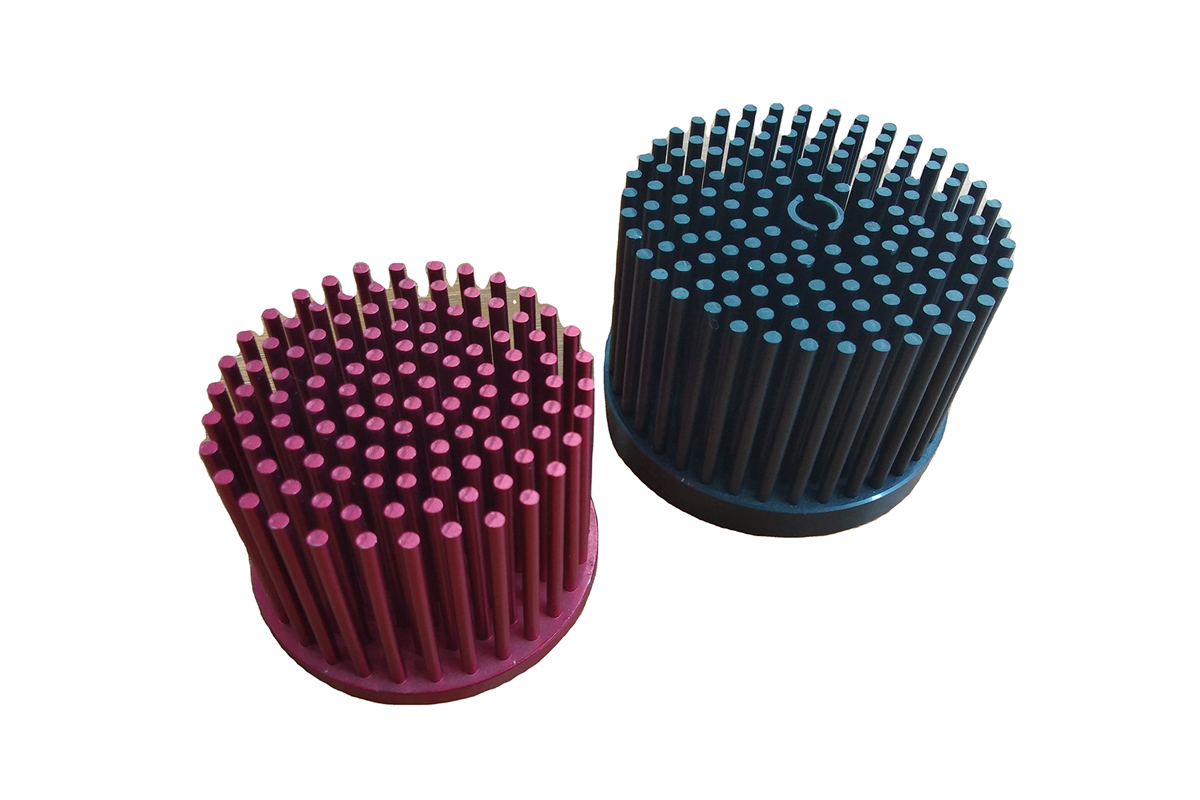
Cold Forging Heat Sinks are advanced thermal management components manufactured using high-precision cold forging technology. Unlike extrusion or bonded fin heat sinks, cold forging involves shaping aluminum alloys under high pressure at room temperature, producing a dense grain structure and superior mechanical properties. These heat sinks offer excellent thermal conductivity, structural strength, and dimensional accuracy, making them ideal for LED lighting, automotive electronics, industrial power devices, and telecom systems.
Cold forging enables complex fin geometries with high fin density, providing maximum heat dissipation in limited space. They can be customized for fin height, base thickness, surface treatment, and mounting configurations to meet diverse cooling requirements.
High Thermal Performance
Cold forged aluminum heat sinks offer thermal conductivity up to 220 W/m·K, ensuring rapid heat transfer from high-power electronic components, reducing the risk of overheating and improving system reliability.
Precision Engineering
Cold forging allows tight tolerances (±0.05 mm), ensuring consistent dimensions and perfect fit in high-density assemblies. Critical for applications where space constraints and precise mounting are required.
Mechanical Strength & Durability
The cold forging process compresses the aluminum microstructure, significantly increasing hardness and mechanical strength compared to extrusion. These heat sinks resist warping, deformation, and vibration, even under thermal cycling.
Customizable Design
Fin height, thickness, spacing, and base size can be optimized for airflow and thermal load. Surface treatments like anodizing or black oxide enhance corrosion resistance and emissivity.
Cost-Effective for Mass Production
Cold forging reduces material waste, minimizes secondary machining, and supports high-volume production, making it suitable for OEM and large-scale industrial applications.
| Parameter | Description | Notes |
|---|---|---|
| Material | Aluminum Alloy 6061 / 6063 | High thermal conductivity & mechanical strength |
| Manufacturing Process | Cold Forging | Optional CNC Machining for fine features |
| Thermal Conductivity | 180 – 220 W/m·K | Depends on alloy and temper |
| Base Thickness | 3 – 20 mm | Customizable per design |
| Fin Height | 10 – 50 mm | Adjustable based on cooling requirements |
| Fin Pitch | 1.5 – 5 mm | High fin density for maximum surface area |
| Surface Finish | Anodized / Black Oxide / Bare | Enhances heat dissipation and corrosion resistance |
| Dimensional Tolerance | ±0.05 mm | Ensures precise fit for assembly |
| Max Operating Temperature | 200°C | Suitable for high-power electronics |
| Weight | 0.5 – 5 kg | Varies by size and fin density |
| Applications | LED Lighting, Automotive Electronics, Power Modules, Industrial Equipment, Telecom | Widely used in high-power and high-density electronic devices |
| Feature | Cold Forging Heat Sink | Extrusion Heat Sink | Skived Fin Heat Sink | Bonded Fin Heat Sink |
|---|---|---|---|---|
| Thermal Conductivity | High (180-220 W/m·K) | Medium | Very High | Medium |
| Mechanical Strength | Very High | Medium | Medium | Low |
| Dimensional Precision | ±0.05 mm | ±0.2 mm | ±0.1 mm | ±0.3 mm |
| Fin Density | High | Medium | Very High | Medium |
| Customization | High | Medium | Medium | Low |
| Durability | Excellent | Good | Moderate | Low |
| Cost | Moderate | Low | High | Low |
| Ideal Applications | High-power electronics, LED lighting, EV modules | General electronics cooling | High-performance compact electronics | Low-cost, standard cooling needs |
Insight: Cold Forging Heat Sinks are particularly advantageous in high-power and high-reliability systems, where both thermal performance and mechanical robustness are critical.
Maintains optimal junction temperature to extend LED lifespan.
Supports high-power LED arrays in compact housings.
Example: Streetlights, architectural lighting, industrial high-bay lighting.
Efficiently cools EV power modules, inverters, and battery management systems.
Resistant to vibration and thermal cycling, critical in automotive environments.
Protects high-power inverters, motor controllers, and industrial converters from overheating.
Maintains consistent performance under continuous operation.
Optimizes cooling in high-density telecom equipment and server racks.
Enables compact designs with high heat dissipation efficiency.
Supports high-current converters, amplifiers, and rectifiers.
Reduces system failures due to overheating.
Superior Thermal Performance: Maximizes heat transfer efficiency.
High-Precision Manufacturing: Ensures consistent assembly and performance.
Robust and Durable: Resists deformation, vibration, and thermal stress.
Customizable for Any Application: Design fin structures, base thickness, and surface finishes per project needs.
Trusted Manufacturing Expertise: Years of experience in aluminum forging and thermal management solutions.
A Cold Forging Heat Sink is a high-performance thermal management component manufactured using cold forging technology, where aluminum alloys are shaped under high pressure at room temperature. This process produces a dense grain structure, enhancing thermal conductivity, mechanical strength, and dimensional accuracy compared to extrusion or bonded fin heat sinks.
Most Cold Forging Heat Sinks are made from Aluminum Alloy 6061 or 6063, known for high thermal conductivity, lightweight structure, and excellent corrosion resistance. Copper can also be used for applications requiring ultra-high thermal conductivity, though aluminum remains the most cost-effective choice.
Compared to extrusion, skived fin, or bonded fin heat sinks, cold forged heat sinks offer:
Higher thermal performance (180–220 W/m·K)
Superior mechanical strength and durability
High fin density for efficient heat dissipation
Precision tolerances (±0.05 mm) for compact designs
Customizable geometries for specific cooling requirements
Cold Forging Heat Sinks are widely used in:
LED Lighting: High-power LED arrays and streetlights
Automotive Electronics: EV power modules, inverters, and battery systems
Industrial Equipment: Motor controllers, inverters, and high-power devices
Telecom & 5G: High-density servers and network equipment
Power Electronics: Converters, amplifiers, and rectifiers
Yes. Cold Forging Heat Sinks can be fully customized in terms of:
Fin height, thickness, and spacing
Base thickness and overall dimensions
Surface treatment (anodizing, black oxide, bare)
Mounting holes and slots for specific assemblies
Customization ensures optimal thermal performance and fit for your application.
Cold Forging Heat Sinks typically operate up to 200°C, depending on the aluminum alloy and surface treatment. This makes them suitable for high-power LED, automotive, and industrial electronics applications.
Higher thermal conductivity due to denser grain structure
Greater mechanical strength and resistance to deformation
More precise tolerances, ideal for compact designs
High fin density without compromising structural integrity
Consider the following factors:
Thermal load of your device – Calculate the heat generated.
Available space – Determine the maximum dimensions for the heat sink.
Airflow conditions – Adjust fin density and geometry accordingly.
Material and surface finish – Choose aluminum alloy and anodizing for corrosion resistance or enhanced emissivity.
Mechanical requirements – Ensure the heat sink can withstand vibration and thermal cycling.
Yes. Cold forging is a highly efficient manufacturing process, suitable for large-scale production. It minimizes material waste and ensures consistent quality and thermal performance across all units.
You can source high-quality Cold Forging Heat Sinks directly from experienced manufacturers that specialize in aluminum thermal solutions. Look for suppliers offering custom design services, precision engineering, and surface treatment options to meet your project needs.

Kingka Tech Industrial Limited
We specialize in precision CNC machining and our products are widely used in telecommunication industry, aerospace, automotive, industrial control, power electronics, medical instruments, security electronics, LED lighting and multimedia consumption.


Address:
Da Long New Village, Xie Gang Town, Dongguan City, Guangdong Province, China 523598
Email:
Tel:
+86 137 1244 4018