
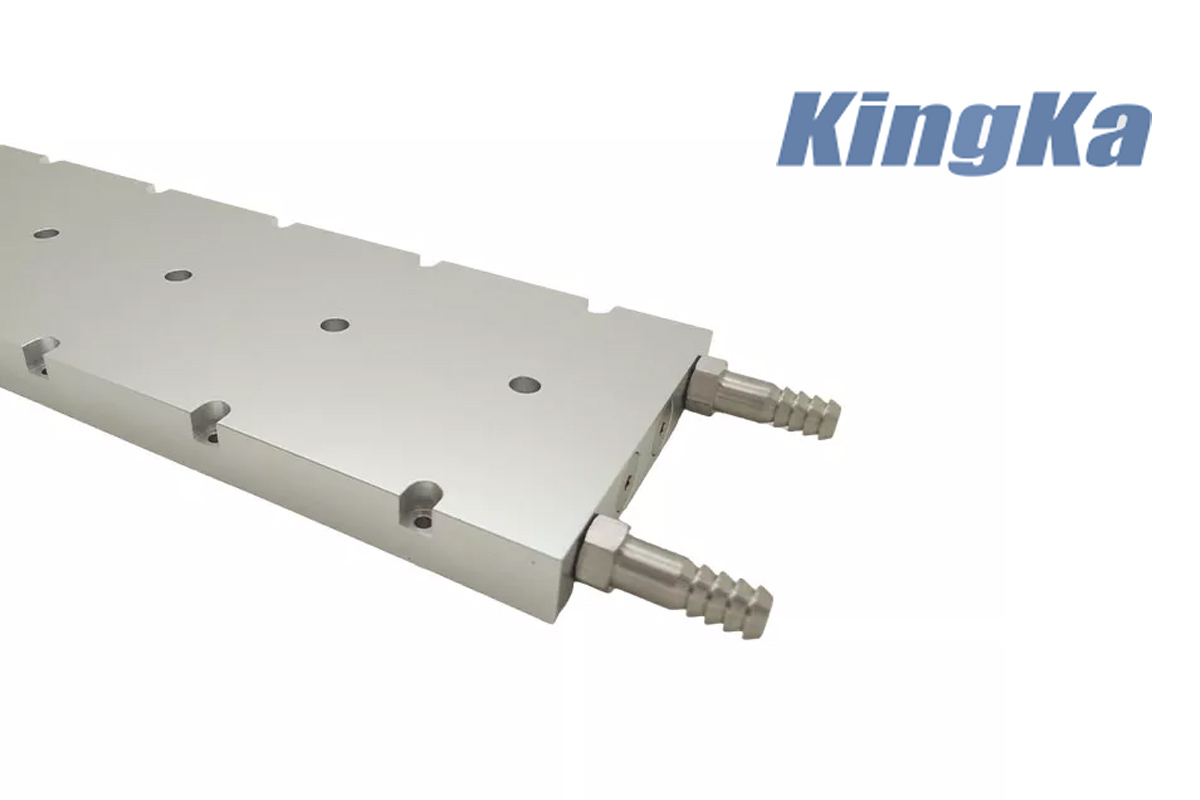
Customized Aluminum Alloy Friction Stir Welding Liquid Cold Plate is a high-performance thermal management solution designed for high-power laser equipment, IGBT modules, semiconductor systems, new energy equipment, optical communication devices, and other high-power electronics. Manufactured from AL6061 aluminum alloy and joined using advanced Friction Stir Welding (FSW) technology, this liquid cold plate provides reliable coolant channels, excellent structural strength, and efficient heat transfer.
Unlike conventional fusion welding, Friction Stir Welding is a solid-state joining process that does not require melting the base material or adding traditional filler metal. This helps reduce weld defects such as porosity while creating strong and reliable joints. The cold plate can also be finished with hard anodizing to improve corrosion resistance, surface hardness, and durability against long-term fluid erosion.
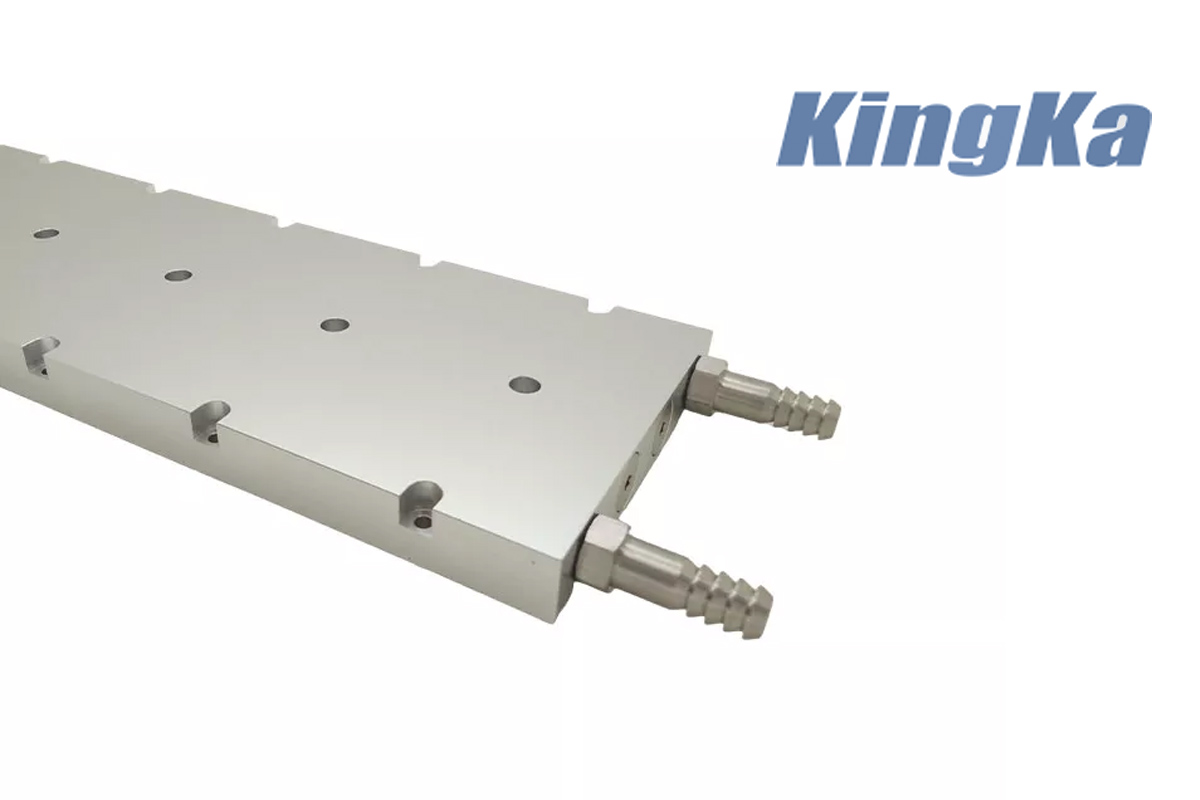
A Friction Stir Welding Liquid Cold Plate is a liquid cooling plate manufactured by joining aluminum components through Friction Stir Welding. Internal cooling channels are formed within the aluminum structure, allowing coolant to circulate continuously and remove heat from high-power components.
The basic heat transfer path is:
Heat Source → Thermal Interface Material → Aluminum Cold Plate → Cooling Channel → Liquid Coolant → Heat Exchanger
Depending on the application, the cooling channels can be customized to optimize coolant flow, pressure drop, heat transfer coefficient, and temperature uniformity.
Friction Stir Welding uses a rotating tool to generate frictional heat and plastic deformation. The aluminum material becomes softened without reaching its melting point, and the rotating tool mechanically stirs the material to form a strong metallurgical bond.
This process is particularly suitable for aluminum liquid cold plates because it provides:
High joint strength
Reliable channel sealing
Low risk of weld porosity
Good dimensional stability
Excellent process repeatability
No conventional filler metal
The FSW process tightly joins the cold plate structure around the cooling channels. This creates a robust sealed structure capable of handling continuous coolant circulation and demanding industrial operating conditions.
For high-power applications, the design can be optimized for pressure resistance, coolant flow, thermal performance, and plate thickness.
AL6061 aluminum alloy is widely used in liquid cooling applications because of its combination of thermal conductivity, mechanical strength, corrosion resistance, machinability, and lightweight construction.
The customized aluminum alloy friction stir welding liquid cold plate can be manufactured according to customer drawings, 3D CAD models, heat load requirements, installation dimensions, and coolant specifications.
Cold plate length, width, and thickness
Cooling channel layout
Channel width and depth
Coolant inlet and outlet positions
Mounting holes and threaded holes
Port specifications
Contact surface dimensions
Surface flatness
Coolant flow requirements
Operating pressure
The performance of an FSW Liquid Cold Plate depends on the complete thermal-fluid design rather than material conductivity alone. Important parameters include heat load, coolant flow rate, inlet temperature, channel geometry, flow velocity, pressure drop, thermal resistance, and heat transfer coefficient.
A properly designed flow channel can increase the effective heat transfer area and improve convective heat transfer between the coolant and aluminum channel wall. For high-power laser and semiconductor applications, the flow path can also be optimized to reduce hot spots and improve temperature uniformity.
Heat Load: The amount of thermal energy that must be removed, measured in W.
Flow Rate: The volume of coolant passing through the cold plate, generally measured in L/min.
Pressure Drop: The pressure loss caused by coolant flow through the internal channels.
Thermal Resistance: The temperature difference divided by heat load, normally expressed in K/W.
Heat Transfer Coefficient: A key parameter describing convective heat transfer between the coolant and channel wall.
The FSW Liquid Cold Plate can be finished with hard anodizing. Hard anodizing creates a durable oxide layer on the aluminum surface and improves resistance to corrosion, wear, and harsh service environments.
This surface treatment is particularly useful for laser equipment and other systems exposed to long-term coolant circulation or fluid erosion.
The engineering team reviews the customer's drawings, 3D models, thermal load, coolant requirements, installation space, and operating conditions before production.
AL6061 aluminum alloy is prepared and machined according to the required cold plate dimensions and cooling channel configuration.
The aluminum components are joined using controlled FSW parameters. Tool rotation speed, travel speed, axial force, and tool geometry are optimized according to the material and cold plate structure.
After FSW, CNC machining can be used to finish mounting holes, threaded holes, coolant ports, external dimensions, and critical contact surfaces. This enables the cold plate to meet application-specific dimensional requirements.
The finished aluminum cold plate can undergo hard anodizing to improve surface durability and corrosion resistance.
Quality control can include dimensional inspection, visual inspection, pressure testing, leak testing, and thermal performance testing. The supplied production specification includes 100% thermal testing.
| Parameter | Specification |
|---|---|
| Product Name | Customized Aluminum Alloy Friction Stir Welding Liquid Cold Plate |
| Material | AL6061 |
| Manufacturing Process | Friction Stir Welding |
| Additional Process | CNC Machining |
| Surface Treatment | Hard Anodizing |
| Shape | Square / Custom |
| Size | Custom Size |
| Tolerance | Up to ±0.01 mm for specified machined features |
| Temper | T3–T8 |
| Cooling Type | Liquid Cooling |
| Channel Design | Customized |
| Application | New Energy, Laser, Semiconductor, IGBT, Optical Communication |
| Quality Control | 100% Thermal Testing |
| Certification | ISO 9001:2015, ISO 14001:2015 |
| OEM/ODM | Available |
| Origin | Shenzhen, China |
Actual heat dissipation capacity, flow rate, pressure rating, and thermal resistance depend on the final cold plate dimensions, channel geometry, coolant, and operating conditions.
The FSW liquid cold plate is suitable for fiber laser systems and other high-power laser equipment where stable temperature control is critical to system performance.
It can be used for IGBT modules, inverters, power converters, motor controllers, and other power semiconductor devices that generate significant heat during operation.
Typical applications include electric vehicle systems, battery thermal management, energy storage systems, power conversion equipment, and other new energy technologies.
Semiconductor equipment requires precise and reliable thermal management. Customized coolant channels can be designed according to the heat distribution and installation requirements of individual components.
The cold plate can provide continuous liquid cooling for optical communication systems, military transmitters, and other high-power electronic equipment.
High-strength AL6061 aluminum construction
Solid-state Friction Stir Welding technology
Reliable sealed cooling channels
Excellent strength-to-weight ratio
Customized cooling channel design
Hard anodized surface protection
CNC precision machining
Suitable for high-power thermal management
OEM and ODM customization
As a professional liquid cold plate manufacturer, KINGKA provides customized thermal management solutions for high-power electronics and industrial equipment.
Our manufacturing capabilities include FSW liquid cold plate production, aluminum liquid cold plate manufacturing, CNC precision machining, hard anodizing, customized cooling channel design, thermal testing, and OEM/ODM production.
Customers can provide 2D drawings, 3D CAD files, samples, or application requirements. The cold plate can then be developed according to the required heat load, coolant flow, pressure, dimensions, and installation conditions.
It is a liquid cooling plate manufactured using Friction Stir Welding to create a sealed internal cooling structure. Coolant flows through the channels and removes heat from high-power components.
AL6061 provides a good combination of thermal conductivity, mechanical strength, corrosion resistance, machinability, and lightweight construction, making it suitable for many thermal management applications.
FSW is a solid-state joining process that does not melt the base material. It can reduce welding defects such as porosity and provide strong, reliable joints for sealed cooling channels.
Yes. Channel layout, dimensions, flow path, inlet and outlet positions, mounting structure, and other features can be customized according to the thermal and mechanical requirements.
Yes. Hard anodizing can improve surface hardness, corrosion resistance, and durability, making the cold plate suitable for demanding industrial environments.
They are widely applicable to laser equipment, IGBT and power electronics, semiconductor equipment, electric vehicles, optical communication equipment, military transmitters, and other high-power devices.

Kingka Tech Industrial Limited
We specialize in Heat Sink、Liquid Cold Plate、precision CNC machining and our products are widely used in telecommunication industry, aerospace, automotive, industrial control, power electronics, medical instruments, security electronics, LED lighting and multimedia consumption.


Address:
Da Long New Village, Xie Gang Town, Dongguan City, Guangdong Province, China 523598
Email:
WhatsAPP: