
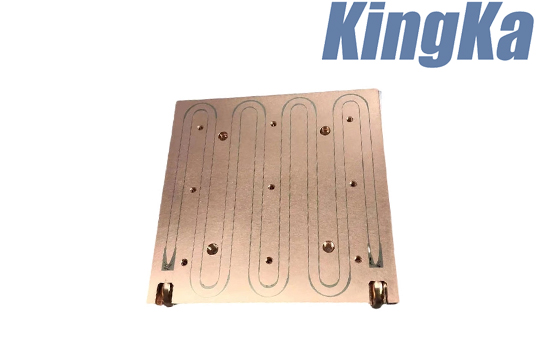
Custom Brazing Welding Cold Plate is an advanced liquid cooling solution designed for high-power thermal management applications. By using vacuum brazing technology or controlled atmosphere brazing processes, multiple metal components are permanently bonded together to create internal cooling channels for efficient heat transfer.
Compared with traditional air cooling methods, a brazed Cold Plate provides higher cooling efficiency, lower thermal resistance, and better temperature uniformity. It is widely used in EV battery thermal management, IGBT cooling, power electronics, semiconductor equipment, energy storage systems, and high-performance computing applications.
As a professional custom liquid cold plate manufacturer, we provide OEM and ODM custom brazing welding cold plate solutions with optimized channel designs, material selection, and thermal performance validation.
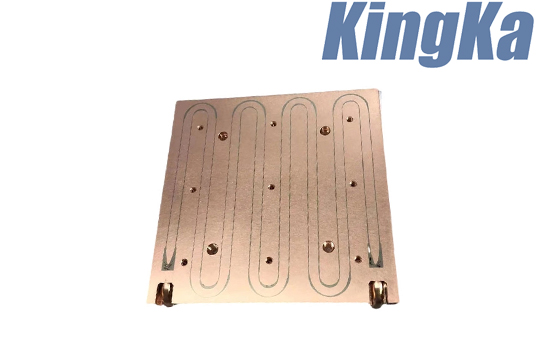
A Custom Brazing Welding Cold Plate is a type of liquid cold plate manufactured by joining metal layers through a brazing process to form internal coolant channels.
The cold plate usually consists of:
Top cover plate
Bottom base plate
Internal flow channels
Cooling fins or turbulators
Liquid inlet and outlet ports
During operation, coolant flows through the internal channels and absorbs heat transferred from electronic components. The heated coolant then circulates to a radiator or heat exchanger to release the thermal energy.
Common materials include:
Aluminum alloy (6061, 6063, 3003)
Copper
Stainless steel
Among them, aluminum brazed cold plates are widely used because of their lightweight structure, good thermal conductivity, and corrosion resistance.
A brazing welding cold plate works based on liquid cooling and forced convection heat transfer.
High-power electronic components generate heat during operation, such as:
IGBT modules
EV battery cells
Power converters
CPUs and GPUs
Laser equipment
The heat is transferred from the component surface to the cold plate through thermal interface materials (TIM), including:
Thermal grease
Thermal pads
Phase change materials
The cold plate absorbs heat through its metal structure.
Inside the plate, customized channels allow coolant to flow continuously.
Common channel structures include:
Serpentine channels
Parallel channels
Microchannels
Multi-pass flow channels
The coolant absorbs heat through direct contact with the internal channel walls.
The heated coolant leaves the cold plate and flows to the cooling system.
Typical cooling cycle:
Electronic Component
↓
Thermal Interface Material
↓
Cold Plate Base
↓
Internal Cooling Channel
↓
Liquid Coolant
↓
Radiator / Heat Exchanger
↓
Return to Cold Plate
This continuous circulation maintains stable component temperatures.
Brazing is a metal joining process where a filler metal is melted at a temperature lower than the base materials.
The molten filler material flows into the joint area through capillary action and creates a strong metallurgical bond after cooling.
Unlike traditional welding methods, brazing does not melt the main metal structure.
For high-performance applications, vacuum brazing cold plates are commonly manufactured in a vacuum furnace.
The process includes:
Metal plates and cooling structures are cleaned and assembled.
A brazing alloy is applied between metal surfaces.
The assembly is heated under controlled vacuum conditions.
The filler metal melts and bonds the components together.
After cooling, the cold plate undergoes:
Leak testing
Pressure testing
Dimensional inspection
Thermal performance testing
A brazed cold plate provides excellent heat transfer efficiency due to optimized internal structures.
Performance depends on:
Channel design
Coolant flow rate
Material conductivity
Heat load requirements
Typical cooling capability:
| Parameter | Range |
|---|---|
| Heat Load Capacity | 200W–5000W+ |
| Coolant Flow Rate | 0.5–10 L/min |
| Working Pressure | 2–10 bar |
| Thermal Resistance | 0.02–0.15 K/W |
(Custom designs can achieve higher performance.)
Brazing technology allows manufacturers to create complex cooling structures, including:
Offset fins
Microchannels
Turbulent flow paths
Multi-layer cooling structures
These designs improve:
Heat transfer coefficient
Coolant mixing
Temperature uniformity
The brazing process creates a continuous bonded structure.
Advantages:
Leak-resistant construction
High pressure capability
Long service life
This makes brazed liquid cold plates suitable for demanding industrial applications.
Aluminum brazed cold plates offer:
Low weight
High stiffness
Compact design
They are especially suitable for:
Electric vehicles
Aerospace systems
Portable electronic equipment
The design process includes:
Customer requirement analysis
Thermal simulation
Flow channel optimization
CAD modeling
Important design parameters:
Heat load (W)
Coolant type
Flow rate
Pressure drop
Operating temperature
Manufacturing processes include:
CNC machining
Extrusion
Fin forming
Cooling channels are precisely manufactured according to design requirements.
Components are assembled and placed into a brazing furnace.
Controlled parameters include:
Brazing temperature
Heating rate
Atmosphere condition
Cooling process
Each custom brazing cold plate is tested for:
Dimensional accuracy
Flatness
Internal cleanliness
Leakage performance
Thermal performance
Testing methods include:
Pressure decay testing
Helium leak testing
Flow resistance testing
| Parameter | Specification |
|---|---|
| Product Name | Custom Brazing Welding Cold Plate |
| Manufacturing Process | Vacuum Brazing / Brazing Welding |
| Material | Aluminum, Copper, Stainless Steel |
| Cooling Type | Liquid Cooling |
| Channel Design | Serpentine, Parallel, Microchannel |
| Coolant | Water, Glycol, Dielectric Fluid |
| Heat Capacity | 200W–5000W+ |
| Working Pressure | 2–10 Bar |
| Thermal Resistance | 0.02–0.15 K/W |
| Surface Treatment | Anodizing / Nickel Plating Optional |
| Customization | OEM / ODM Available |
Brazed cold plates are widely used in:
Battery packs
Battery modules
Electric vehicle thermal management systems
They help maintain consistent battery temperature and improve safety.
Applications include:
IGBT modules
Inverters
Motor controllers
Power converters
Efficient cooling helps prevent semiconductor overheating.
Used for:
CPU cooling
GPU cooling
AI servers
HPC systems
Liquid cold plates provide efficient cooling for high-density computing hardware.
Suitable for:
Laser systems
Medical devices
Automation equipment
Renewable energy systems
As an experienced liquid cold plate supplier, we specialize in developing customized brazing welding cold plates for global customers.
Our thermal management capabilities include:
Custom liquid cold plate design
Vacuum brazing manufacturing
CNC machining
Thermal simulation analysis
Leak testing
Performance validation
We provide complete solutions from prototype development to mass production.
Whether you need an aluminum brazed cold plate, copper brazed cold plate, or custom liquid cooling plate, we can optimize the design according to your application requirements.
A brazing welding cold plate is a liquid cooling plate manufactured by bonding metal components through brazing technology to create internal coolant channels.
Common materials include aluminum alloys, copper, and stainless steel depending on thermal and mechanical requirements.
Brazed cold plates can create more complex internal structures and are suitable for lightweight, high-performance cooling applications, while machined cold plates rely on CNC-processed channels.
The cooling capacity depends on size, coolant flow, channel design, and application requirements. Typical designs can handle hundreds to thousands of watts.
Yes. Dimensions, materials, cooling channels, ports, and thermal performance can all be customized according to customer requirements.

Kingka Tech Industrial Limited
We specialize in Heat Sink、Liquid Cold Plate、precision CNC machining and our products are widely used in telecommunication industry, aerospace, automotive, industrial control, power electronics, medical instruments, security electronics, LED lighting and multimedia consumption.


Address:
Da Long New Village, Xie Gang Town, Dongguan City, Guangdong Province, China 523598
Email:
WhatsAPP: