As thermal demands continue to rise in power electronics, new energy equipment, energy storage systems, industrial control, communication devices, LED lighting, and medical electronics, the Heat Sink has become a critical component for maintaining stable system operation. Whether it is an Extrusion Heat Sink, Skived Fin Heat Sink, Bonded Fin Heat Sink, Cold Forging Heat Sink, Die Casted Heat Sink, or Heat Pipe Heat Sink, each plays an essential role in modern thermal management systems.
However, a heat sink is not guaranteed to maintain high cooling performance over the long term simply because it has been installed. In real applications, different types of Heat Sink products may face a range of potential problems, such as insufficient heat dissipation, structural deformation, excessive contact thermal resistance, surface corrosion, poor assembly reliability, and local overheating under complex thermal loads. If these issues are not fully addressed during the design, material selection, and manufacturing stages, even a heat sink with good initial performance may eventually cause excessive temperature rise, shortened service life, or even system failure.
As a professional thermal management manufacturer, KINGKA has extensive experience in Aluminum Extrusion Heat Sink, Skiving Heat Sink, Bonded Fin Heat Sink, Cold Forging Heat Sink, Heat Pipe Thermal Module, and Heat Pipe Assemblies, and can provide more reliable and more efficient thermal solutions for different application needs.
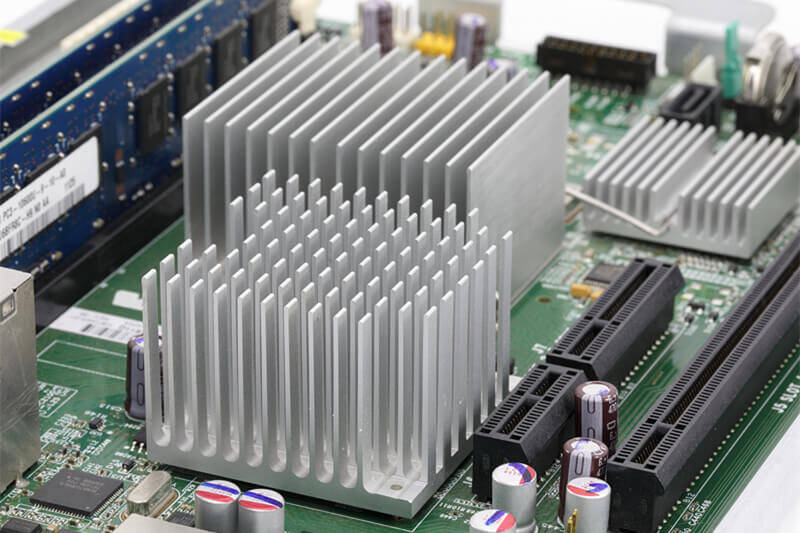
1. Why Do Heat Sinks Have Potential Problems?
The basic function of a heat sink is to transfer heat generated by the heat source, spread it across a larger surface area, and then dissipate it through natural convection or forced air cooling. Although this sounds straightforward, the actual cooling result is influenced by many factors, including:
material thermal conductivity
fin structure design
base flatness
machining accuracy
surface treatment quality
condition of the mounting interface
airflow matching
welding or assembly reliability
In other words, the performance of a Heat Sink depends not only on whether it is an Extrusion Heat Sink or a Skived Fin Heat Sink, but also on whether it is truly matched to the actual application.
2. Potential Problem One: Insufficient Heat Dissipation Efficiency
2.1 Why Does a Heat Sink Fail to Dissipate Enough Heat?
When selecting a heat sink, many buyers assume that “a larger surface area is always better” or “the denser the fins, the better.” In practice, this is not always true. If the structure is not properly designed, even a high-specification Aluminum Extruded Radiator or Extrusion Heat Sink Parts may fail to deliver the desired thermal performance.
Common reasons include:
improper fin height, thickness, or spacing
airflow cannot effectively pass through the fin area
uneven heat spreading in the base
concentrated heat sources with very high local heat flux
material conductivity does not match the working condition
For example, a standard Aluminum Extrusion Heat Sink performs well in medium- and low-power applications, but when local heat flux becomes very high, a simple extruded structure may not spread heat fast enough from the hotspot. In that case, higher-performance solutions such as Skived Fin Heat Sink, Bonded Fin Heat Sink, or Heat Pipe Heat Sink may be required.
2.2 What Happens When Heat Dissipation Is Insufficient?
If a heat sink cannot dissipate heat effectively, it may lead to:
excessive junction temperature of components
performance degradation
faster LED lumen depreciation
lower power module efficiency
shortened life of IGBT, MOSFET, CPU, and other devices
unstable system operation
These issues become especially obvious in high heat flux applications.
2.3 How Does KINGKA Improve Heat Dissipation Efficiency?
Selecting the Right Process Based on Heat Source Characteristics
KINGKA does not treat every project as the same type of heat sink application. Instead, based on thermal power, heat flux density, installation space, airflow conditions, and budget, KINGKA recommends the most suitable solution, such as:
Extrusion Heat Sink: suitable for standardized and medium heat load applications
Skived Fin Heat Sink: suitable for high fin density and high thermal conductivity needs
Bonded Fin Heat Sink: suitable for higher aspect ratio fins and more demanding cooling applications
Cold Forging Heat Sink: suitable for high precision and locally enhanced cooling
Heat Pipe Heat Sink: suitable for applications that require fast heat transfer over a distance
Optimizing Fin Structure and Airflow
For Extrusion Heat Sink Manufacturers, real competitiveness is not just the ability to extrude profiles, but the ability to optimize fin structure according to actual airflow conditions. KINGKA can optimize fin thickness, spacing, and height based on project requirements, helping customers achieve better cooling balance in limited spaces.
Combining Heat Pipe Technology for Hotspot Management
If a metal-only heat sink cannot remove localized heat fast enough, KINGKA can further provide Heat Pipe Thermal Module, Heat Pipe Assemblies, and Heat Pipe Heat Sink Parts solutions to improve heat spreading and reduce hotspot temperatures.
3. Potential Problem Two: Excessive Contact Thermal Resistance
3.1 Why Does a Heat Sink Have Surface Area But Still Perform Poorly?
In many cases, the problem is not in the fins, but in the interface between the heat sink base and the heat source. If the contact surface is not flat, installation pressure is uneven, or surface roughness is not properly controlled, heat cannot be transferred efficiently into the Heat Sink body.
This issue is especially critical for:
because these products are typically used in applications where thermal resistance is more sensitive.
3.2 What Are the Effects of Excessive Contact Thermal Resistance?
actual cooling performance is much lower than theoretical expectations
localized overheating at the heat source
poor utilization of thermal interface materials
the heat sink itself may not seem very hot, but the chip temperature remains high
This problem is often overlooked, but it can have a major impact on system reliability.
3.3 KINGKA’s Solution
Controlling Base Flatness and Machining Accuracy
In projects involving CNC finishing, Cold Forging Heat Sink, and high-performance Skiving Heat Sink, KINGKA places strong emphasis on base flatness, key dimensional tolerances, and the machining quality of mounting interfaces, helping customers reduce contact thermal resistance.
Choosing the Right Base Structure
For applications requiring higher thermal conductivity, copper bases, aluminum-copper composite bases, or Heat Pipe Heat Sink structures can be used to avoid the heat spreading limitations of a pure aluminum base under hotspot conditions.
Improving Overall Module Matching
For Heat Pipe Thermal Module Parts and Heat Pipe Assemblies, KINGKA can consider heat source location, mounting method, and mechanical stress during the structural design stage, ensuring that heat is transferred more efficiently into the overall cooling system.
4. Potential Problem Three: Insufficient Structural Strength or Deformation
4.1 Which Heat Sinks Are More Likely to Have Structural Problems?
In practice, the taller and thinner the fins are, the greater the cooling potential tends to be, but the higher the risk of mechanical weakness. This can be especially relevant for:
high-density Skived Fin Heat Sink
large-size Bonded Fin Heat Sink
complex Zipper Fin Heat Sink
large Heat Pipe Heat Sink assemblies
If materials, structural design, and manufacturing processes are not properly controlled, these products may experience:
4.2 How Do Structural Problems Affect Performance?
lower airflow efficiency through the fin array
higher noise and airflow resistance
reduced mounting stability
lower long-term reliability
gradual decline in thermal performance
4.3 How Does KINGKA Improve Structural Reliability?
Selecting the Right Manufacturing Process
Different manufacturing processes are suitable for different structural requirements. KINGKA can recommend the most appropriate option, such as:
Extrusion Heat Sink Parts: good overall structural integrity, suitable for medium fin aspect ratios
Bonded Fin Heat Sink: suitable for designs requiring taller fins
Zipper Fin Heat Sink: suitable for lightweight structures with large surface area requirements
Cold Forging Heat Sink: suitable for dense structures and complex mechanical loads
Die Casted Heat Sink: suitable for complex shapes and volume production
Strengthening Structural Design and Validation
For large-size or high-demand heat sinks, KINGKA balances fin rigidity, base thickness, and assembly strength during the design stage, rather than blindly pursuing extreme fin parameters at the expense of product reliability.
5. Potential Problem Four: Surface Corrosion and Poor Environmental Adaptability
5.1 Why Can Heat Sinks Also Corrode?
Many Heat Sink products are made from aluminum alloy or copper. In humid environments, salt spray conditions, industrial pollution, or applications with frequent temperature cycling, the surface may suffer from oxidation, corrosion, or contamination buildup. For Copper Skived Fin Heat Sink Parts, insufficient protection may not only affect appearance, but also reduce long-term stability.
5.2 What Problems Can Corrosion Cause?
changes in surface thermal and radiation properties
reduced appearance quality
increased dirt accumulation in fin areas
shortened structural service life
reduced stability of bonded or assembled sections
5.3 KINGKA’s Solution
Comprehensive Surface Treatment Capability
KINGKA can provide suitable surface treatment processes according to different Heat Sink types and operating environments, including anodizing, sandblasting, passivation, and plating, to improve corrosion resistance and appearance consistency.
Selecting Materials According to the Environment
KINGKA helps customers balance thermal conductivity and environmental adaptability. For example:
aluminum is suitable for lightweight and cost-sensitive applications
copper is ideal for hotspot-focused thermal conduction
composite structures are suitable for balancing performance and cost
6. Potential Problem Five: Improper Process Selection Leading to High Cost or Wasted Performance
6.1 Why Is Choosing the Wrong Process a Problem?
When selecting a heat sink solution, some customers simply choose the “most advanced” option, while others look only at the initial unit price. In reality, the wrong process choice can lead to two problems:
the cost is high, but the performance is not fully utilized
the cost seems low, but the cooling capability cannot meet thermal requirements
For example, not every project requires Copper Skived Fin Heat Sink Parts or a Heat Pipe Thermal Module. Likewise, not every application can be handled by a standard Aluminum Extrusion Heat Sink.
6.2 How Does KINGKA Help Customers Choose the Right Process?
KINGKA can provide more reasonable recommendations based on each project’s characteristics:
Aluminum Extrusion Heat Sink: suitable for mass production and general-purpose applications
Skived Fin Heat Sink Parts: suitable for high-density fin and high-performance requirements
Bonded Fin Heat Sink: suitable for large-size and high fin ratio projects
Cold Forging Heat Sink: suitable for compact structures and refined shapes
Die Casted Heat Sink: suitable for complex shapes and large-scale production
Heat Pipe Heat Sink: suitable for systems with concentrated heat sources and rapid heat spreading needs
Heat Pipe Thermal Module Parts: suitable for advanced electronics and complex thermal modules
By matching the process more accurately, customers can achieve better thermal performance while controlling overall cost.
7.KINGKA’s Core Advantages
7.1 Integrated Multi-Process Capability
KINGKA is not limited to a single Extrusion Heat Sink process or a single Skiving Heat Sink process. Instead, the company integrates extrusion, skiving, cold forging, die casting, welding, heat pipe assembly, and surface treatment, providing customers with more complete thermal solutions.
7.2 Custom Development Capability
From Extrusion Heat Sink Parts to Heat Pipe Assemblies, KINGKA can provide custom services based on customer drawings, heat source layouts, installation space, and operating environment.
7.3 Balance of Performance and Reliability
A good Heat Sink is not only about high initial cooling performance. It must also remain reliable during long-term use. KINGKA emphasizes a balance among cooling efficiency, structural strength, surface protection, and assembly reliability.
7.4 Suitable for Different Budget Levels
Whether the customer needs a cost-effective Aluminum Extrusion Heat Sink or a high-performance Heat Pipe Thermal Module or Bonded Fin Heat Sink, KINGKA can provide targeted solution recommendations.
From insufficient heat dissipation and excessive contact thermal resistance to structural deformation, surface corrosion, and improper process selection, Heat Sink products do face a variety of potential problems in real applications. For high-power and high-reliability equipment, if these issues are not identified and resolved early, they may lead to excessive temperature rise, performance loss, or even system failure during later operation.
That is why choosing an experienced and technically capable supplier is so important. With rich experience in Extrusion Heat Sink, Skived Fin Heat Sink, Bonded Fin Heat Sink, Cold Forging Heat Sink, Heat Pipe Heat Sink, Heat Pipe Assemblies, and Die Casted Heat Sink, KINGKA can provide customers with heat sink solutions that are more efficient, more reliable, and better suited to real working conditions.
If you are looking for a professional Heat Sink supplier, KINGKA is a partner you can trust.