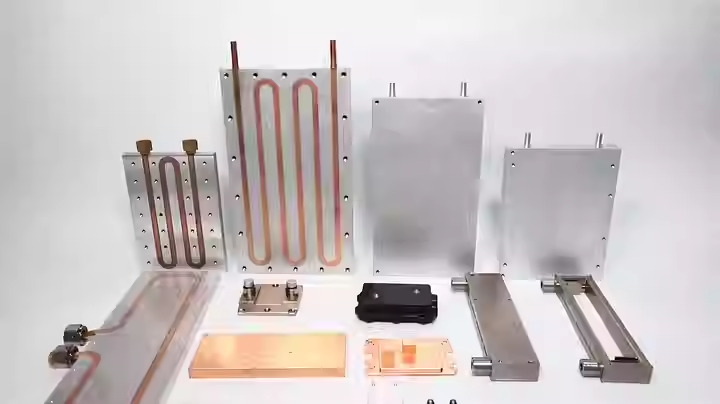
As the demand for thermal performance continues to grow in high-power electronics, new energy systems, energy storage equipment, medical devices, and industrial automation, the Liquid Cold Plate has become a key component in efficient thermal management systems. Whether it is a Gun Drilled Cold Plate, Tube Cold Plate, Brazed liquid cold plate, or FSW Liquid Cold Plate Parts, these solutions all play an important role in rapidly removing heat and maintaining stable equipment operation.
However, liquid cooling systems are not without risks. During long-term operation, water cooling systems may face several potential problems, including corrosion, clogging, and leakage. If these issues are not properly addressed, they can reduce cooling efficiency and even threaten the safety and service life of the entire system.
As a professional thermal management component manufacturer, KINGKA has extensive experience in CNC Machined Liquid Cold Plate, Custom FSW Liquid Cold Plate, Embedded Tube Cold Plate, and Vacuum Brazing Liquid Cold Plate solutions, and can provide more reliable designs and manufacturing strategies to address these risks.
1. Why Do Liquid Cold Plates Have Potential Problems?
A liquid cooling system works by allowing coolant to flow through internal channels in the cold plate, carrying heat away from the heat source quickly and efficiently. Because the cold plate is exposed to liquid for long periods, experiences repeated temperature changes, and often contains complex internal channels, it may gradually develop hidden risks during long-term use.
These problems are mainly concentrated in three areas:
For any High Efficiency Liquid Cold Plate, if these three issues are not effectively controlled, even excellent initial heat transfer performance may be difficult to maintain over time.
2. Potential Problem One: Corrosion
2.1 Corrosion Is One of the Most Common Risks in Liquid Cooling Systems
Many microchannel liquid cold plates are made of copper and assembled using brazing alloys. For some Copper Liquid Cold Plate Parts and Brazed Liquid Cold Plate products, material differences between the base metal and the brazing filler can create a potential difference.
During long-term operation, when water-based coolant comes into contact with different metals, galvanic corrosion may occur. In addition, the system may also suffer from:
oxygen corrosion
acid corrosion
microbial corrosion
These corrosion issues can gradually attack the inner walls of the channels, brazed joints, and critical connection areas, increasing surface roughness inside the cold plate and, in severe cases, causing local perforation or leakage.
2.2 How Does Corrosion Affect a Liquid Cold Plate?
Corrosion can directly cause the following problems:
reduced integrity of internal flow channels
increased flow resistance
lower heat transfer efficiency
shorter service life
higher risk of leakage
For applications that require long-term reliability, such as Vacuum Brazed Cold Plate, Tube Liquid Cold Plate Parts, and Gun Drilled Cold Plate, corrosion resistance is a critical factor.
2.3 How Does KINGKA Solve Corrosion Problems?
To reduce corrosion risks, KINGKA improves performance from the perspectives of material selection, process control, structural design, and surface protection.
Careful Material Selection to Reduce Potential Difference
When designing Copper Liquid Cold Plate Parts or Brazed Liquid Cold Plate, KINGKA evaluates the compatibility between the base material, brazing filler, and coolant system to minimize potential difference between dissimilar metals and reduce the chance of galvanic corrosion.
Mature Manufacturing Processes
For Vacuum Brazing Liquid Cold Plate and Vacuum Brazed Cold Plate, KINGKA uses stable vacuum brazing processes to control joint quality and reduce the risk of weak brazing, inclusions, and local defects, helping lower corrosion risks at the source.
Optimized Surface Protection
For certain CNC Machined Liquid Cold Plate and Embedded Tube Cold Plate products, KINGKA can provide suitable surface treatment and protection solutions according to application requirements to improve overall corrosion resistance.
Better Cooling Channel Design
By optimizing flow channel design and avoiding dead zones or stagnant liquid areas, KINGKA helps reduce microbial growth and corrosion deposits, improving the long-term reliability of every High Efficiency Liquid Cold Plate.
3. Potential Problem Two: Clogging
3.1 Why Do Liquid Cold Plates Become Clogged?
Clogging is especially common in microchannel or narrow-channel designs. To achieve higher heat transfer efficiency, many Liquid Cold Plate products use narrow flow paths or even microchannels. However, the smaller the channel, the more sensitive it becomes to impurities.
During system operation, the following substances may enter or form in the cooling loop:
These materials gradually occupy space in the channel and interfere with the normal flow of coolant. For high-precision Gun Drilled Cold Plate designs or complex-channel Epoxy Resin Filling Liquid Cold Plate products, clogging can reduce flow rate, increase thermal resistance, and significantly weaken cooling performance.
3.2 What Are the Consequences of Clogging?
Clogging can result in:
insufficient local heat dissipation
reduced coolant flow
increased system pressure drop
uneven temperature distribution
sharp decline in cooling performance
In severe cases, localized overheating may cause critical components to fail and affect overall system stability.
3.3 How Does KINGKA Reduce the Risk of Clogging?
Selecting the Right Cold Plate Structure for the Application
Not every project requires extremely narrow microchannels. Based on heat flux, pressure drop, and coolant conditions, KINGKA helps customers choose the most suitable cold plate type, such as:
In many real-world applications, a properly designed channel size and layout is more beneficial to long-term stable operation than simply pursuing smaller flow passages.
Improving Channel Precision and Cleanliness
KINGKA has strong experience in CNC Machined Liquid Cold Plate production and can precisely control channel dimensions while minimizing burrs, residues, and machining defects, thereby reducing the risk of clogging.
Stable Welding and Filling Processes
For Epoxy Resin Filling Liquid Cold Plate Manufacturing, KINGKA carefully controls the resin filling process to avoid excess residue that could affect coolant flow. For Tube Liquid Cold Plate Parts and Vacuum Brazing Liquid Cold Plate products, mature assembly and joining processes help ensure smooth internal channels.
Balancing Efficiency and Reliability
A truly excellent High Efficiency Liquid Cold Plate should not only deliver strong initial cooling performance, but also maintain long-term serviceability and anti-clogging capability. KINGKA emphasizes both efficient heat dissipation and stable fluid flow to provide customers with a more balanced cooling solution.
4. Potential Problem Three: Leakage
4.1 Why Is Leakage Dangerous?
Leakage is one of the most serious risks in liquid cooling systems. Over time, seals, rubber components, hoses, and connectors may gradually age and lose elasticity, causing coolant to leak.
Since water-based coolants are usually electrically conductive to some extent, leakage may lead to serious consequences, such as:
For many high-power systems, even a high-performance Brazed Liquid Cold Plate or Custom FSW Liquid Cold Plate cannot guarantee system safety if sealing reliability is insufficient.
4.2 What Factors Increase the Risk of Leakage?
Common causes include:
insufficient joint strength
unreasonable port or connection design
unstable sealing structure
material fatigue caused by long-term thermal cycling
aging of pipes and sealing components
In particular, structures such as Tube Cold Plate, Embedded Tube Cold Plate, and Epoxy Resin Filling Liquid Cold Plate require highly reliable connection and sealing methods.
4.3 How Does KINGKA Address Leakage Problems?
Stable Joining and Connection Processes
KINGKA applies suitable manufacturing processes according to product type. For example:
Vacuum Brazing Liquid Cold Plate: achieves strong bonding and high sealing reliability through vacuum brazing
FSW Liquid Cold Plate Parts: uses friction stir welding to achieve strong and stable joints
Tube Liquid Cold Plate Parts: optimizes tube embedding and fixing methods to improve overall reliability
Reliability-Focused Structural Design
In Custom FSW Liquid Cold Plate and CNC Machined Liquid Cold Plate projects, KINGKA fully considers port position, channel layout, wall thickness distribution, and mounting stress to reduce fatigue and leakage risks during long-term use.
Strict Testing and Quality Control
To ensure that every Liquid Cold Plate meets application requirements, KINGKA strengthens sealing verification and structural integrity inspection during production, helping reduce the probability of leakage in customers’ systems.
5. Key Risk Control Points for Different Types of Liquid Cold Plates
Different liquid cold plate structures have different priorities in risk control. KINGKA applies different manufacturing strategies based on product type.
5.1 Gun Drilled Cold Plate
The Gun Drilled Cold Plate has a solid structure and relatively regular channels, making it suitable for many industrial and power electronics applications. KINGKA focuses on drilling precision, channel sealing, and end-port closure quality to balance cooling performance and long-term sealing reliability.
5.2 FSW Liquid Cold Plate Parts
For FSW Liquid Cold Plate Parts and Custom FSW Liquid Cold Plate, KINGKA emphasizes welding consistency and structural strength to provide customers with more reliable joint performance.
5.3 Tube Cold Plate
Tube Cold Plate and Tube Liquid Cold Plate Parts usually offer good cost advantages and strong adaptability. KINGKA can optimize tube routing and embedded structures to improve heat dissipation uniformity and leakage resistance.
5.4 Embedded Tube Cold Plate
The Embedded Tube Cold Plate combines structural strength with good thermal performance. KINGKA improves pipe fitting quality during machining and assembly to reduce heat transfer loss and structural loosening.
5.5 Epoxy Resin Filling Liquid Cold Plate
For Epoxy Resin Filling Liquid Cold Plate and Epoxy Resin Filling Liquid Cold Plate Manufacturing, KINGKA pays close attention to filling uniformity, structural stability, and long-term reliability, preventing resin-related issues from negatively affecting flow paths or sealing performance.
5.6 Brazed Liquid Cold Plate
Brazed Liquid Cold Plate, Vacuum Brazing Liquid Cold Plate, and Vacuum Brazed Cold Plate are suitable for complex channel designs and high-performance thermal management applications. KINGKA improves welding reliability, structural integrity, and long-term sealing performance through mature brazing processes and strict quality control.
6. Advantages of KINGKA’s Liquid Cold Plate Solutions
When addressing corrosion, clogging, and leakage in real-world liquid cooling systems, KINGKA offers not only product manufacturing, but also more comprehensive liquid cold plate solutions.
6.1 Multiple Liquid Cold Plate Manufacturing Capabilities
KINGKA can provide various technology routes, including:
Gun Drilled Cold Plate
Copper Liquid Cold Plate Parts
CNC Machined Liquid Cold Plate
FSW Liquid Cold Plate Parts
Custom FSW Liquid Cold Plate
Embedded Tube Cold Plate
Tube Cold Plate
Tube Liquid Cold Plate Parts
Brazed Liquid Cold Plate
Vacuum Brazing Liquid Cold Plate
Vacuum Brazed Cold Plate
Epoxy Resin Filling Liquid Cold Plate
6.2 Focus on Both Efficiency and Reliability
A truly excellent High Efficiency Liquid Cold Plate must offer not only strong heat transfer performance, but also long-term reliability. During design and manufacturing, KINGKA considers cooling performance, flow resistance, corrosion resistance, and sealing reliability together for a more complete optimization.
6.3 Custom Support
Different customers have different application environments, heat source layouts, installation spaces, and coolant conditions. KINGKA can provide customized development services to help customers match the most suitable Liquid Cold Plate solution for their projects.
From corrosion to clogging and leakage, liquid cold plates do face a series of potential problems during long-term operation. Especially in applications with high power and high reliability requirements, the manufacturing quality, material compatibility, process level, and structural design of the cold plate will directly affect the stability of the entire system.
That is why choosing an experienced and technically capable supplier is so important. With rich manufacturing experience in Gun Drilled Cold Plate, CNC Machined Liquid Cold Plate, Tube Cold Plate, FSW Liquid Cold Plate Parts, Vacuum Brazing Liquid Cold Plate, and Brazed Liquid Cold Plate, KINGKA can provide liquid cold plate solutions that balance thermal performance with long-term reliability.
If you are looking for a more stable, more efficient, and more application-oriented Liquid Cold Plate solution, KINGKA is a reliable partner you can trust.