As high-power applications such as EV batteries, energy storage systems, and AI data centers continue to evolve, the performance of the liquid cooling plate has become a critical factor in thermal management. Among all design elements, the internal flow channel structure and manufacturing process play a decisive role in heat transfer efficiency, pressure drop, and system reliability.
This article explores the design principles of aluminum liquid cooling plate flow channels, compares machining and extrusion approaches, and introduces an optimized liquid cooling system structure based on friction stir welding (FSW) technology.
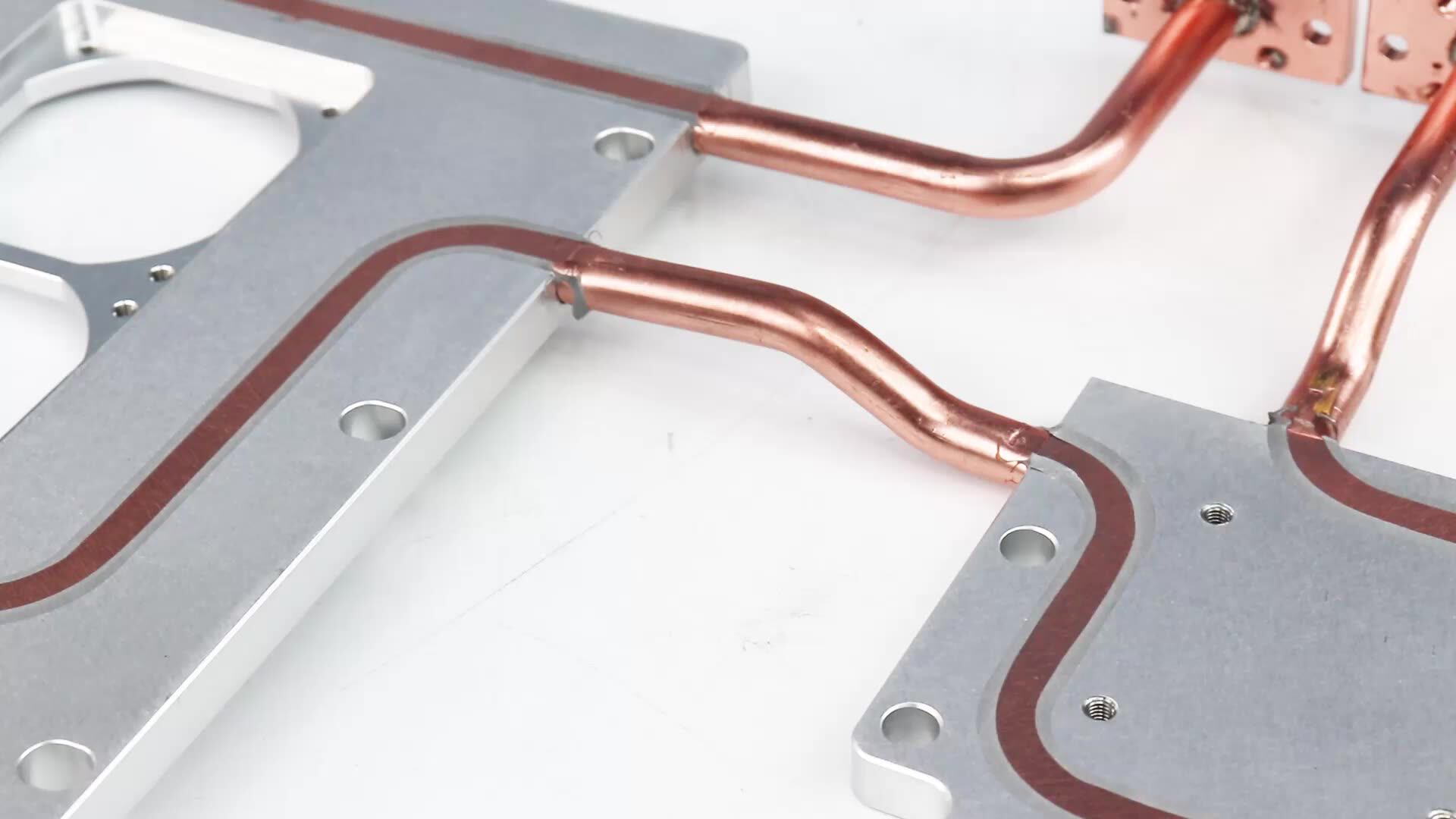
Flow Channel Design: Machining vs. Extrusion
The internal channels of a liquid cooling plate can be manufactured in two main ways:
1. CNC Machined Channels
Channels can be directly machined into an aluminum plate, allowing maximum flexibility in flow path design. Advanced methods such as topology optimization can be used to create highly efficient channel layouts tailored to heat distribution.
However, although machined cold plates offer superior design freedom and thermal performance, their high manufacturing cost makes them less suitable for large-scale production.
2. Extruded Aluminum Channels
Alternatively, flow channels can be formed using the internal cavities of aluminum extrusion profiles. While the channel layout is more regular, key parameters such as plate thickness, channel width, and the number of parallel channels can be optimized through numerical simulation.
Extruded liquid cooling plates offer several advantages:
Because of these benefits, extrusion-based aluminum liquid cooling plate solutions are widely used in practical applications.
FSW-Based Liquid Cooling Plate Structure
To further enhance performance and reliability, multiple extruded aluminum sections can be joined using friction stir welding (FSW). This results in a FSW Liquid Cold Plate with a simple structure, strong sealing performance, and high mechanical strength.
Unit Liquid Cooling Plate Design
A typical unit liquid cold plate consists of:
All components are made of aluminum alloy and assembled through machining, FSW, and arc welding. The end caps are joined to the main plate using FSW, ensuring excellent sealing and minimizing leakage risk.
The internal structure includes a coolant channel, while the external surface must support battery modules or electronic components. Therefore, the cross-sectional design is critical.
Thick Rib Structure Advantage
Compared with thin-wall designs, a thick rib structure provides:
In this design, the coolant flows through internal cavities, while the reinforced rib sections remain solid, preventing leakage even when mounting structures penetrate the plate.
Serpentine Flow Channel Optimization
The internal channel of the unit liquid cooling plate adopts a single-inlet, single-outlet serpentine design. This structure is simple and effective for heat transfer.
However, increasing the number of channel loops also increases flow resistance. Excessive pressure drop can:
Based on simulation and experimental data, a four-loop serpentine channel design provides a good balance between cooling performance and pressure drop. In most systems, the pressure drop is typically controlled within 20–30 kPa.
Modular Assembly with FSW
For large battery packs or large-area cooling requirements, a single unit cold plate may not be sufficient. In such cases, multiple unit plates are joined together using FSW to form a larger liquid cooling plate assembly.
This modular design offers:
Flexible scalability
High structural integrity
Ability to serve as both cooling and load-bearing structure
Simplified installation of battery modules or equipment
The use of FSW Liquid Cold Plate technology ensures strong joints and reliable sealing across the entire structure.
Cooling System Layout and Flow Distribution
In practical applications, multiple liquid cooling plates are often connected in parallel to form a complete cooling system. Compared with series connections, parallel systems offer:
Lower overall flow resistance
Better temperature uniformity
Improved cooling efficiency
However, achieving uniform flow distribution across all branches is a key challenge.
Piping Design
The cooling system typically includes:
Inlet and outlet pipelines
Flexible hoses (such as nylon corrugated pipes)
Connectors (tees, elbows)
Sealing components
Flexible hoses are preferred due to their corrosion resistance and ease of installation. Flow distribution is controlled through pipeline layout.
Flow Distribution Optimization
Simulation studies using a 50/50 ethylene glycol-water mixture at 15 L/min show that:
Simple layouts have lower pressure drop but poor flow uniformity
Multi-stage inlet designs improve flow consistency
A three-stage inlet configuration provides the best balance between pressure drop and flow uniformity
Although this design slightly increases system pressure drop, it ensures consistent cooling across all liquid cooling plate branches, which is critical for performance and safety.
Product Solutions from KINGKA
As a professional manufacturer, KINGKA offers a full range of liquid cooling plate solutions tailored for different applications:
Liquid Cold Plate for general thermal management
FSW Liquid Cold Plate for high-strength, leak-resistant structures
Tube Liquid Cold Plate for cost-effective cooling solutions
Brazed Liquid Cold Plate for complex channel designs and high efficiency
CPU Water Block for direct chip cooling in data centers and AI systems
These products are widely used in EV batteries, energy storage systems, power electronics, and data center cooling.
Why Choose KINGKA
KINGKA has over 15 years of experience in thermal management and precision machining. With more than 50 advanced machines, including CNC and friction stir welding systems, we provide high-quality aluminum liquid cooling plate solutions from prototype to mass production.
Our strengths include:
Advanced cold plate manufacturing capabilities
Expertise in FSW, brazing, and extrusion processes
Strict quality control and leak testing
Custom design for different industries
Reliable global delivery
By combining engineering innovation with manufacturing excellence, KINGKA delivers high-performance liquid cooling plate solutions that meet the demands of modern thermal systems.
The performance of a liquid cooling plate depends heavily on its internal channel design and manufacturing process. While CNC Machining offers flexibility, extrusion combined with FSW liquid cold plate technology provides a more scalable and cost-effective solution.
Optimized serpentine channels, modular assembly, and well-designed parallel flow systems ensure efficient heat transfer and uniform cooling. As demand for high-performance thermal management continues to grow, advanced aluminum liquid cooling plate solutions will play an increasingly important role across industries.