The rapid growth of artificial intelligence (AI) and machine learning (ML) is transforming the global data center industry. As next-generation chips deliver unprecedented computing power, they also generate significantly higher heat loads. This creates new challenges for thermal management, pushing traditional cooling systems to their limits.
To support increasing performance demands, data center operators must design infrastructure capable of handling high thermal loads while maintaining scalability and 24/7 uptime. At the same time, improving energy efficiency and reducing power consumption have become critical goals, especially as sustainability and Power Usage Effectiveness (PUE) gain more attention across the industry.
In this context, liquid cooling systems are becoming the preferred solution, and the liquid cooling plate plays a central role in enabling efficient heat dissipation.
Why Liquid Cooling is Essential for High-Density Computing
Compared with air cooling, liquid cooling offers significantly higher heat transfer efficiency. Coolant can be delivered directly to the heat source, allowing heat to be captured and removed at the point of generation. This makes cold plate cooling especially effective for high-performance CPUs, GPUs, and AI accelerators.
By integrating liquid cooling plates into server racks and chip-level cooling systems, data centers can:
Improve cooling efficiency and reduce thermal resistance
Support higher rack power density within the same footprint
Lower energy consumption and improve PUE
Reduce total cost of ownership (TCO)
Enhance system reliability and stability
Among various solutions, CPU water block and Liquid Cold Plate technologies are widely used for direct-to-chip cooling, ensuring precise temperature control in high-performance computing environments.
CDU: The Core of Liquid Cooling Systems
At the heart of any data center liquid cooling architecture is the Cooling Distribution Unit (CDU). The CDU is responsible for circulating coolant through a closed-loop system, delivering liquid to racks, liquid cooling plates, and CPU water blocks, and then returning it for heat exchange.
The CDU controls both temperature and flow rate to maximize system efficiency. Coolant flows through hoses and manifolds to IT equipment, absorbs heat via cold plates, and then returns to the CDU, where the heat is transferred to facility water before recirculation.
Because this is a closed-loop system, the risk of leakage and electrical contact is minimized. However, reliability is critical. Any leakage in a liquid cooling system can result in significant operational risks and costs.
Key Considerations for CDU and System Design
1. Performance Based on Real Testing
While simulation tools such as CFD, digital twins, and heat exchanger modeling are useful during design, real-world testing is essential. At high flow rates, hydraulic losses and thermal inefficiencies may occur in pipes and heat exchangers.
Testing CDU systems under extreme conditions helps identify performance differences and ensures that liquid cooling plate systems operate reliably across all scenarios. Data centers should work with suppliers capable of full testing and customization.
2. Component Selection and Reliability
Key CDU components, especially pumps, must meet strict standards. In closed-loop cooling systems, debris during initial operation can damage mechanical seals and increase maintenance needs.
Magnetic drive pumps are often preferred due to their improved reliability and reduced leakage risk. Material compatibility is also essential, especially when working with different coolants in liquid cooling plate systems.
3. Leak Integrity and System Safety
Leakage is one of the most critical risks in liquid cooling. Every connection point must be carefully designed and tested.
High-quality liquid cold plate products typically undergo strict leak testing, including helium leak detection and pressure decay testing, ensuring long-term sealing performance. Reliable sealing is especially important for brazed liquid cold plate and FSW Liquid Cold Plate structures used in data center and energy applications.
4. Design for Manufacturability
As AI demand increases, data centers require scalable solutions that can be produced in large volumes. A well-designed liquid cooling plate must not only perform well but also be manufacturable at scale.
Manufacturing-friendly designs ensure consistency, reduce costs, and enable rapid deployment across multiple data center projects.
5. Maintainability and Total Cost of Ownership
CDUs and cooling systems are electromechanical equipment that require maintenance. Easy access to components, replaceable parts, and durable design all contribute to lower maintenance costs.
Selecting the right cold plate and system components helps reduce downtime and ensures long-term operational efficiency.
Advanced Liquid Cooling Plate Solutions from KINGKA
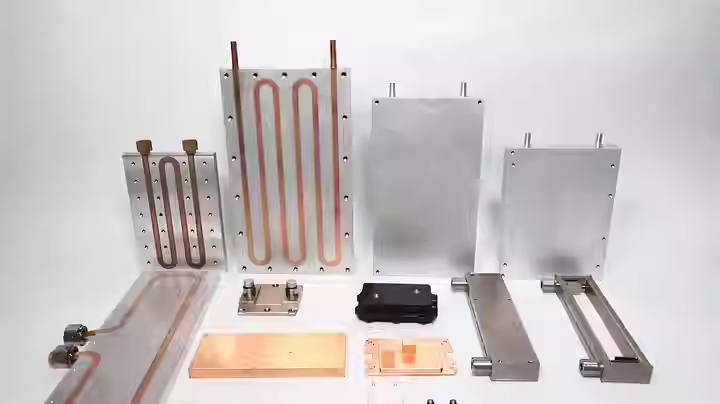
As a professional manufacturer, KINGKA provides a wide range of liquid cooling plate solutions designed for high-performance thermal management applications.
Our product portfolio includes:
Liquid Cold Plate for general cooling applications
FSW Liquid Cold Plate with excellent sealing and structural strength
Tube Liquid Cold Plate for cost-effective and reliable cooling
Brazed Liquid Cold Plate for complex flow channels and high performance
CPU Water Block for direct chip cooling in servers and AI systems
These products are widely used in data centers, power electronics, renewable energy systems, and industrial equipment.
Why Choose KINGKA
KINGKA is a trusted manufacturer with over 15 years of experience in thermal management and precision machining. We specialize in high-performance liquid cooling plates, heat sinks, and custom-engineered solutions.
With more than 50 advanced machines, including CNC systems, skiving equipment, and friction stir welding (FSW) technology, we ensure high-quality production from prototyping to mass manufacturing.
Our advantages include:
Strong expertise in cold plate design and manufacturing
Advanced production capabilities for aluminum liquid cooling plate solutions
Strict quality control and leak testing standards
Customization for different industries and applications
Reliable and cost-effective global supply
At KINGKA, we combine advanced technology with skilled craftsmanship to deliver efficient, durable, and scalable liquid cooling plate solutions for modern thermal management challenges.
As AI and high-performance computing continue to push the limits of data center infrastructure, liquid cooling is no longer optional—it is essential. The combination of efficient liquid cooling plates, reliable CDU systems, and advanced manufacturing technologies enables data centers to achieve higher performance, better energy efficiency, and long-term sustainability.
With innovative solutions such as brazed liquid cold plate, FSW liquid cold plate, and CPU water block, companies like KINGKA are helping shape the future of thermal management in the AI era.