With the rapid expansion of electric vehicles (EVs), energy storage systems, and high-power electronics, efficient thermal management has become increasingly important. The liquid cooling plate market is expected to grow significantly, driven by the need for higher energy density, faster charging, and improved safety. In battery systems, the battery liquid cooling plate plays a critical role in maintaining stable operating temperatures and extending service life.
Traditionally, most cold plate designs were placed at the bottom of battery cells. While this bottom cooling method is simple and widely used, it has several limitations. The battery cell itself has relatively high thermal resistance, which slows down heat transfer. In addition, the contact area between the cell and the cooling plate is limited, resulting in slower cooling and heating response.
To overcome these issues, more manufacturers are now adopting the side liquid cooling plate design. In this approach, the cooling plate is positioned between adjacent battery cells, allowing direct contact with the larger surface area of the cells. This significantly improves heat transfer efficiency. Compared with bottom cooling, side cooling can shorten temperature control time, reduce temperature differences between cells, and improve overall system safety. In extreme conditions, such as thermal runaway, the side liquid cooling plate can help quickly remove heat and reduce the spread of abnormal temperatures between cells.
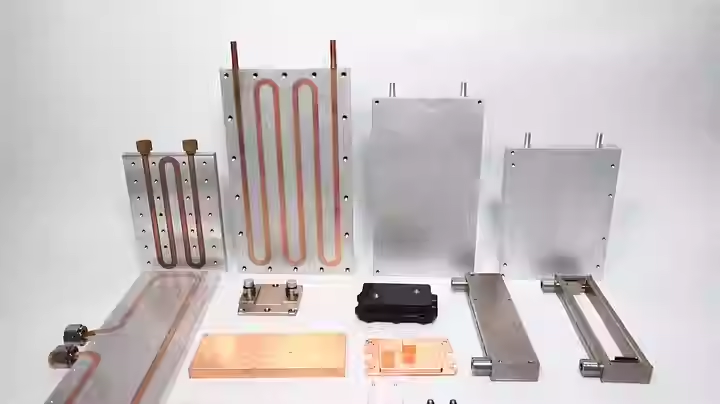
Main Liquid Cooling Plate Manufacturing Technologies
There are several common liquid cooling plate manufacturing methods used in the industry today. Each process offers different advantages depending on application requirements, cost, and structural design.
1. Embedded Tube Process
The embedded tube liquid cooling plate is one of the most mature and widely used solutions. In this process, grooves are first machined into an aluminum plate using CNC equipment. Pre-bent copper tubes are then pressed into the grooves using Stamping equipment, followed by brazing to ensure strong bonding and sealing.
This method is reliable and cost-effective, making it suitable for many standard water cooling plate applications. Common variations include shallow embedded tubes, deep embedded tubes, and double-sided clamped tube structures.
2. Extruded Profile + Welding
The extruded aluminum liquid cooling plate is produced by forming internal flow channels directly through extrusion. After extrusion, machining is used to complete the flow path, and welding is applied to seal the structure.
This method offers high production efficiency and relatively low cost, making it suitable for large-scale production. It is widely used in battery cooling systems, coolant distribution units, and integrated thermal management products. However, its design flexibility is limited compared with fully machined solutions.
A machined cold plate allows for highly flexible internal channel design. Engineers can customize the channel size, shape, and layout to meet specific thermal requirements. This makes it ideal for applications with high heat density, complex structures, or limited space.
Typical applications include inverters, IGBT modules, motor controllers, lasers, servers, and energy storage power systems. A special type of machined plate is the microchannel liquid cooling plate, which provides excellent cooling performance by using finely distributed channels to remove concentrated heat quickly. However, this process is more complex and costly.
4. Die Casting + Welding
The die cast liquid cooling plate is widely used in mass production due to its high efficiency and consistency. It is commonly applied in motor controllers, battery trays, and structural cooling components.
However, this process requires strict control of defects such as porosity and impurities. Reliable sealing methods, such as friction stir welding, brazing, or sealing rings, are necessary to prevent leakage and ensure long-term performance.
Materials for Liquid Cooling Plates
The two main materials used in liquid cooling plates are copper and aluminum. Copper provides excellent thermal conductivity but is heavier and more expensive. Therefore, most applications prefer the aluminum liquid cooling plate, which offers a good balance of weight, cost, corrosion resistance, and thermal performance.
Aluminum alloys are widely used in automotive, aerospace, and electronic industries. They are compatible with multiple manufacturing processes, including brazing, laser welding, TIG welding, and friction stir welding.
Vacuum Brazing Technology
Among various joining methods, vacuum brazing liquid cooling plate technology is particularly important for high-quality aluminum products. In vacuum brazing, components are heated in a vacuum environment, allowing filler metal to melt and bond without oxidation.
This process offers several advantages:
Uniform heating and minimal deformation
No flux residue, resulting in better corrosion resistance
Ability to join complex and narrow channels
High production efficiency for batch processing
Because of these benefits, vacuum brazing is widely used in advanced cold plate manufacturing, especially for battery and energy storage applications.
However, it also has some challenges, including high equipment cost, strict process control requirements, and potential material softening after high-temperature processing.
Typical Liquid Cooling Plate Manufacturing Flow
A complete liquid cooling plate production process generally includes the following steps:
Surface cleanliness is critical before brazing, as contamination can affect bonding quality. Many manufacturers use high-temperature degreasing to ensure cleanliness while reducing environmental impact.
Leak testing is also a key step. High-precision helium leak detection is commonly used to ensure that the cold plate meets strict sealing requirements. Dimensional inspection, often performed using CMM, ensures the product meets assembly and performance standards.
As battery technology continues to evolve, the role of the liquid cooling plate becomes more critical. The transition from bottom cooling to side liquid cooling plate design reflects the industry's pursuit of higher efficiency and better safety.
Whether using embedded tube, extrusion, machining, or die casting, each liquid cooling plate manufacturing process must ensure excellent heat transfer, structural strength, and sealing reliability. Advanced technologies such as vacuum brazing further enhance product performance and enable more complex designs.
In the future, with increasing demand for high-performance battery systems and energy storage solutions, the development of more efficient and reliable battery liquid cooling plate technologies will remain a key focus for manufacturers worldwide.