As artificial intelligence (AI), cloud computing, and big data continue to evolve, data centers are under increasing pressure to deliver higher computing performance within limited physical space. One of the most significant trends is the rapid rise in rack power density—from traditional 5–10kW to 20kW, 30kW, and even beyond 50kW per rack.
However, higher power density leads directly to increased thermal loads, creating a major challenge for conventional cooling systems. As a result, liquid cooling solutions are becoming the preferred approach for modern data centers, replacing traditional air cooling in high-performance environments.
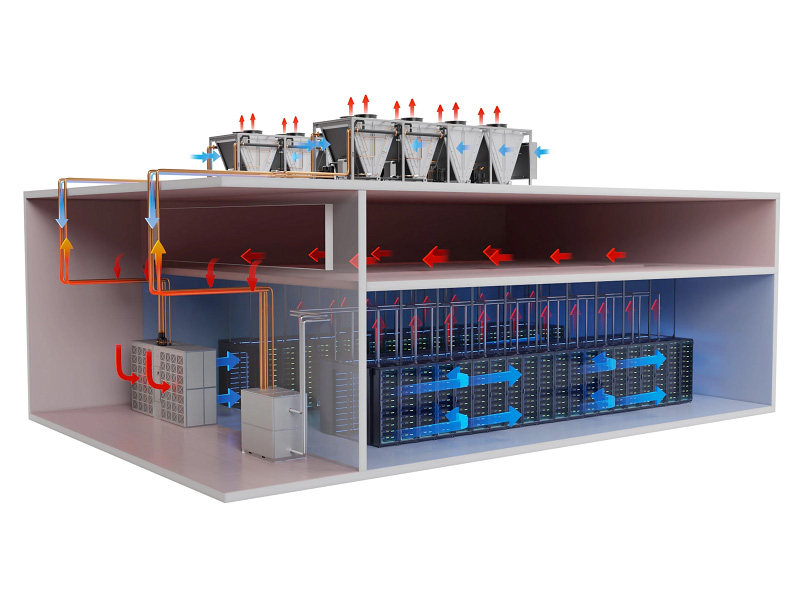
What Is Liquid Cooling and Why Is It Replacing Air Cooling?
Liquid cooling refers to the use of a liquid coolant—such as water or dielectric fluid—to absorb and transfer heat away from electronic components like CPUs, GPUs, and power modules.
The thermal management process typically involves:
Heat conduction from the chip to the cooling interface
Convective heat transfer via circulating coolant
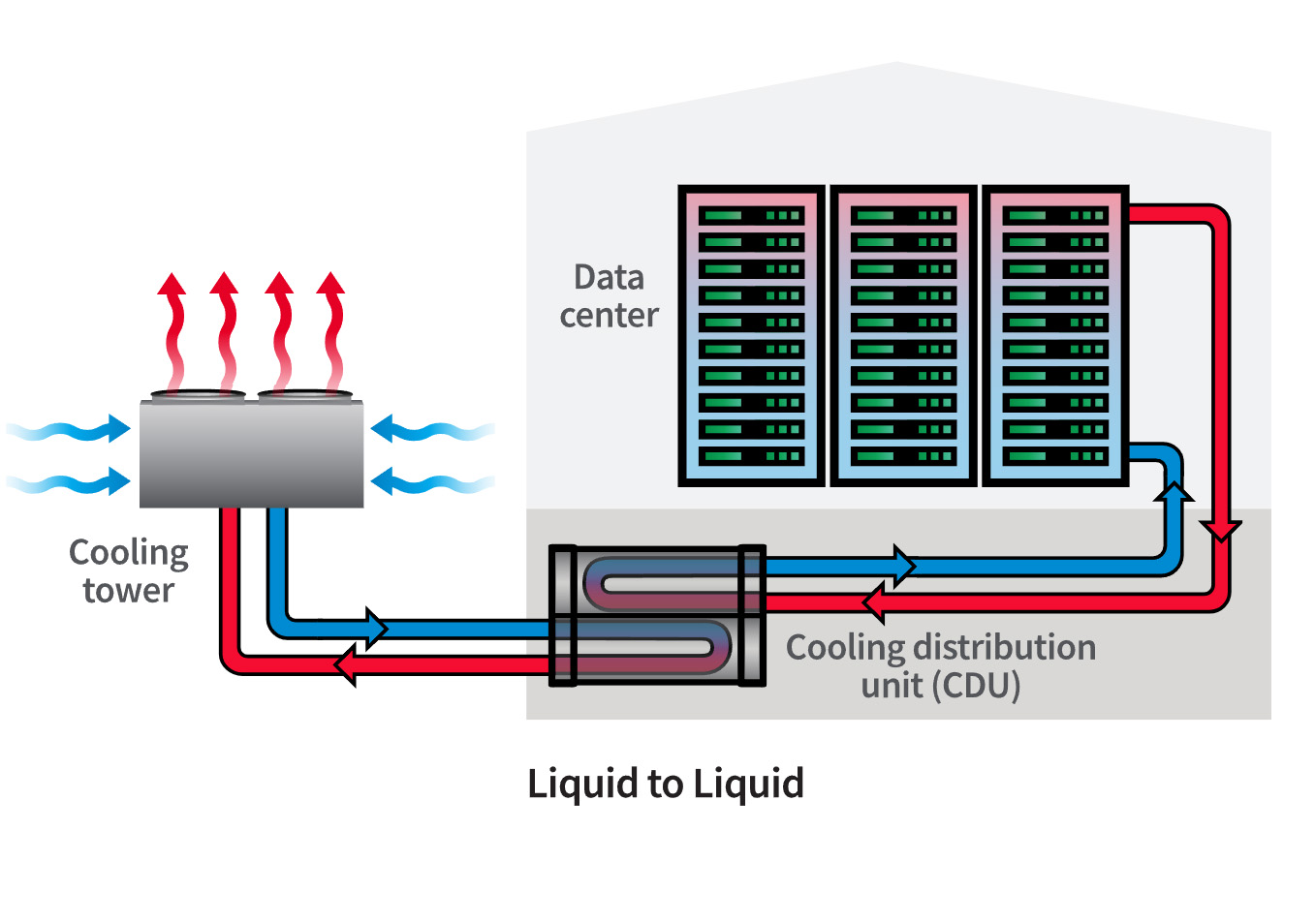
Heat dissipation through heat exchangers or cooling towers
Compared to air cooling, liquid cooling offers several advantages:
Higher thermal conductivity for faster heat transfer
Greater heat capacity, allowing more efficient cooling
Lower energy consumption by reducing reliance on fans and HVAC systems
Support for higher rack power density
These benefits make liquid cooling essential for high-performance computing, AI clusters, and modern data centers.
Limitations of Traditional Air Cooling
As rack densities exceed 15kW, air cooling systems face critical limitations:
Low heat transfer efficiency due to air’s poor thermal properties
High energy consumption from CRAC/CRAH units
Hotspot formation around CPUs and GPUs
Increased noise and airflow management complexity
In contrast, liquid cooling provides targeted, efficient heat removal directly at the source.
Types of Liquid Cooling in Data Centers
Liquid cooling technologies can be broadly categorized into three types, each associated with specific products and applications.
1. Cold Plate Liquid Cooling – The Mainstream Solution
Cold plate liquid cooling is currently the most widely adopted and commercially viable solution for data centers.
It uses a Liquid Cold Plate mounted on high-heat components such as CPUs, GPUs, or power electronics. Coolant flows through internal channels, absorbing heat and carrying it away.
A high-performance liquid cold plate typically includes:
Base material (aluminum or copper)
Internal flow channels (microchannels or serpentine design)
Inlet and outlet ports
Sealing system (O-rings or brazed structure)
The flow channel design plays a critical role in determining heat transfer efficiency and pressure drop.
Manufacturing Technologies
Common production methods include:
Each method influences performance, cost, and long-term reliability.
Advantages of Liquid Cold Plates
High heat transfer efficiency for high-power devices
Indirect contact with electronic components for enhanced safety
Flexible customization for different applications
Easy integration into existing server architectures
Typical Applications
Data center servers for CPU and GPU cooling
Artificial intelligence and machine learning systems
Power electronics and IGBT modules
Energy storage and electric vehicle systems
2. Water Blocks – Precision Cooling for CPUs and GPUs
A water block is a compact liquid cooling component designed for localized heat sources. It can be considered a smaller and more precise version of a cold plate.
Key Features of Water Blocks
Microchannel or pin-fin structures to increase surface area
Compact design for direct chip cooling
High thermal transfer performance
Common Applications
CPU cooling in servers and workstations
GPU cooling for high-performance computing
Edge computing and compact systems
Water Block vs. Liquid Cold Plate
| Feature | Liquid Cold Plate | Water Block |
|---|
| Application | Servers / Industrial systems | CPU / GPU |
| Size | Larger | Compact |
| Customization | High | Moderate |
| Heat Load Capacity | Very High | Medium to High |
3. Immersion Cooling – Advanced High-Density Solution
Immersion cooling involves submerging servers directly into a dielectric liquid, allowing heat to be removed without relying on air.
Types of Immersion Cooling
Advantages
Extremely high cooling efficiency
Minimal noise due to the absence of fans
Suitable for ultra-high-density deployments
Challenges
This solution is typically used in hyperscale data centers and AI training environments.
Key Components of a Liquid Cooling System
A complete liquid cooling system includes:
Cooling Distribution Unit (CDU)
Pumps and circulation systems
Piping and quick connectors
Heat exchangers
Cooling towers or dry coolers
The liquid cold plate or water block acts as the final heat transfer interface, while the system ensures continuous heat removal.
Coolant Selection and Its Impact
Selecting the appropriate coolant is essential for system performance:
Water: High efficiency but electrically conductive
Mineral oil: Suitable for immersion cooling
Fluorinated fluids: Non-conductive and safe, but costly
Engineered fluids: Designed for stability and performance
Why Liquid Cooling Is the Future of Data Centers
Improved Energy Efficiency
Liquid cooling reduces reliance on energy-intensive air systems and improves overall efficiency.
Enhanced System Reliability
Stable temperature control minimizes thermal stress and extends component lifespan.
Higher Power Density Support
Liquid cooling enables data centers to scale beyond traditional thermal limits.
Our Liquid Cooling Solutions and Capabilities
We provide advanced liquid cooling products and custom thermal solutions for demanding applications.
Product Portfolio
Liquid cold plates for server and industrial cooling
Custom cold plate solutions
CPU and GPU water blocks
Integrated liquid cooling modules
Engineering Capabilities
Flow channel optimization using simulation tools
Advanced manufacturing including CNC, brazing, and FSW
Leak testing and reliability validation
High-precision machining and assembly
Industries Served
Data centers and cloud infrastructure
Artificial intelligence systems
Power electronics and energy storage
Electric vehicles and renewable energy
We support both OEM and ODM projects, delivering solutions tailored to specific thermal requirements.
How to Choose the Right Liquid Cooling Solution
When selecting a liquid cooling system, consider:
Power density requirements
Type of heat source (CPU, GPU, or power modules)
Mechanical layout and available space
Electrical insulation requirements
In most cases, liquid cold plates are ideal for server-level cooling, while water blocks are better suited for chip-level applications. Immersion cooling is typically reserved for extremely high-density deployments.
Request a Custom Liquid Cooling Solution
If you are looking for a reliable partner for liquid cooling components or system design, we can support your project from concept to production.
Our team provides:
FAQ
What is the difference between a liquid cold plate and a water block?
A liquid cold plate is used for larger systems such as servers and industrial equipment, while a water block is designed for localized cooling of CPUs or GPUs.
Is liquid cooling safe for data centers?
Yes. With proper sealing and quality control, liquid cooling systems are highly reliable and widely used.
When should liquid cooling be considered?
Liquid cooling becomes increasingly beneficial when rack power density exceeds 15–20kW.
As data centers continue to evolve toward higher power densities, liquid cooling is becoming a critical technology for maintaining performance and efficiency.
Liquid cold plates provide scalable solutions for server-level cooling, while water blocks offer precise thermal management for individual components. Together, these technologies form the foundation of next-generation thermal management systems.