A heat sink is one of the most fundamental components used to cool electronic devices. Whenever a heat source cannot dissipate heat effectively through its own conduction and requires more efficient cooling, a heat sink is used to transfer heat away from the source and dissipate it through optimized conduction and convection.
Heat sinks are widely used in power electronics, telecommunications equipment, servers, LED lighting, automotive electronics, and industrial devices.
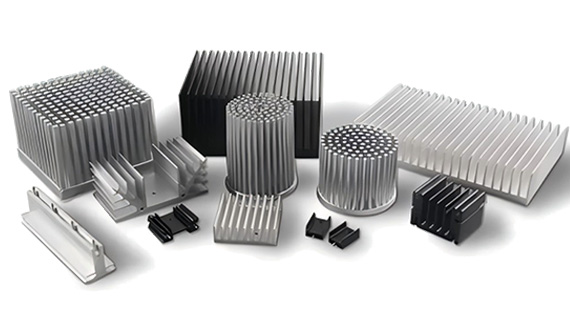
Basic Structure of a Heat Sink
A typical heat sink mainly consists of two parts:
The base is usually a flat surface that makes direct contact with the heat source. Its function is to transfer heat from the hotspot and distribute it evenly across the fins.
The fins are designed to increase the total surface area of the heat sink. They can be manufactured in a wide range of geometries and are typically positioned vertically from the base to maximize heat dissipation.
The primary design goal of a heat sink is to maximize surface area, allowing more heat to be transferred to the surrounding air.
Heat Sink Materials
With very few exceptions, heat sinks are made from thermally conductive metals, most commonly aluminum or copper.
Aluminum
Aluminum is the most widely used material for heat sinks.
These characteristics make aluminum ideal for lightweight and economical heat sink solutions.
Copper
Copper is another popular material for heat sinks.
Although copper is heavier and more expensive, it is often required in high-performance thermal applications.
Natural Convection vs Forced Convection
Heat sinks are typically classified into two categories based on airflow conditions.
Natural Convection (Passive Cooling)
Passive heat sinks rely solely on natural airflow to remove heat.
They are designed to:
Passive heat sinks are commonly used in low-power electronic devices.
Forced Convection (Active Cooling)
Active heat sinks use fans or blowers to force air through the fins.
This forced airflow creates turbulence, significantly increasing heat transfer efficiency and cooling performance.
Active cooling solutions are widely used in:
Common Types of Heat Sinks
Several manufacturing technologies are used to produce heat sinks, each suited for different thermal requirements and applications.
1. Stamped Heat Sinks (Board-Level)
Stamped heat sinks are produced from sheet metal using progressive Stamping processes. Each stamping step adds features and details as the metal passes through the die.
These heat sinks are typically designed for specific electronic package types to ensure optimal fit on printed circuit boards (PCBs).
They may operate in passive mode or include a fan to increase airflow across the board.
Advantages
Ideal for low power applications (0–5W)
Quick and simple assembly
Low manufacturing cost
Scalable for high-volume production
Available for many package types
Disadvantages
Not suitable for applications above 5W
Size limited (generally under 50 mm)
Designed to cool a single device only
2. Extruded Aluminum Heat Sinks
Extrusion is one of the most popular and cost-effective heat sink manufacturing methods.
extruded heat sinks vary in size depending on the application. Smaller versions are used for board-level cooling, while larger ones are designed for medium-power thermal management.
They can be optimized for both passive and active cooling, depending on fin geometry and spacing.
Board-level extruded heat sinks are commonly used for components such as:
The extrusion process begins with a profile die that defines the fin structure, spacing, and base dimensions. Heated aluminum is then pushed through the die to create a long profile, which is later cut into the desired length and further processed.
Advantages
Ideal for medium power applications
Cost-effective production
Highly scalable for mass production
Easy customization
One-piece construction with low thermal resistance
Disadvantages
Not suitable for very high power applications
Size limitations (approximately 23 inches wide and 47 inches long)
Large profiles may have finishing limitations
Skiving is a machining process that forms fins directly from a solid metal block. Thin layers are sliced from the base and folded upward to create fins.
Because the fins and base are formed from the same piece of material, there are no joints or interfaces, which reduces thermal resistance.
This process also allows for very thin fins and high fin density, significantly increasing the total surface area.
Unlike extrusion, skiving requires no dedicated tooling, which lowers tooling costs and allows faster prototyping.
Advantages
Disadvantages
Not ideal for extremely high-power applications
Size limitations
Thin fins may be more fragile
Less suitable for very large production volumes
4. Bonded Fin and Brazed Fin Heat Sinks
Bonded fin heat sinks consist of two main components:
A base (extruded or machined)
Individual fins attached using thermally conductive adhesive, epoxy, or brazing
The fins are typically stamped from thin sheet metal, while the base can be extruded, die cast, or machined.
Additional thermal technologies such as heat pipes or vapor chambers can also be integrated into the base to improve performance.
Bonded fin heat sinks provide greater design flexibility and allow higher fin density within a smaller footprint.
Advantages
Compact design for space-constrained applications
High thermal performance
Suitable for forced convection
Tight fin spacing
High fin aspect ratios
Flexible design integration
Lower tooling costs
Disadvantages
5. Zipper Fin Heat Sinks
Zipper fins are made from a series of individually stamped sheet metal fins that are folded and interlocked together.
These fins can be arranged in either:
The fin stack is usually attached to the heat sink base or heat pipes through soldering, brazing, or epoxy bonding.
This design offers excellent mechanical stability and high flexibility for integrated thermal solutions.
Advantages
High thermal performance
Ideal for forced airflow applications
Flexible design integration
Lower tooling cost
Lightweight
Can improve heat pipe efficiency
Enhanced mechanical stability
Disadvantages
6. Folded Fin Heat Sinks
Folded fins are created by bending thin metal sheets into complex shapes to increase surface area.
These fins are typically bonded or brazed to a base to form the final heat sink assembly. Folded fin technology can also be used in Liquid Cold Plate solutions.
Advantages
Disadvantages
7. Die Cast Heat Sinks
Die cast heat sinks are produced as single-piece structures using molten metal injected into custom molds.
This manufacturing method is ideal for high-volume production and allows complex geometries that would be difficult to achieve through other processes.
After casting, minimal machining and finishing are required to achieve the final product.
Advantages
Ideal for high-volume production
Suitable for complex shapes
Low or near-zero thermal resistance
Disadvantages