Efficient thermal management is critical in modern electronics, automotive systems, and industrial equipment. As power density increases and components become more compact, heat sinks play a vital role in maintaining safe operating temperatures and ensuring long-term system reliability.
For heat sink manufacturers and system designers, understanding the structure, working principles, and performance factors of heat sinks is essential for building effective cooling solutions.
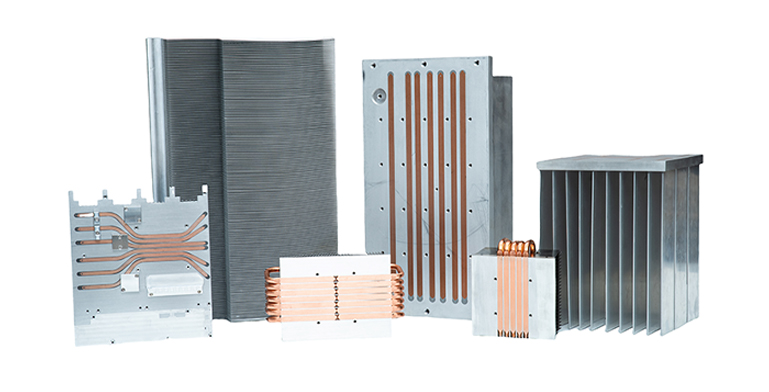
1. What Is a Heat Sink and Why Is It Important?
A heat sink is a passive heat exchanger designed to dissipate heat from electronic components or mechanical systems into the surrounding air.
In automotive engines, electronic devices, power electronics, and industrial machinery, excessive heat can lead to:
A well-designed heat sink ensures that heat generated by a device is efficiently transferred away from the heat source and released into the environment, maintaining the system within a safe operating temperature range.
In many applications, heat sinks work together with fans or liquid cooling systems to enhance heat dissipation efficiency.
2. Basic Structure of a Heat Sink
Although heat sinks come in many shapes and designs, their basic structure generally includes three main elements:
| Component | Function |
|---|
| Base Plate | Absorbs heat from the heat source |
| Fins | Increase surface area for heat dissipation |
| Airflow System (Fan or Natural Convection) | Transfers heat to surrounding air |
Base Plate
The base plate is the contact surface between the heat sink and the heat-generating component, such as a CPU, power module, or automotive engine part.
The primary role of the base plate is to:
Materials with high thermal conductivity, such as aluminum and copper, are commonly used.
Heat Dissipation Fins
Fins significantly increase the heat transfer surface area, allowing more heat to be transferred to the surrounding air.
Fin performance depends on several parameters:
Fin height
Fin thickness
Fin spacing
Fin geometry
Advanced manufacturing techniques enable the production of different heat sink types, including:
Each design offers different advantages depending on the cooling requirements.
Airflow System
Heat sinks often rely on airflow to enhance heat dissipation.
Airflow can be generated through:
In high-power systems, fans are typically installed near the heat sink to push air across the fins, significantly improving thermal performance.
3. Working Principle of a Heat Sink
The working principle of a heat sink is based on heat conduction and convection.
The process occurs in three main stages:
Heat Conduction
Heat travels from the heat source into the heat sink base.
Heat Distribution
Heat spreads through the base plate and into the fins.
Heat Dissipation
Air flowing across the fins removes heat and releases it into the surrounding environment.
The overall cooling efficiency depends on several design factors, including material selection, fin structure, airflow design, and heat sink size.
4. Key Factors Affecting Heat Sink Performance
Although heat sink structures appear simple, their cooling performance can be influenced by multiple parameters.
These include:
5. Influence of Fin Structure on Cooling Performance
Fin structure is one of the most important design parameters for any heat sink solution.
Increasing the heat transfer surface area allows more heat to be dissipated.
However, design trade-offs must be considered:
Larger fins increase cooling capacity
Excessively large structures may increase weight and size
Improper spacing may restrict airflow
Several advanced heat sink technologies have been developed to optimize fin performance.
Extrusion Heat Sink
An Extrusion Heat Sink is manufactured by forcing aluminum through a die to create continuous fin profiles.
Advantages include:
extruded heat sinks are widely used in:
LED lighting
Power electronics
Consumer electronics
Skived Fin Heat Sink
A Skived Fin Heat Sink is created by slicing thin fins directly from a solid metal block.
Advantages:
This design is commonly used in:
high-power electronics
data center equipment
telecom hardware
Bonded Fin Heat Sink
In a Bonded Fin Heat Sink, fins are attached to the base plate using thermal bonding or soldering techniques.
Advantages include:
Bonded fin heat sinks are commonly used in industrial power systems and high-performance computing.
6. Impact of Heat Sink Material on Thermal Performance
Material selection significantly influences heat sink efficiency.
Two key properties are critical:
Thermal conductivity
Thermal stability
Materials with higher thermal conductivity transfer heat more quickly.
Common materials include:
| Material | Advantage |
|---|
| Aluminum | Lightweight and cost-effective |
| Copper | Superior thermal conductivity |
However, materials must also maintain structural stability under high temperatures and long-term operating conditions.
7. Advanced Heat Sink Technologies
To meet the demands of high-power electronics, several advanced cooling technologies are widely used.
Cold Forging Heat Sink
A Cold Forging Heat Sink is manufactured by applying high pressure to shape metal without melting it.
Advantages include:
Cold forging is often used for automotive electronics and LED lighting systems.
Heat Pipe Thermal Module
A Heat Pipe Thermal Module integrates heat pipes with a heat sink structure.
Heat pipes transfer heat extremely efficiently through phase-change heat transfer, moving heat away from hot spots much faster than solid metal conduction alone.
Applications include:
high-performance CPUs
GPUs
servers
telecom equipment
Die Casted Heat Sink
A Die Casted Heat Sink is produced by injecting molten metal into a mold.
Advantages:
Complex shapes
High-volume production
Integrated structures
Die cast heat sinks are widely used in automotive electronics, power electronics, and industrial systems.
8. Influence of Airflow and Fan Design
Fans are critical components in many heat sink systems.
Fan design affects:
airflow speed
airflow pressure
cooling coverage
Two common fan types include:
| Fan Type | Characteristics |
|---|
| Axial Fan | High airflow, low pressure |
| Centrifugal Fan | Higher pressure, suitable for dense fins |
Fan placement is equally important.
Improper fan arrangement may cause:
Optimal airflow design ensures that all fin surfaces are effectively cooled.
9. Achieving Optimal Heat Sink Performance
Designing an efficient heat sink requires balancing multiple factors, including:
material selection
fin geometry
airflow design
manufacturing technology
system integration
Instead of optimizing a single parameter, engineers must evaluate the entire thermal management system.
Proper integration between components such as Extrusion Heat Sink, Skived Fin Heat Sink, Bonded Fin Heat Sink, Cold Forging Heat Sink, Heat Pipe Thermal Module, and Die Casted Heat Sink ensures maximum cooling efficiency for specific applications.
Heat sinks are essential components in modern thermal management systems. Although their structure may appear simple, their performance depends on careful design, material selection, and manufacturing techniques.
By selecting the appropriate heat sink type—whether an Extrusion Heat Sink, Skived Fin Heat Sink, Bonded Fin Heat Sink, Cold Forging Heat Sink, Heat Pipe Thermal Module, or Die Casted Heat Sink—manufacturers and engineers can significantly improve cooling performance and extend the lifespan of electronic systems.
As technology continues to advance, innovative heat sink designs will remain a key factor in ensuring reliable and efficient thermal management across industries.