As electronics continue to become more powerful and compact, thermal management has become one of the most critical engineering challenges. Traditional air cooling methods often reach their physical limits when dealing with high-power electronics.
In these situations, liquid cold plates (also called water cooling plates or liquid cooling plates) provide a highly efficient solution for removing heat from high-power components.
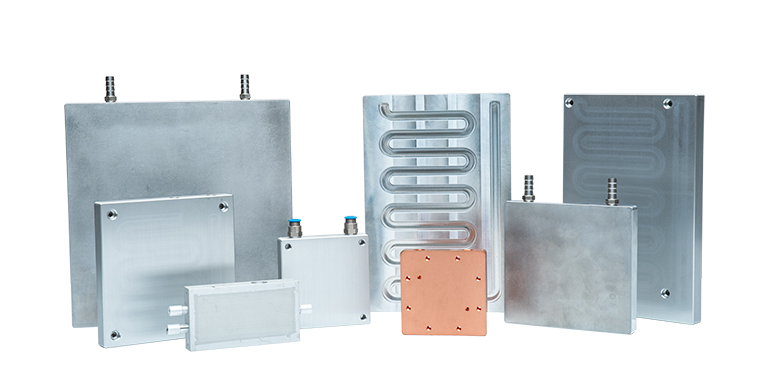
In simple terms, Liquid Cold Plates solve high-density heat dissipation problems.
Modern electronics continue to shrink in size while increasing in performance. This leads to extremely high power density, meaning a large amount of heat is generated in a very small space.
When this happens, traditional air cooling systems face several limitations:
Air has very low thermal conductivity
Fans cannot remove heat quickly enough
Localized hot spots appear on critical components
These issues can result in:
This is where liquid cooling plates become essential.
They create a direct thermal path that efficiently transfers heat away from high-power components.
Thermal Conductivity Comparison
| Medium | Thermal Conductivity (W/m·K) |
|---|
| Air | ~0.026 |
| Water | ~0.6 |
| Ethylene Glycol/Water (50/50) | ~0.4 |
Water conducts heat more than 20 times better than air, which is why liquid cooling systems are far more effective for high heat flux applications.
Typical applications include:
2. Basic Components of a Liquid Cold Plate
Although liquid cold plates may appear complex, they are built from four fundamental components.
| Component | Main Function |
|---|
| Base Plate | Absorbs heat directly from the heat source |
| Internal Channels | Guide coolant flow |
| Inlet & Outlet Ports | Connect to the cooling loop |
| Cover Plate | Seals the internal channels |
Base Plate
The base plate is the part that directly contacts the heat source. Material selection is critical because it determines heat transfer efficiency.
Common materials include:
| Material | Key Advantage |
|---|
| Copper | Maximum thermal conductivity |
| Aluminum | Lightweight and cost-effective |
For many industrial applications, aluminum cold plates provide the best balance between performance, weight, and cost.
Internal Flow Channels
Inside the cold plate, channels guide the coolant flow.
Their purpose is to:
The design of these channels has a major impact on the overall performance of the cooling plate.
Inlet and Outlet Ports
These ports connect the cold plate to the complete liquid cooling loop.
They must ensure:
Cover Plate
The cover plate seals the channel structure and prevents coolant leakage during operation.
The manufacturing process directly affects:
Cooling performance
Reliability
Production cost
Scalability
Common cold plate manufacturing methods include:
| Manufacturing Method | Key Advantage | Best Application |
|---|
| Brazed Cold Plates | High thermal performance | Complex internal fin structures |
| Friction Stir Welding (FSW) | Extremely reliable sealing | Large aluminum plates |
| CNC Machined Cold Plates | High precision | Prototypes or custom designs |
| Die-Cast Cold Plates | Low cost for mass production | Consumer electronics |
Brazed Cold Plates
Brazing uses a filler metal to bond multiple components together.
Advantages:
These are commonly used in data center cooling plates and high-performance electronics.
Friction Stir Welding (FSW)
FSW is a solid-state joining process that creates strong, leak-free joints without melting the base material.
Advantages include:
CNC Machined Cold Plates
Machined cold plates are typically produced by gun drilling channels into solid metal blocks.
Advantages:
Design flexibility
High precision
Ideal for prototyping
However, machining can be expensive for large-volume production.
Die-Cast Cold Plates
Die casting is suitable for high-volume manufacturing.
Advantages include:
Low production cost
Fast production cycle
The trade-off is slightly lower thermal performance compared to brazed or machined designs.
4. Types of Cold Plate Flow Channel Designs
The internal channel layout is one of the most important factors affecting liquid cold plate performance.
Three common channel types include:
| Channel Design | Main Feature |
|---|
| Serpentine Channels | Single continuous flow path |
| Parallel Channels | Multiple parallel flow paths |
| Microchannels | Extremely small channels with large surface area |
Serpentine Flow Channels
A serpentine design forces coolant to travel along a long winding path.
Advantages:
Disadvantages:
Higher pressure drop
Requires a stronger pump
Parallel Flow Channels
Parallel channels divide the coolant flow into multiple shorter paths.
Advantages:
Lower pressure drop
More uniform cooling
The main challenge is ensuring even flow distribution.
Microchannel Cold Plates
Microchannel designs dramatically increase heat transfer surface area.
Advantages:
However:
5. Serpentine vs Parallel Flow Channels
Selecting the right channel design depends on several factors.
| Design Factor | Serpentine | Parallel |
|---|
| Pressure Drop | High | Low |
| Temperature Uniformity | Moderate | Better |
| Hotspot Cooling | Excellent | Moderate |
Recommended Applications
| Heat Source Type | Recommended Design |
|---|
| Small concentrated hotspots | Serpentine |
| Large uniform surfaces | Parallel |
| Complex heat distribution | Hybrid designs |
6. Structure of a Complete Liquid Cooling System
A liquid cold plate does not operate alone. It is part of a complete liquid cooling loop.
Key components include:
| Component | Function |
|---|
| Pump | Circulates coolant |
| Radiator | Releases heat into the air |
| Reservoir | Stores extra coolant |
| Tubing | Connects the system |
Cooling Cycle
Cold plate absorbs heat from electronics
Heated coolant flows to the radiator
Heat is transferred to the air
Coolant returns to the reservoir
The cycle repeats continuously
7. Designing Cold Plates for Electric Vehicle Batteries
EV battery thermal management requires solving several challenges:
A common solution is:
Stamped aluminum cold plates with serpentine channels and brazed assembly.
Advantages include:
Lightweight structure
Good temperature uniformity
Cost-effective mass production
Strong mechanical durability
8. Optimizing Data Center Cooling Plates
For data center cold plates, the goal is not simply the lowest temperature.
Instead, engineers optimize for Total Cost of Ownership (TCO).
Important factors include:
Thermal performance
Pumping power
Energy consumption
Engineers often use CFD simulation (Computational Fluid Dynamics) to optimize cold plate designs before manufacturing.
9. Achieving Temperature Uniformity Across Large Surfaces
Maintaining consistent temperatures across large surfaces is challenging.
Advanced cold plate designs use several techniques:
Flow Path Optimization
Channels are designed to direct coolant toward hotspot regions.
Variable Channel Width
Adjusting channel width controls flow velocity and heat transfer performance.
Multi-Zone Cooling
Different cooling zones are created for different heat loads.
This approach is often used in:
AI servers
High-power electronics
Multi-chip systems
10. Future Trends in Liquid Cold Plate Technology
Liquid cooling technology continues to evolve rapidly.
Several innovations are shaping the future of cold plate design.
3D-Printed Cold Plates
Additive manufacturing enables:
Two-Phase Cooling
Instead of simply heating liquid, two-phase cooling uses boiling heat transfer.
Phase change absorbs significantly more heat than single-phase cooling.
Advanced Materials
New materials under development include:
These offer dramatically improved thermal conductivity.
Smart Cold Plates
Future cold plates may include integrated sensors, enabling:
As power density continues to increase in modern electronics, liquid cold plates are becoming a critical technology for thermal management.
From data center cooling plates to EV battery cold plates, properly designed liquid cooling systems can significantly improve:
Equipment performance
Reliability
Energy efficiency
For manufacturers, selecting the right materials, manufacturing processes, and channel designs is essential for delivering high-performance liquid cooling solutions.