With the rapid growth of AI computing, GPU clusters, power electronics, and high-performance processors, thermal management has become a critical factor affecting system performance and reliability.
Even when two systems both use liquid cooling, one may operate reliably under heavy load while the other overheats. The difference often lies in one crucial factor:
Cooling channel design.
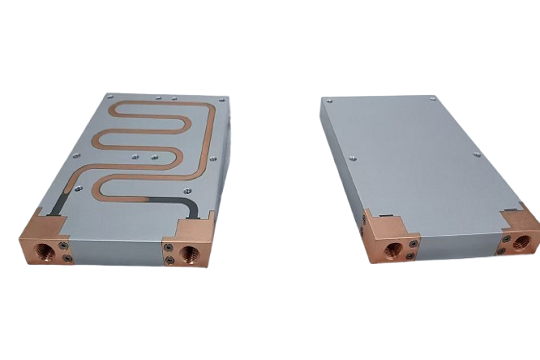
The internal flow channels of a Liquid Cold Plate determine how efficiently coolant absorbs and removes heat. Channel structure directly affects flow distribution, pressure drop, and heat transfer efficiency, making it the true “core” of cold plate performance.
This article explores the engineering principles behind liquid cold plate channel design—from basic concepts to advanced optimization techniques—and explains how channel geometry and material selection influence cooling efficiency, manufacturing cost, and system reliability.
Understanding the Liquid Cooling Loop
What Is a Liquid Cooling Loop?
A typical liquid cooling system forms a closed-loop circuit that continuously transfers heat from the heat source to the surrounding environment.
The cooling path usually includes:
Cold Plate → Pump → Heat Exchanger (Radiator) → Reservoir → Cold Plate
Among these components, the liquid cold plate plays the most critical role, because it is the component that directly contacts the heat source such as:
CPUs
GPUs
IGBT modules
Power electronics
The cold plate ensures rapid heat transfer from the device surface to the circulating coolant.
The Core Role of Cooling Channels
Inside the cold plate, the cooling channels control how coolant flows across the heated surface.
A well-designed channel structure should:
Maximize the heat transfer surface area between coolant and metal
Ensure uniform heat distribution across the heating zone
Minimize pressure drop to maintain pump efficiency
Balance thermal performance and manufacturability
Effective channel design therefore requires balancing heat transfer performance, pumping power, and production feasibility.
Material Selection for Liquid Cold Plates
Material selection significantly influences thermal performance, durability, and manufacturing cost.
Common Materials Used in Cold Plates
| Material | Advantages | Limitations | Typical Applications |
|---|
| Aluminum Alloy | Lightweight, cost-effective, easy to machine | Lower thermal conductivity, coolant compatibility concerns | Consumer electronics, medium power cooling |
| Copper | Excellent thermal conductivity, superior heat transfer | Higher cost, heavier, more difficult to machine | Data center servers, high-power electronics |
| Stainless Steel | Strong corrosion resistance and mechanical strength | Poor thermal conductivity, higher weight | Harsh environments and chemical systems |
Key Factors in Material Selection
When selecting materials for liquid cold plates, engineers must consider several factors:
1. Thermal Conductivity
Higher conductivity improves heat transfer from the base plate to the coolant.
2. Coolant Compatibility
Material and coolant combinations must avoid corrosion, scaling, or electrochemical reactions.
3. Manufacturability
The material must support advanced manufacturing methods such as:
CNC Machining
vacuum brazing
friction stir welding
additive manufacturing
4. Cost Optimization
Material choice must balance performance requirements with project budget.
5. Density and Mechanical Strength
These properties affect system weight and structural stability.
For high heat flux applications, copper or copper alloys are often preferred despite their higher cost. Aluminum alloys are frequently used when weight reduction and cost control are important.
Cooling Channel Topology and Structure
Channel topology strongly influences heat transfer efficiency and hydraulic performance.
Common Cooling Channel Designs
Straight Channels
Straight channels provide simple linear flow paths.
Advantages
Low pressure drop
Easy manufacturing
Disadvantages
Typical Use
Serpentine Channels
Serpentine channels guide coolant through a long winding path.
Advantages
Disadvantages
Typical Use
Parallel Channels
Parallel channels divide coolant into multiple flow paths.
Advantages
Disadvantages
Pin-Fin or Micro-Fin Arrays
Pin-fin structures consist of densely arranged micro fins to increase surface area.
Advantages
Disadvantages
Biomimetic Flow Channels
Inspired by natural vascular systems such as leaf veins or blood vessels, these designs optimize fluid distribution.
Advantages
Disadvantages
Key Geometric Parameters in Channel Design
Several geometric parameters control thermal and hydraulic performance:
Hydraulic Diameter
Determines flow regime (laminar vs turbulent) and heat transfer coefficient.
Aspect Ratio (Width / Depth)
Influences structural strength and heat transfer area.
Wall Thickness
Balances mechanical strength and thermal resistance. Excessively thin walls may deform under pressure.
A well-designed cold plate aims to maintain uniform coolant velocity across high-temperature regions while minimizing local temperature gradients and hotspots.
CFD-Based Optimization for Cold Plate Design
In modern engineering, Computational Fluid Dynamics (CFD) plays a crucial role in optimizing liquid cold plate designs before physical prototyping.
Typical CFD Workflow
1. 3D Modeling and Meshing
Engineers create a detailed CAD model and generate computational meshes, with refined grids near channel walls.
2. Boundary Conditions
Simulation parameters include:
inlet flow rate and temperature
heat flux distribution
material thermal properties
outlet pressure conditions
3. Solver Calculation
Advanced turbulence models such as k-ω SST are used to simulate fluid flow and heat transfer.
4. Result Analysis
Engineers analyze:
temperature distribution
pressure fields
velocity vectors
potential hotspots
5. Iterative Optimization
Channel spacing, depth, and manifold geometry are adjusted until performance targets are achieved.
Popular CFD tools include:
CFD significantly reduces design cycles and prototyping costs while improving thermal performance.
Engineering Considerations Beyond Simulation
Cold plate design must also consider real-world constraints such as manufacturing processes and operational reliability.
Thermal Performance
Designers must define:
target thermal resistance (°C/W)
allowable temperature rise
transient thermal response during power cycles
Fluid Dynamics
Proper hydraulic design ensures:
total pressure drop matches pump capacity
balanced flow distribution in parallel channels
sufficient NPSH margin to prevent cavitation
Reliability
Long-term reliability requires attention to:
structural integrity under pressure
thermal cycling resistance
corrosion prevention
leak prevention through high-quality sealing and brazing
Manufacturing Feasibility
Channel designs must match available production methods, including:
vacuum brazing
friction stir welding
CNC machining
additive manufacturing
Manufacturing methods influence cost, production time, and achievable tolerances.
Common Liquid Cold Plate Design Challenges
Flow Dead Zones
Low-velocity regions can cause overheating. Engineers typically identify these zones through CFD analysis and redesign the manifold structure.
Uneven Flow Distribution
Parallel channels may experience different flow rates. Resistance balancing or calibrated restrictors can solve this problem.
Excessive Pressure Drop
High pressure drop increases pump power consumption. Designers can optimize channel dimensions and reduce sharp turns.
Air Entrapment
Trapped air bubbles reduce cooling efficiency. Proper venting design and filling procedures help eliminate this issue.
Future Trends in Liquid Cold Plate Technology
The future of thermal management is evolving rapidly.
Additive Manufacturing
3D printing enables complex internal channel geometries that are impossible to machine traditionally.
AI-Driven Topology Optimization
Machine learning algorithms can automatically generate high-efficiency channel layouts that minimize pressure drop while maximizing heat transfer.
Integrated Cooling Systems
Future cold plates may integrate pumps, sensors, and valves directly into the cooling module, enabling compact and intelligent thermal solutions.
Cooling channel design in liquid cold plates is a multi-objective engineering optimization problem. Engineers must balance thermal performance, hydraulic resistance, manufacturing feasibility, cost, and long-term reliability.
A well-optimized channel structure can significantly improve thermal control, energy efficiency, and system lifespan.
As high-performance computing, electric vehicles, and AI infrastructure continue to expand, advanced liquid cold plate technology will play a central role in next-generation thermal management solutions.