As computing power continues to grow in AI servers, data centers, electric vehicles, and industrial electronics, thermal management has become one of the most critical factors affecting system reliability and performance.
Excessive heat can cause:
For high-density electronic systems, traditional air cooling often struggles to keep up with rising power densities. As a result, engineers increasingly evaluate advanced cooling technologies such as liquid cooling systems and vapor chamber cooling.
Among these technologies, liquid cooling—especially Liquid Cold Plate solutions—has become one of the most effective approaches for managing high heat loads, while vapor chamber technology is often used as a heat spreading solution in compact electronics.
This article compares these two technologies and explains how they are used in modern thermal management systems.
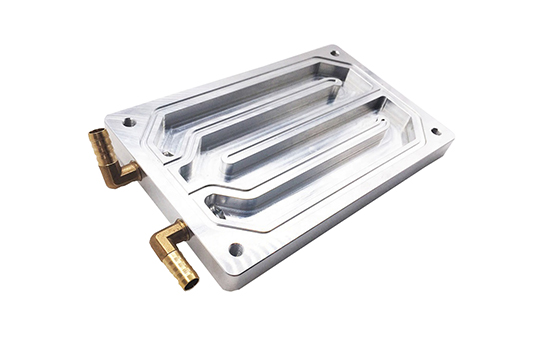
Why Liquid Cooling Is Becoming the Preferred Thermal Solution
In many high-performance applications, air-based cooling is no longer sufficient. High-power CPUs, GPUs, and power electronics can generate hundreds of watts of heat in a very small area.
Liquid cooling offers a major advantage because liquids transfer heat much more efficiently than air.
A typical liquid cooling system includes:
The cooling process works as follows:
Heat generated by electronic components transfers to the liquid cold plate.
Coolant absorbs the heat through internal microchannels.
The heated coolant flows through tubing to a radiator or heat exchanger.
The heat is then dissipated into the surrounding environment.
Because liquid has higher heat capacity and thermal conductivity than air, liquid cooling can remove significantly larger heat loads.
Liquid Cold Plates: The Core of Industrial Liquid Cooling Systems
In modern industrial electronics and data center infrastructure, liquid cold plates are one of the most important thermal management components.
A liquid cold plate is a heat exchanger that allows direct liquid-to-chip heat transfer, dramatically improving cooling efficiency compared with traditional heatsinks.
Liquid cold plates are widely used in:
AI servers
GPU clusters
data centers
EV battery systems
power electronics
telecom infrastructure
Modern liquid cold plates often incorporate advanced manufacturing technologies such as:
skived fin structures
microchannel designs
friction stir welding
vacuum brazing
These designs maximize surface area and fluid turbulence, allowing the system to handle extremely high heat flux.
In demanding applications, liquid cold plates can dissipate hundreds or even thousands of watts of heat, making them ideal for high-power electronics.
Advantages of Liquid Cooling Systems
Compared with traditional air cooling, liquid cooling provides several important benefits.
1. Higher Cooling Capacity
Liquid cooling systems can handle significantly higher thermal loads, making them ideal for high-performance processors and industrial electronics.
2. Stable Operating Temperatures
Continuous coolant circulation maintains consistent temperatures even during heavy workloads.
3. Reduced Noise
Because heat is removed more efficiently, systems require fewer high-speed fans.
4. Multi-Component Cooling
A single liquid loop can cool multiple components, such as:
5. Ideal for High-Density Systems
Liquid cooling is widely used in data centers, AI computing clusters, and industrial equipment where space is limited and heat density is extremely high.
Vapor Chamber Cooling (Brief Overview)
Vapor chamber cooling is another thermal technology commonly used in compact electronic devices.
A vapor chamber is a sealed metal plate containing a working fluid under vacuum conditions. When heat is applied, the liquid evaporates and spreads as vapor across the chamber. The vapor then condenses in cooler regions and returns to the heat source through a wick structure.
This phase-change cycle enables very efficient vapor chamber heat spreading, distributing heat evenly across the chamber surface.
Because of this ability to spread heat quickly, vapor chamber cooling is widely used in:
GPUs
laptops
compact servers
mobile devices
However, vapor chambers mainly function as heat spreaders rather than high-capacity cooling systems, which means their ability to remove heat is limited when power density increases significantly.
Vapor Chamber vs Liquid Cooling
Both technologies play important roles in thermal management, but they serve different purposes.
| Heat Load | Vapor Chamber | Liquid Cooling |
|---|
| ≤100W | Highly efficient heat spreading | Usually unnecessary |
| 100–250W | Moderate cooling capability | Very effective |
| >250W | Limited performance | Excellent cooling capacity |
Vapor chambers are effective for heat spreading in compact devices, while liquid cooling systems are designed for removing large amounts of heat from high-power electronics.
Hybrid Thermal Solutions
In some advanced systems, manufacturers combine multiple thermal technologies to improve overall cooling performance.
Examples include:
Vapor Chamber + Heat Pipes
Common in high-performance laptops where vapor chambers spread heat before transferring it to remote heatsinks.
Vapor Chamber + Liquid Cold Plate
Used in high-density computing environments where vapor chambers distribute heat evenly before transferring it to liquid cooling modules.
These hybrid designs can significantly improve overall thermal efficiency in complex systems.
Choosing the Right Cooling Technology
Selecting the right cooling solution depends on several design factors:
In general:
Vapor chamber cooling is ideal for compact electronics requiring efficient heat spreading.
Liquid cooling systems are better suited for high-power computing and industrial applications.
Liquid cold plates provide one of the most efficient solutions for removing heat directly from high-power components.
Both vapor chamber cooling and liquid cooling technologies are important in modern electronics thermal management.
Vapor chambers are excellent for heat spreading in compact systems, while liquid cooling—especially liquid cold plate solutions—offers the performance needed for high-power and high-density computing environments.
As processor power and system density continue to increase, liquid cooling will remain one of the most effective solutions for managing extreme thermal loads in next-generation electronics.