Selecting a Liquid Cold Plate starts with understanding the application. Two plates with similar dimensions can deliver different results because their coolant passages, contact surfaces and operating conditions are different.
For engineers and equipment buyers, the important questions extend beyond cooling capacity. How much flow is available? What pressure drop can the pump accommodate? Which materials contact the coolant? How will the plate be manufactured and inspected?
This guide explains the fundamentals and provides a practical framework for specifying a custom cooling component.
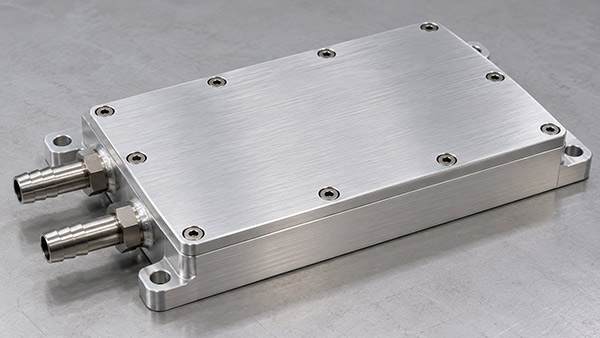
A liquid cold plate is a heat exchanger that collects heat from a component and transfers it into circulating coolant. It usually includes a metal mounting surface, internal fluid passages, and inlet and outlet connections.
The component transfers heat into the plate through its contact interface. Coolant flowing through the passages absorbs that heat and transports it to another part of the cooling system.
A cold plate therefore removes heat from the device locally, while a separate heat exchanger rejects that heat from the loop.
How Does Liquid Cold Plate Cooling Work?
Cooling involves conduction through the component interface and plate, followed by convection from the internal surfaces into the coolant.
The complete thermal path includes:
Heat source → Contact interface → Cold plate → Coolant → Heat exchanger
Each stage matters. An effective internal channel cannot compensate fully for a poor mounting interface, and a well-machined plate cannot achieve its intended performance without suitable coolant conditions.
The cooling loop must also provide enough circulation and heat-rejection capacity. Depending on the installation, it may include a pump, piping, manifolds, a radiator or liquid-to-liquid heat exchanger, and fluid-management components.
Liquid Cold Plates vs Air-Cooled Heat Sinks
Liquid cooling is useful when the thermal load, component density or mechanical envelope makes air cooling difficult.
| Selection Factor | Air-Cooled Heat Sink | Liquid Cold Plate |
|---|
| Heat transport | Transfers heat to nearby air | Transfers heat into a fluid loop |
| Component integration | Requires space for fins and airflow | Requires a contact surface and fluid connections |
| Supporting equipment | May require fans and ducting | Requires circulation and heat rejection |
| Maintenance considerations | Airflow and dust management | Coolant, connections and leakage management |
A compact cold plate does not necessarily mean the complete system is smaller or consumes less energy. Compare the entire cooling architecture under the same operating conditions.
Main Liquid Cold Plate Manufacturing Types
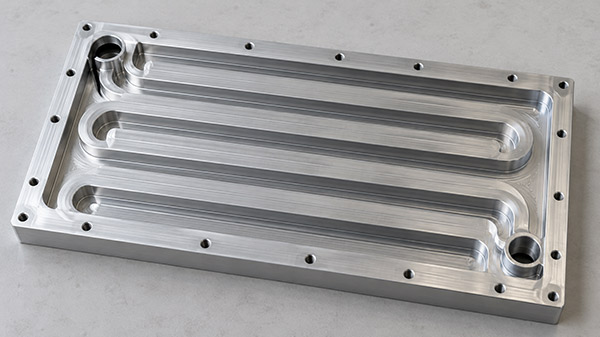
Manufacturing construction and channel geometry are related, but they describe different aspects of the design. For example, a serpentine channel can be incorporated into more than one construction method.
Embedded Tube Cold Plates
An embedded tube cold plate uses formed tubing installed in grooves within a metal base. The base supports the heat source, while the tubing provides the coolant path.
The tube-to-base contact is an important part of the thermal path. Tube routing should cover the heat-generating areas without introducing unnecessary length or restrictive bends.
This construction can be evaluated for power supplies, converters and other equipment where a practical tube layout meets the cooling requirements.
Brazed Liquid Cold Plates
Brazed construction joins separately manufactured parts into an assembly. The base, cover and internal cooling features can be designed together to accommodate the component layout.
Internal fins or other structures provide additional coolant-contact area. Their benefit must be balanced against flow resistance and manufacturing requirements.
Inspection should address joining integrity as well as dimensions and performance.
Friction stir welding uses a rotating tool to join materials in a solid-state process. In an aluminum cold plate, a cover can be welded to a base containing machined coolant passages.
This approach allows the passages to follow an application-specific layout. Weld access, supporting geometry and final machining requirements should be considered during design.
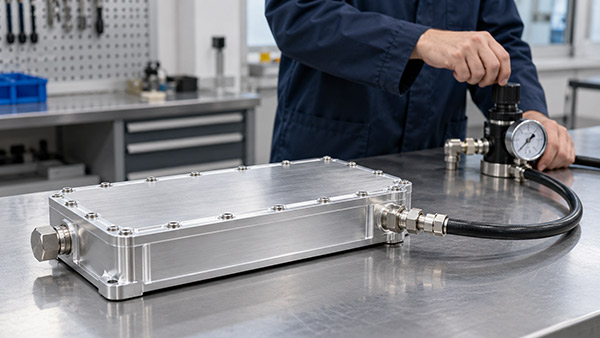
No joining method automatically guarantees a leak-free product; acceptance criteria and inspection remain necessary.
Choosing Aluminum or Copper
Material selection affects heat spreading, mass, cost and coolant compatibility.
Aluminum is attractive where low weight and practical manufacturing are priorities. Copper offers higher thermal conductivity and may be considered when heat is concentrated within a small area.
However, bulk conductivity alone does not determine cold plate performance. Contact resistance, channel placement and coolant conditions also influence component temperature.
Review the materials exposed to coolant throughout the loop. The exterior base material and the wetted material are not always the same, particularly in embedded tube constructions.
Internal Channel Design and Pressure Drop
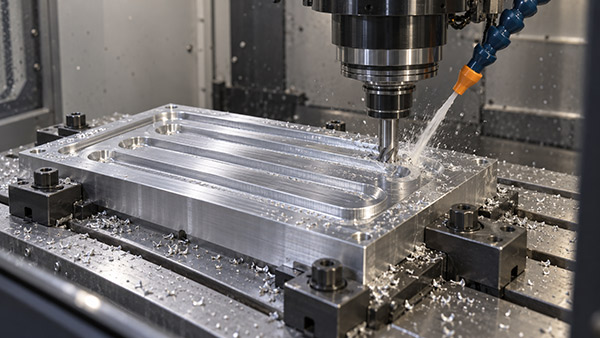
Channel design must balance cooling coverage with the hydraulic capability of the system.
A serpentine path directs coolant through a defined route. Parallel passages divide flow among multiple routes and require suitable distribution at their entrances and exits.
Smaller passages or additional internal features may improve local heat transfer, but they can also increase resistance or sensitivity to contamination.
Before approving a design, check:
Whether coolant reaches every important heat-source region.
Whether the predicted pressure drop fits the available pump capability.
Whether the passages can be manufactured and inspected.
Whether the fluid-management strategy suits the passage dimensions.
Coolant Compatibility and Reliability
Select coolant together with the plate and the rest of the loop.
Water-based fluids are common, while water-glycol mixtures may be considered where freeze protection is needed. Changing fluid composition changes thermal and hydraulic behavior.
Review compatibility with metals, seals and connections. Specify the required fluid condition and maintenance approach rather than assuming that any water-based coolant is suitable.
Cleanliness is particularly important where passages are narrow. Debris or deposits can restrict flow and change performance over time.
A standard plate is worth considering when its published performance and mechanical interfaces match the application. Confirm the conditions behind the performance data before making a comparison.
A custom liquid cold plate may be appropriate when several heat sources share one surface, mounting space is unusual, or the coolant connections must fit an existing assembly.
Customization should solve a defined requirement. It does not automatically deliver better performance than a suitable standard component.
What to Include in a Cold Plate RFQ
A useful quotation request connects the mechanical drawing with operating requirements.
| Information | What to Provide |
|---|
| Heat sources | Power, dimensions and locations |
| Temperature targets | Maximum temperatures and measurement references |
| Coolant | Fluid specification and inlet temperature range |
| Hydraulics | Available flow and allowable pressure drop |
| Pressure | Operating and required test conditions |
| Mechanical interfaces | CAD files, mounting details and port requirements |
| Quality requirements | Inspection criteria and required records |
| Quantity | Prototype and expected production volumes |
Define missing inputs explicitly. This helps the supplier distinguish confirmed requirements from assumptions.
Custom Liquid Cold Plates from KINGKA
KINGKA offers FSW, embedded tube and brazed liquid cold plate manufacturing, supported by precision CNC machining.
Send your drawings and operating requirements to discuss an appropriate construction method. Review the proposed design, inspection requirements and quotation basis before moving into prototype production.
Frequently Asked Questions
Is a liquid cold plate the same as a water block?
The terms overlap. Water block is frequently used in processor cooling, while liquid cold plate is a broader term used across industrial thermal management applications.
Which cold plate type is best?
Choose according to the application’s thermal, hydraulic, mechanical and manufacturing requirements. No construction method is best for every project.
Can a cold plate cool several components?
Yes, but their locations and individual heat loads should be included in the design requirements.
What makes a cold plate comparison meaningful?
Compare products at equivalent coolant conditions, heat-source arrangements and mounting conditions. A single performance value without its test conditions provides an incomplete comparison.