




When purchasing a water cooling plate, engineers often focus on the base material, external dimensions, and thermal performance. However, the materials that come into direct contact with coolant are equally important for long-term system reliability.
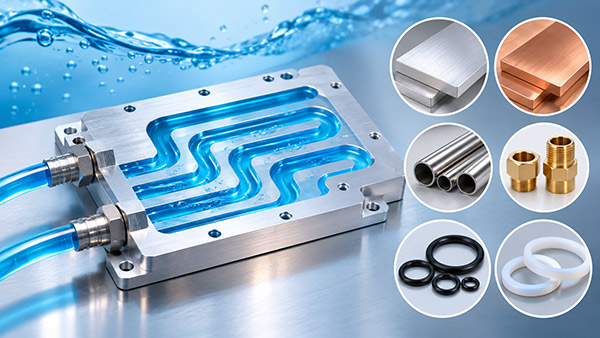
A cooling plate may contain an aluminum base, copper tubing, stainless steel fittings, or other connection materials. Yet not every material in the assembly necessarily contacts the coolant.
Understanding the difference between structural materials and wetted materials helps OEM buyers evaluate corrosion risks and specify compatible liquid cooling components.
What Are Wetted Materials?
Wetted materials are the surfaces and components that come into direct contact with the circulating coolant during normal operation.
Depending on the cooling system, these may include:
Internal surfaces of cooling tubes.
Metal fittings and adapters.
Valve and pump internal surfaces.
Hose materials.
Sealing elastomers.
Heat exchanger passages.
Reservoir surfaces.
The wetted material list should represent the complete cooling loop, not just the cold plate.
Aluminum Base vs. Copper Coolant Tube
In a typical embedded tube aluminum cold plate, the aluminum base provides mechanical support and conducts heat toward the embedded tubing.
When the coolant is fully contained within a continuous copper tube, the liquid primarily contacts the copper tube interior rather than the surrounding aluminum.
This distinction matters when assessing coolant chemistry and corrosion compatibility.
However, fittings, connectors, or other components may introduce additional wetted materials into the system.
The final material map must reflect the actual manufactured construction.
Why Mixed-Metal Cooling Loops Require Attention
Cooling circuits may contain components made from copper, stainless steel, brass, aluminum, or other materials.
When dissimilar metals are electrically connected and exposed to a common electrolyte, galvanic corrosion may occur under suitable conditions.
The actual risk depends on the material combination, coolant properties, electrical continuity, geometry, temperature, and operating environment.
A mixed-metal system is not automatically unsuitable, but compatibility must be assessed.
How Coolant Chemistry Affects Material Compatibility
Water
Water provides favorable heat transfer characteristics, but its chemical composition can influence corrosion, deposits, and biological growth.
Water quality requirements should be defined for the intended system.
Water-Glycol Mixtures
Glycol-based cooling fluids may provide freeze protection and formulated corrosion inhibition.
The type of glycol, concentration, and inhibitor package affect compatibility and fluid properties.
Not every glycol mixture is interchangeable with every cooling circuit.
Deionized Water
Deionized water may initially have low electrical conductivity, but this condition can change during service.
Contact with materials, dissolved ions, and contamination can alter its conductivity and chemistry.
Therefore, deionized water should not be assumed to provide permanent electrical isolation or corrosion protection.
How to Evaluate Fittings and Seals
External connections may contain metals and elastomers that differ from the cold plate tube material.
Even when a fitting satisfies the required pressure rating, it may still need evaluation for chemical compatibility.
Seal materials should be selected according to the specified fluid, concentration, temperature range, and expected exposure duration.
The manufacturer's compatibility data and applicable test requirements should be reviewed before approval.
Wetted Material Specification Checklist
| Component | Required Information | Compatibility Concern |
|---|---|---|
| Cold plate tubing | Material grade and internal surface requirements | Corrosion and coolant chemistry |
| Fittings | Metal grade and coating | Mixed-metal compatibility |
| Hoses | Polymer material and operating rating | Chemical exposure and aging |
| Seals | Elastomer specification | Swelling and degradation |
| Pump | Wetted component materials | Fluid and material compatibility |
| Heat exchanger | Internal passage materials | Corrosion and deposits |
| Coolant | Type, concentration, inhibitors | System-level chemical compatibility |
What Should Be Included in the OEM RFQ?
When sourcing a custom water cooling plate, buyers should identify the proposed coolant and relevant compatibility requirements.
The RFQ may include:
Coolant type and concentration.
Normal and extreme operating temperatures.
Working pressure and applicable pressure transients.
Required wetted material specifications.
Fitting and sealing requirements.
Expected service environment.
Applicable material documentation.
Any required corrosion or compatibility testing.
Providing this information helps the manufacturer review the cold plate construction against the intended cooling loop.
Why Should the Entire Circuit Be Reviewed?
Evaluating the cold plate alone may overlook components elsewhere in the loop.
For example, a Copper Tube Cold Plate may be connected to a heat exchanger containing different wetted metals.
The coolant will interact with all relevant wetted materials as it circulates.
Therefore, the equipment designer should establish a complete material compatibility strategy.
Corrosion inhibitors, fluid maintenance, and inspection requirements may form part of this strategy.
How to Validate Material Compatibility
Validation may involve reviewing supplier specifications, relevant material compatibility data, and laboratory testing where justified.
For demanding applications, the test program may consider coolant aging, material exposure, deposits, corrosion, and seal performance.
Test methods and acceptance criteria should reflect the expected operating conditions.
Short-term compatibility observations should not automatically be treated as proof of unlimited service life.
Custom Water Cooling Plate Manufacturing with KINGKA
KINGKA provides custom water cooling plate manufacturing for industrial electronics and OEM liquid cooling systems.
Tube Liquid Cold Plate construction can combine machined aluminum or copper bases with embedded metal tubing and customized connections according to project specifications.
Buyers should provide coolant information, wetted-material requirements, drawings, and expected production quantities for manufacturing review.
Specify a Custom Water Cooling Plate
Need a tube-based water cooling plate for an industrial cooling circuit? Share your material specifications, coolant conditions, and thermal requirements with KINGKA.
Explore KINGKA Water Cooling Plate SolutionsFrequently Asked Questions
Is aluminum always a wetted material in an aluminum cold plate?
No. In an embedded copper tube design, coolant may remain within the tubing without directly contacting the aluminum base.
Can copper and aluminum be used in one cooling system?
Yes, when the materials and coolant chemistry are properly evaluated. Potential galvanic corrosion and other compatibility risks must be considered.
Is deionized water always safe for liquid cooling?
No. Its conductivity and chemistry can change during operation, and it may not be compatible with every system material.
Should hose and seal materials be included in coolant compatibility reviews?
Yes. All relevant wetted components should be evaluated under the specified fluid and operating conditions.
