




A thermoelectric cold plate uses a thermoelectric cooler, commonly called a TEC or Peltier module, to transfer heat between two surfaces. These assemblies are used in applications where localized temperature control is important.
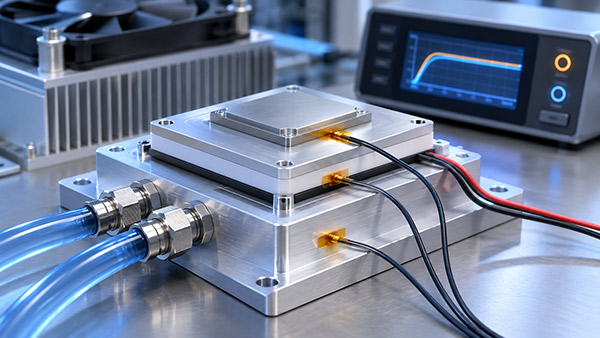
However, the achievable temperature stability depends on more than the TEC module itself. Temperature sensor position, thermal interface quality, controller response, and hot-side heat rejection all influence system behavior.
For OEM equipment designers, proper sensor integration is an important step when combining thermoelectric cooling with a liquid-cooled base.
Why Does Temperature Sensor Placement Matter?
A temperature controller adjusts electrical power according to the temperature measured by its sensor.
If the sensor is positioned far from the component that needs temperature control, it may respond more slowly or measure a temperature that differs from the critical location.
This difference can lead to inaccurate control or unnecessary temperature variation.
The correct sensor position depends on whether the application requires control of the TEC cold plate, a mounted component, or another temperature-sensitive assembly.
1. Measure the Temperature That Matters
Before choosing a sensor location, define the actual controlled temperature.
For example, an optical instrument may require a specific component temperature rather than a particular TEC surface temperature.
In this case, a sensor positioned close to the component's relevant thermal reference point may provide more useful control information.
The allowable sensor location must also respect mechanical, electrical, and product-specific requirements.
2. Consider Thermal Lag
Temperature changes take time to travel through materials and thermal interfaces.
A sensor separated from the controlled component by a thick metal section or poorly conducting interface may respond with noticeable delay.
This delay can affect control loop behavior, particularly when the heat load changes rapidly.
The sensor should therefore be placed in a location that provides representative temperature feedback without introducing unnecessary thermal delay.
3. Control Contact Between Sensor and Plate
Contact-type temperature sensors require an appropriate thermal connection to the measured surface.
Air gaps, inconsistent mounting pressure, or unsuitable installation materials may affect measurement accuracy.
Where a sensor pocket or mounting hole is required, its position should be coordinated with the cold plate structure.
For embedded tube plates, machining must not interfere with the internal coolant path.
4. Separate Control and Protection Measurements
Some equipment uses one sensor for normal temperature regulation and another independent measurement for monitoring or protective functions.
This can provide additional information about abnormal operating conditions.
However, the correct architecture depends on application risk and the required functional safety design.
A temperature sensor alone does not guarantee protection against all cooling system failures.
Understanding Temperature Control Stability
Many TEC systems use feedback controllers that adjust electrical current or power in response to measured temperature.
Some controllers use proportional-integral-derivative (PID) control.
The controller parameters influence how quickly the system approaches its target temperature and whether it overshoots or oscillates.
However, there is no universal PID setting suitable for every thermoelectric cold plate.
Controller tuning depends on thermal mass, heat load, sensor location, TEC characteristics, and hot-side cooling performance.
Temperature Sensor Placement Options
| Location | Potential Benefit | Limitation |
|---|---|---|
| Near controlled component | Represents critical application temperature | May be difficult to integrate mechanically |
| Cold plate surface | Convenient temperature feedback | May differ from component temperature |
| TEC hot-side base | Provides heat rejection information | Does not directly measure cold-side temperature |
| Coolant inlet | Monitors incoming fluid temperature | Does not represent component temperature |
| Coolant outlet | Supports system monitoring | May not detect localized hot spots |
How Hot-Side Liquid Cooling Affects TEC Control
When a TEC operates, its hot side must reject both the heat pumped from the cold side and the electrical input power.
A Liquid Cooling Plate can transfer this heat into circulating coolant.
However, changes in coolant inlet temperature or flow conditions may change the hot-side temperature.
These changes can affect TEC performance and the controller's ability to maintain the target cold-side temperature.
Therefore, temperature control testing should include realistic coolant conditions rather than assuming a constant hot-side temperature.
Thermal Interface and Mounting Requirements
Thermoelectric modules can be sensitive to uneven mechanical loading.
The hot-side mounting surface should satisfy the module manufacturer's flatness, interface, and clamping requirements.
The design must also consider differential thermal expansion between the TEC, metal cooling plate, and mounted equipment.
How to Validate Temperature Control Stability
A representative validation procedure may include:
Confirm sensor calibration and installation.
Verify the controlled temperature measurement location.
Establish steady-state operation.
Apply representative changes in thermal load.
Measure temperature overshoot and settling behavior.
Repeat testing at relevant coolant temperatures.
Evaluate condensation risk and operating limits.
The acceptance criteria should be based on the actual equipment requirements.
Custom Liquid Cooling Plates for TEC Assemblies
KINGKA manufactures custom tube liquid cold plates that can be evaluated as hot-side cooling components for suitable thermoelectric assemblies.
Plate dimensions, mounting features, embedded tube layouts, and connection locations can be reviewed according to project requirements.
Customers should provide TEC module information, expected heat loads, coolant conditions, sensor integration requirements, and mechanical drawings.
Develop a Thermoelectric Cooling Assembly
Need a custom water-cooled base for a TEC system? Share your module specifications, temperature requirements, and mechanical design with KINGKA.
Explore KINGKA Liquid Cold Plate SolutionsFrequently Asked Questions
Where should a TEC temperature sensor be installed?
The preferred location depends on the temperature that must be controlled. It should provide representative feedback from the critical component or surface.
Does a PID controller guarantee stable TEC temperature?
No. Stability depends on controller tuning, thermal lag, sensor placement, heat load, and hot-side cooling conditions.
Can a Liquid Cold Plate improve TEC control performance?
Effective hot-side heat rejection can support TEC operation, but the entire thermal and control system must be evaluated.
Should coolant temperature be monitored in a TEC system?
Coolant monitoring may be useful because changes in hot-side cooling conditions can affect TEC temperature control performance.
