




A thermoelectric cold plate uses a thermoelectric cooler, or TEC module, to transfer heat from its cold side toward its hot side. In many precision cooling applications, the electronic component or sample being cooled does not have the same contact area as the TEC module.
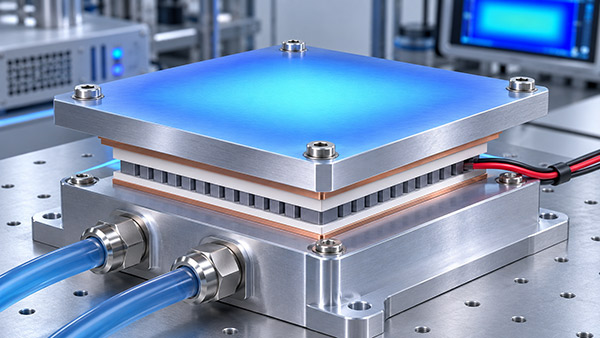
A cold-side heat spreader may be used to distribute the thermal load between the cooled object and the thermoelectric module. Its design affects contact temperature, uniformity, thermal resistance, and transient response.
What Is a Cold-Side Heat Spreader?
A cold-side heat spreader is a thermally conductive component positioned between the cooled load and the TEC cold face.
It can provide a mounting surface and help distribute heat over a larger area when the source and TEC footprints differ.
Depending on the application, the spreader may be a machined aluminum or copper plate.
It is important to distinguish this component from a water cooling plate used on the TEC hot side. The cold-side spreader distributes the heat load, while the hot-side cooling system rejects the heat pumped by the TEC together with its electrical input power.
Why Is Heat Spreading Necessary?
Some cooled components produce heat over a small area. Others require a relatively uniform temperature over a larger contact surface.
Without appropriate heat spreading, the temperature measured near the center of the TEC may differ from the temperature near the edges of the cooled assembly.
The extent of this difference depends on the heat source geometry, material conductivity, thickness, contact quality, and operating conditions.
1. Choose the Spreader Material
Aluminum
Aluminum provides useful thermal conductivity, comparatively low mass, and good machinability.
It may be suitable for larger mounting surfaces where structural weight matters.
Copper
Copper generally has higher thermal conductivity than common aluminum alloys.
It can be considered when stronger lateral heat spreading is needed within a limited footprint.
However, copper is denser and typically more expensive. Material selection should also consider the electrical, mechanical, and environmental requirements of the assembly.
2. Select a Suitable Thickness
Spreader thickness has competing effects.
A thicker plate may provide more lateral conduction area and improve temperature distribution across some load arrangements.
At the same time, increasing thickness adds conduction distance through the metal, increases mass, and can change the thermal response time.
There is no universal optimum thickness for every TEC module.
The spreader should be sized according to the actual cooled area, TEC footprint, heat load, and permitted temperature variation.
3. Control the Thermal Interfaces
There may be separate contact interfaces between the load and spreader, and between the spreader and TEC module.
Each interface introduces potential thermal resistance.
Surface flatness, interface material, mechanical loading, and the manufacturer's module requirements must be considered together.
Thermoelectric modules can be sensitive to excessive or uneven clamping forces, so mounting procedures should follow the module manufacturer's technical documentation.
4. Avoid Unnecessary Heat Leakage
Cold surfaces can absorb heat from the surrounding air, mounting brackets, electrical connections, or other structural parts.
Increasing the exposed size of a cold-side spreader may increase unwanted heat gain.
This can reduce the useful cooling capacity available for the intended load.
Where necessary, insulation and environmental control should be included in the assembly design.
Cold-Side Spreader Design Trade-Offs
| Parameter | Potential Benefit | Possible Trade-Off |
|---|---|---|
| Higher conductivity | Improved lateral heat spreading | Material weight and cost |
| Greater thickness | More spreading capability in some designs | Longer conduction path and higher thermal mass |
| Larger footprint | More load contact area | Potentially greater environmental heat gain |
| Thinner interface | Potentially lower interface resistance | Requires compatible surface and mounting conditions |
| Additional insulation | Reduced unwanted heat gain | More packaging complexity |
How Does Hot-Side Liquid Cooling Affect the Design?
The TEC hot side must reject the heat absorbed from the cooled load plus the TEC's electrical input energy.
The fundamental energy relationship is:
Qh = Qc + Pel
Here, Qh is the heat rejected at the hot side, Qc is the heat absorbed at the cold side, and Pel is the electrical input power.
A properly designed hot-side water cooling plate can help maintain the required operating condition, but it cannot correct every cold-side spreading or interface problem.
Both sides must be evaluated as one thermal system.
Prototype Validation
Testing should measure temperatures at the locations that matter to the cooled component.
When uniformity is important, engineers should evaluate several points across the cold-side surface.
Record the heat load, ambient conditions, TEC electrical input, hot-side temperature, and relevant coolant conditions.
Where the cold-side temperature falls below the surrounding air's dew point, condensation protection must also be considered.
Custom Cooling Plates for TEC Applications
KINGKA manufactures custom tube liquid cold plates for suitable thermoelectric cooling assemblies, particularly where the TEC hot side requires heat rejection into circulating coolant.
OEM customers should provide module information, thermal loads, contact dimensions, mounting requirements, and coolant conditions for review.
Develop a Water-Cooled TEC Assembly
Need a custom liquid-cooled base for thermoelectric equipment? Share your TEC specifications, heat load, and mechanical requirements with KINGKA.
Explore KINGKA Liquid Cold Plate SolutionsFrequently Asked Questions
Does a thermoelectric cold plate always need a cold-side spreader?
No. It depends on the contact geometry, cooling load, and temperature distribution requirements.
Is copper always better than aluminum for the TEC cold side?
No. Copper offers higher thermal conductivity, but weight, cost, geometry, and interface requirements also matter.
Does a thicker spreader always improve temperature uniformity?
Not necessarily. The benefit depends on geometry and operating conditions, and additional thickness introduces other thermal effects.
Can a water cooling plate replace the cold-side heat spreader?
They serve different purposes in a typical TEC assembly. A hot-side liquid plate removes rejected heat, while a cold-side spreader distributes the cooled load.
