

Custom thermal components may remain in production for several years. During that time, an OEM manufacturer may revise mounting features, change materials or modify a product's operating requirements.
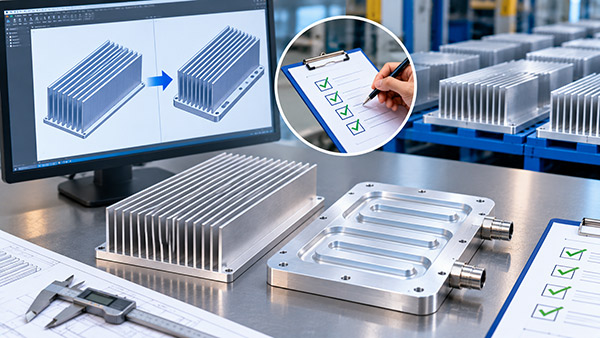
These updates can affect manufacturing even when the changes appear minor.
For extruded aluminum heatsinks, a small modification to the cross-sectional geometry may require an extrusion tooling review, while a change to a mounting hole may only affect secondary CNC machining.
Understanding the distinction is essential for repeat-order control.
1. Why Drawing Revision Control Matters
A custom heat sink is manufactured according to approved engineering information.
This information may include the 3D model, 2D drawing, material specification, critical dimensions, surface finish and inspection requirements.
If the buyer and supplier are working from different drawing revisions, the finished component may not meet the current assembly requirements.
Therefore, both sides should clearly identify the approved production version.
2. Changes to an Extrusion Profile Require Special Review
In aluminum extrusion, the die determines the continuous cross-sectional profile.
Changes to the following features may influence extrusion tooling:
Fin height and thickness.
Fin spacing and count.
Base thickness.
Cross-sectional width and shape.
Integrated mounting or structural features.
Not every geometry change can be accommodated using the existing die.
For example, increasing fin height or changing channel width may affect material flow and the manufacturability of the profile.
Before approving a new revision, the engineering team should confirm whether the existing tooling remains suitable.
The relationship between extrusion profile geometry, tooling and manufacturing limitations is explained in KINGKA's extruded aluminum heatsink manufacturing and design guide.
3. Secondary Machining Changes May Be Different
Some revisions do not alter the extruded cross-section.
For example, a change to the finished component length or the position of a mounting hole may be handled through revised cutting or CNC machining instructions.
However, manufacturing feasibility should still be reviewed.
A new hole position may leave insufficient material around a fastener or interfere with other features.
Engineers should not assume that a change is harmless simply because the extrusion die remains unchanged.
4. Material Changes Can Affect Performance
Changing the aluminum alloy or temper may influence thermal conductivity, strength, machinability and extrusion behavior.
The proposed replacement should be evaluated against the original requirements.
A different material should not be introduced into production without appropriate approval when the material is controlled by the drawing.
5. When Should Thermal Performance Be Rechecked?
Not every drawing revision requires a complete new thermal qualification.
However, modifications that affect the fin structure, heat-spreading base, mounting interface or airflow conditions may justify additional analysis or testing.
For example, reducing fin height to meet a new enclosure restriction changes the available cooling surface area.
Similarly, a modified mounting arrangement may affect the thermal contact between the heat source and the base.
The need for requalification should be determined from the actual engineering impact.
6. Manage Old and New Inventory
Engineering changes can become complicated when components from earlier production runs remain in storage.
The buyer and supplier should decide whether existing inventory can still be used or must be separated from the new revision.
Part labels, packing lists and production records should identify the relevant revision where required.
Clear implementation dates are particularly helpful when several factories or assembly sites use the same component.
7. Practical Engineering Change Workflow
Document the proposed design change.
Identify the affected dimensions and functions.
Review extrusion tooling and CNC machining implications.
Evaluate material, thermal and mechanical consequences.
Approve revised drawings and specifications.
Update manufacturing and inspection instructions.
Complete any necessary verification.
Control the transition between inventory revisions.
Frequently Asked Questions
Does changing the length of an extruded heat sink require a new die?
Not necessarily. A different cut length may be produced from the same profile if other engineering requirements are satisfied.
Can fin dimensions be changed without revising extrusion tooling?
Some changes may be possible through secondary operations, but modifying the profile cross-section generally requires a tooling review.
Should previous inventory be discarded after a drawing revision?
Not automatically. Its disposition should depend on compatibility, customer approval and the agreed change-control process.
Engineering change control is essential for reliable repeat production of custom thermal components.
For extruded aluminum heatsinks, understanding which changes affect the extrusion die and which affect only secondary operations helps OEM teams manage tooling, costs and product revisions more effectively.