

OEM electronics manufacturers often develop several products with similar cooling requirements but different power ratings, enclosure sizes and mounting arrangements. Designing a completely different heat sink for every product can increase tooling requirements, purchasing complexity and inventory management work.
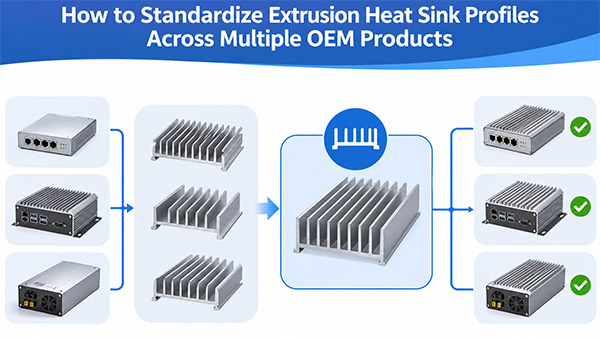
A standardized extrusion heat sink profile may offer an alternative approach. By using a common aluminum cross-section across several product variants, manufacturers can create a more consistent thermal and mechanical platform.
However, profile standardization should be based on actual engineering requirements rather than assuming that one heat sink geometry will suit every application.
What Is a Standardized Heat Sink Profile?
A standardized profile is an aluminum extrusion cross-section that can be used across a defined group of products.
The base thickness, fin height, fin spacing and overall width remain consistent, while selected secondary features may vary.
Depending on the design, different product variants may use different lengths, mounting-hole positions or machining features.
This approach allows several finished part numbers to originate from a common extrusion profile.
Why Should OEM Manufacturers Consider Standardization?
1. Reduce Unnecessary Tooling Variations
A custom extrusion profile generally requires suitable tooling.
When multiple products can use the same cross-section, it may be possible to avoid creating separate dies for every product.
Tooling reuse should be evaluated against expected production quantities and design requirements.
2. Simplify Product Development
A common profile provides a consistent starting point for related cooling assemblies.
Previously collected thermal and manufacturing data may help guide the development of new variants.
Nevertheless, each new application must still meet its own thermal and mechanical requirements.
3. Improve Purchasing Coordination
A shared material and profile specification can simplify communication between product engineering, purchasing and manufacturing teams.
Different finished components can be linked to one approved base profile while maintaining separate part numbers for their unique machining requirements.
4. Support Product Family Expansion
As an OEM introduces related equipment models, the common profile may provide a practical basis for developing additional variants.
This can be particularly useful when multiple products share similar PCB layouts or cooling orientations.
Which Features Can Be Standardized?
| Feature | Possible Standardization | Engineering Consideration |
|---|---|---|
| Aluminum alloy | Common material specification | Thermal and mechanical properties |
| Profile width | Shared cross-section | Available installation space |
| Fin geometry | Common fin height and spacing | Cooling conditions across products |
| Base thickness | Common base design | Heat spreading and mounting loads |
| Profile length | Different lengths where appropriate | Heat load and airflow |
| Mounting features | Variant-specific machining | Hole position and assembly requirements |
| Surface treatment | Common finish when suitable | Environmental and interface requirements |
How to Select a Common Profile
Step 1: Compare Product Thermal Requirements
List the expected heat load, maximum allowable temperature and available airflow for each product.
Products with very different operating conditions may not be suitable for the same cooling profile.
Step 2: Identify Shared Mechanical Constraints
Compare the available installation width, height and mounting regions across the product family.
A common profile should fit the equipment without compromising electrical clearances or assembly access.
Step 3: Evaluate the Most Demanding Applications
Determine whether the proposed profile can satisfy the products with the strictest relevant thermal requirements.
However, using an excessively large profile for every product may increase material cost and unnecessary weight.
Step 4: Define Permitted Variations
Identify which features may change without modifying the common extrusion cross-section.
For example, the finished length and mounting-hole locations may be adjusted through secondary manufacturing operations.
Step 5: Validate Each Finished Configuration
Each product variant should be tested or otherwise qualified according to its application requirements.
Successful testing of one length or mounting arrangement does not automatically qualify every configuration.
Example of a Modular Heat Sink Product Family
Consider an illustrative OEM platform containing three industrial controller models.
Each model uses a similar enclosure width but generates a different amount of heat.
Instead of designing three completely different extrusion cross-sections, engineers may investigate one common aluminum profile with different finished lengths.
| Product | Profile Strategy | Required Review |
|---|---|---|
| Controller A | Shorter finished profile | Thermal and assembly verification |
| Controller B | Intermediate finished profile | Thermal and dimensional verification |
| Controller C | Longer finished profile | Cooling, airflow and structural verification |
This is an example of a product development strategy, not a guarantee that profile length alone can accommodate different heat loads.
Changes in airflow distribution, heat source location or mounting structure may make a different cross-section necessary.
How Does Standardization Affect Manufacturing Cost?
Potential benefits may include reduced tooling variation, simpler raw profile purchasing and better coordination of related part numbers.
However, the economics depend on actual demand.
A common profile that requires extensive secondary machining for each product may be more expensive than a purpose-designed alternative.
Likewise, a large shared profile may consume unnecessary aluminum in smaller products.
Total cost should consider tooling, profile mass, machining, surface finishing, inspection, inventory and product performance.
Managing Part Numbers and Drawing Revisions
A common extrusion profile and its finished product variants should have a clear identification structure.
For example, the base profile can be controlled through a master drawing while each finished part has its own machining drawing and revision.
If the shared profile changes, engineers should review the effect on every dependent product.
This helps reduce the risk of introducing an unapproved change into multiple equipment variants.
Custom Extrusion Heat Sink Manufacturing with KINGKA
KINGKA provides custom heat sink extrusion solutions for OEM electronics, industrial power equipment and other thermal management applications.
Available options include customized aluminum profiles, CNC-machined mounting features, different finished dimensions and surface finishing.
For manufacturers developing multiple related products, sharing the thermal and mechanical requirements for the entire product family can support a more complete manufacturing feasibility review.
Develop a Modular Heat Sink Product Family
Need aluminum heatsinks for several related OEM products? Share your profile requirements, equipment drawings, thermal targets and expected annual demand with KINGKA.
Explore KINGKA Extrusion Heat Sink ManufacturingFrequently Asked Questions
Can different OEM products use the same extrusion heat sink profile?
Yes, when the common cross-section meets each product's cooling and mechanical requirements.
Can one extrusion profile be manufactured in different lengths?
Yes. Different lengths can be produced through cutting, subject to thermal, mechanical and manufacturing requirements.
Does a standardized profile reduce tooling costs?
It may reduce the need for separate dies, but the overall cost depends on production volume and secondary manufacturing requirements.
Should each heat sink variant have a separate drawing?
Maintaining controlled finished-part specifications is recommended, even when several variants share the same base extrusion profile.