




One of the first purchasing decisions in an OEM cooling project is whether to select an existing extruded aluminum heatsink or invest in a custom extrusion profile.
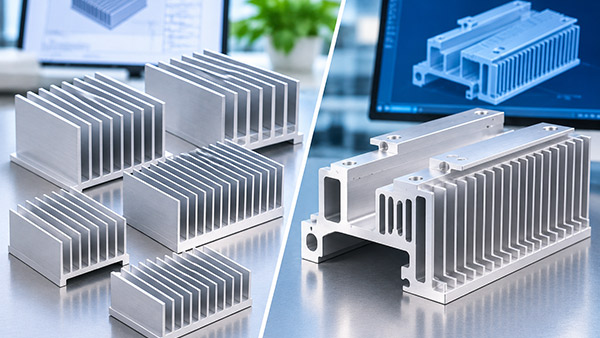
A standard heatsink may reduce initial tooling requirements and support faster prototype development. A custom profile, however, can be designed around specific thermal, mechanical and assembly requirements.
Neither option is automatically more economical. The right choice depends on the entire product program rather than the heatsink's unit price alone.
1. When Does a Standard Extruded Heatsink Make Sense?
Standard aluminum heatsinks are attractive when an existing profile already satisfies the thermal requirements and fits within the available mechanical space.
They may be particularly useful for:
Early-stage product development.
Low-volume or uncertain demand.
Applications with flexible mounting layouts.
Projects requiring several design iterations.
Equipment using common cooling configurations.
However, standard does not always mean ready to install. Cutting, drilling, tapping or other machining may still be necessary.
2. When Should an OEM Consider a Custom Profile?
A custom extrusion becomes worth evaluating when an available profile creates compromises that affect the finished equipment.
Examples include excessive weight, incompatible mounting geometry, unused space, or inadequate thermal performance within the required enclosure.
A dedicated profile can combine the required base and fin geometry into one continuous aluminum extrusion, subject to manufacturing feasibility.
However, it normally introduces upfront die development and qualification work.
3. Compare the Cost Across the Product Program
Instead of comparing only the initial part price, OEM buyers should calculate the estimated total cost over the expected production volume.
A simplified evaluation is:
Total program cost = Nonrecurring tooling and qualification costs + Recurring finished-part costs
For a standard profile, the recurring cost may include substantial secondary machining if the shape does not match the final assembly.
For a custom extrusion, the upfront tooling cost may be higher, but recurring machining or material use may be reduced if the design is appropriately optimized.
The actual financial crossover depends on supplier quotations, quantity, tooling life, material use and design stability.
4. A Practical Decision Matrix
| Decision Factor | Standard Profile | Custom Profile |
|---|---|---|
| Initial tooling | May avoid new die development | New tooling may be required |
| Thermal geometry | Limited to available profiles | Designed for the application |
| Prototype changes | Often simpler to evaluate alternatives | Major profile revisions can affect tooling |
| Mechanical fit | May need additional machining | Can be designed around the assembly |
| Repeat production | Depends on profile availability | Depends on controlled tooling and supply |
5. What If Production Demand Is Uncertain?
When the annual forecast is uncertain, it may be sensible to validate the thermal and mechanical requirements using a suitable existing profile before committing to custom tooling.
This can help the engineering team identify whether the primary limitation is thermal performance, airflow, available space or mechanical integration.
Once the design becomes more stable, the team can evaluate whether dedicated extrusion tooling offers a meaningful benefit.
This approach does not guarantee lower cost, but it can reduce the risk of committing to a profile before the product requirements are understood.
6. Questions to Ask heat sink manufacturers
Do you have an existing profile close to our required dimensions?
What additional machining would it need?
What are the estimated costs of a dedicated extrusion die?
Can the proposed custom fin geometry be manufactured?
How would lead time differ between the two approaches?
What qualification would be necessary before repeat production?
7. Evaluating a Custom Manufacturing Partner
A suitable supplier should be able to explain the manufacturing trade-offs rather than automatically recommending the most complex option.
KINGKA's custom thermal manufacturing services cover aluminum heat sinks and related precision metal components for OEM applications.
Buyers can also review the extruded aluminum heatsink product range when evaluating standard and custom profile requirements.
Frequently Asked Questions
Is a custom extrusion always cheaper for high-volume production?
No. It may reduce recurring costs, but the result depends on tooling expense, geometry, machining requirements and production volume.
Can a standard heat sink profile be modified?
Selected features can often be created through secondary machining, but changing the original cross-section generally requires a separate feasibility review.
When should a custom extrusion die be approved?
Ideally, after the key thermal, mechanical and commercial requirements are sufficiently stable and the proposed design has passed a manufacturing feasibility assessment.
Conclusion
The choice between standard and custom aluminum heatsinks should be based on program economics, engineering fit and production risk.
For some OEM projects, a standard profile offers the most practical solution. For others, custom aluminum heat sink extrusion can provide better integration and repeat-production economics.
Making the decision with reliable drawings, technical requirements and realistic forecasts is more valuable than selecting either option by default.
Compare Standard and Custom Thermal Solutions
Share your drawings, thermal requirements and expected production volume for a manufacturing feasibility discussion.
Explore KINGKA Thermal Manufacturing