




A skiving heat sink is manufactured by cutting and raising thin fins from a solid metal workpiece. Unlike a bonded fin assembly, the fins remain part of the original base material, creating a continuous metal structure.
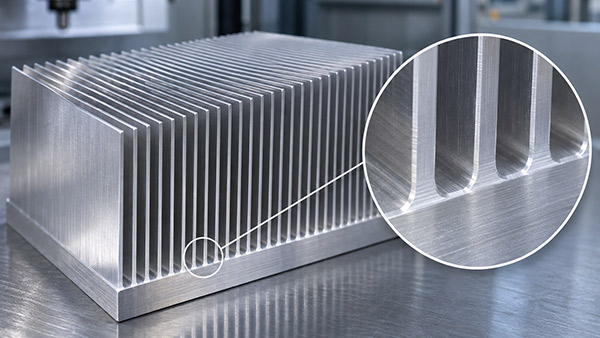
While this manufacturing approach avoids a separate fin-to-base joining interface, it introduces its own process considerations. One of the most important is the condition of the fin root, where each raised fin connects to the remaining base.
For OEM engineers, understanding fin root integrity helps distinguish a visually acceptable skived heatsink from one that has been adequately evaluated for its intended mechanical and thermal requirements.
1. What Is the Fin Root in a Skived Fin Heat Sink?
The fin root is the transition region between a raised fin and the heat sink base.
During skiving, the cutting tool removes and raises a controlled portion of the parent metal to form a fin. The formed fin remains connected to the base through material that has undergone the cutting and forming process.
This region is important because heat travels through the root into the fin, and mechanical loads on the fin are transmitted through the same connection.
Therefore, the root geometry and material condition deserve attention during process development.
2. Why Material Condition Matters
Aluminum and copper can both be used for skived fin manufacturing, but they have different mechanical and thermal properties.
The alloy, purity, temper and workpiece condition can influence how the material responds during cutting and fin formation.
For example, changing the material condition may affect forming resistance, the resulting fin shape and the forces required by the process.
Manufacturers should therefore evaluate skiving parameters against the specified material grade rather than assuming that every aluminum or copper workpiece behaves identically.
3. Tool Geometry and Fin Formation
The skiving tool and process setup influence the resulting fin geometry.
Important process considerations can include tool condition, cutting depth, tool geometry, workpiece support and the intended fin dimensions.
If these conditions are unsuitable, the finished geometry may differ from the design or show localized surface irregularities.
The manufacturing process should be developed to produce consistent fins without unacceptable deformation or root damage.
Very thin, tall fins may require additional attention because the resulting structures are comparatively delicate.
4. What Types of Root Problems Should Be Investigated?
Depending on the material and manufacturing conditions, potentially relevant observations may include:
Localized tearing near the fin root.
Unintended cracking or discontinuities.
Inconsistent fin formation.
Excessive deformation near the base.
Irregular geometry affecting neighboring fins.
Damage introduced during subsequent machining or handling.
Not every visible process mark is automatically a defect. Acceptance should be based on controlled design requirements and the actual manufacturing process.
Where structural integrity is critical, the inspection approach should be capable of evaluating the relevant features.
5. How Fin Root Geometry Influences Heat Transfer
Heat travels from the base into the fin through the continuous metal connection.
Although skiving avoids a separate bonded interface, the effective conduction path still depends on fin geometry, material properties and the thermal loading of the assembly.
The fin root is part of this conduction path. Its geometry and continuity should therefore be considered when evaluating manufacturing quality.
However, an acceptable root does not by itself guarantee low overall thermal resistance. Convection, fin efficiency and heat spreading remain significant parts of the complete cooling system.
6. How Should Manufacturers Inspect Fin Roots?
Inspection methods should be selected according to the relevant feature and required accuracy.
Possible approaches include:
Visual inspection of representative fin regions.
Optical magnification where smaller features require review.
Dimensional evaluation of fin geometry.
Destructive cross-section analysis when appropriate for process qualification.
Application-specific mechanical or thermal qualification.
Destructive testing is not automatically required for every production batch. Its use should depend on engineering risk, qualification needs and agreed inspection requirements.
7. What Should OEM Buyers Specify?
When requesting a custom skived fin component, buyers should identify the material grade, fin geometry and any special mechanical reliability requirements.
If the equipment is exposed to vibration, repeated handling or other demanding service conditions, those requirements should be disclosed before production approval.
This allows the manufacturer to evaluate whether the proposed fin structure and inspection approach are appropriate.
8. KINGKA Custom skiving heat sink Manufacturing
KINGKA supplies custom aluminum and copper skived heat sink solutions for industrial electronics and high-density cooling applications.
Engineers evaluating a precision skiving heat sink can review material and geometry options and submit drawings for manufacturing feasibility assessment.
For demanding projects, relevant root-quality and reliability requirements should be defined during technical review rather than introduced only after prototype completion.
Frequently Asked Questions
Are skived fins bonded to the heat sink base?
No. Conventional skiving creates fins from the original metal workpiece, leaving an integral connection between the fins and the base.
Can fin root defects affect reliability?
Potentially. The significance depends on the defect, geometry, applied loads and intended operating environment.
Is visual inspection sufficient for every skived heatsink?
Not necessarily. Some applications may require additional dimensional or process qualification methods.
Fin root integrity is an important consideration in skiving heat sink manufacturing. It connects the material forming process with the finished part's thermal path and mechanical behavior.
By controlling material selection, cutting conditions and inspection requirements, manufacturers can establish a more reliable basis for custom skived fin production.
Developing a Precision Skiving Heat Sink?
Submit your fin dimensions, material requirements, engineering drawings and operating conditions for a custom manufacturing review.
View KINGKA Skived Fin Solutions