




When designing a skived heatsink, engineers usually focus on fin thickness, pitch, material and airflow. Surface finishing is often considered later, but it can influence corrosion resistance, product appearance, dimensional requirements and contact-surface preparation.
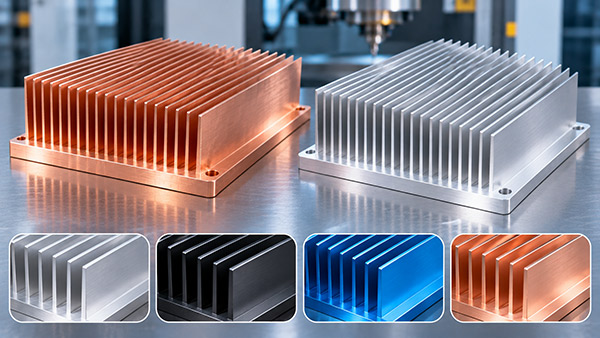
Both copper and aluminum skived fin heat sinks can be supplied with different finishing options. However, the appropriate treatment depends on the base metal, operating environment and intended assembly.
A surface finish should be selected for a specific engineering purpose rather than assuming that every coating will improve thermal performance.
1. Why Does a Skived Fin Heat Sink Need Surface Treatment?
Depending on the application, surface finishing may help address:
Corrosion protection.
Appearance and product identification.
Surface oxidation concerns.
Electrical contact or insulation requirements.
Material compatibility within an assembly.
Customer-specific finishing specifications.
However, not every heat sink needs a decorative or protective coating.
In controlled environments, a suitable bare-metal finish may satisfy the relevant product requirements.
2. Anodizing Aluminum Skived Heatsinks
Anodizing is commonly used on aluminum components to form a controlled oxide layer on the surface.
It may be selected for corrosion protection, appearance or other application-specific requirements.
Clear and black anodizing are both familiar options in heat sink manufacturing.
However, the final characteristics depend on the anodizing process and specification.
Does Black Anodizing Improve Cooling?
A darker, high-emissivity surface can improve the radiative heat transfer contribution compared with some bright metallic surfaces under suitable conditions.
However, the importance of radiation depends on surface temperature, surroundings and the overall cooling system.
In a fan-cooled skived heatsink, forced convection may dominate the heat transfer. Black anodizing should therefore not be assumed to produce a large reduction in component temperature without testing.
Consider the Contact Surface
Anodized aluminum surfaces have different electrical and thermal interface characteristics from bare aluminum.
If a design requires a specified metal-to-metal contact or electrical continuity, the coating requirements and any masking areas should be defined.
Contact regions should be evaluated with the intended thermal interface material and mounting method.
3. Nickel Plating for Copper Skived Heatsinks
Copper offers high thermal conductivity but can develop surface oxidation and discoloration under environmental exposure.
Nickel plating may be specified where surface protection or other coating characteristics are desired.
For skived copper heat sinks, the coating process should be selected with the thin-fin geometry in mind.
Closely spaced fins may create challenges for achieving the intended coating distribution, depending on the plating process and part design.
Therefore, coating requirements should be reviewed for manufacturability rather than specifying a nominal thickness without considering the geometry.
4. Can Surface Coatings Affect Heat Transfer?
Yes, but the effect depends on where the coating is located and how the heat sink operates.
At a device contact surface, additional layers may influence the thermal interface and electrical characteristics.
On the fins, surface finish can affect radiative behavior and may influence the surface condition.
The overall performance depends on the complete assembly, and a surface treatment cannot compensate for inadequate fin geometry or poor airflow.
5. Comparing Common Surface Finish Options
| Finish | Typical Consideration | Engineering Attention |
|---|---|---|
| Bare aluminum | No additional decorative coating | Surface condition and environmental suitability |
| Clear anodized aluminum | Protective oxide finish | Contact surfaces, coating specification and dimensions |
| Black anodized aluminum | Protective finish and darker appearance | Emissivity, masking and actual thermal benefit |
| Bare copper | High-conductivity exposed metal | Oxidation and handling conditions |
| Nickel-plated copper | Protective metallic finish | Coating coverage, thickness and contact requirements |
These comparisons are general considerations. The final choice should follow the actual component specification and service conditions.
6. Why Thin Skived Fins Require Special Attention
A skiving heat sink may contain many closely spaced, relatively thin fins.
The fin array can be vulnerable to mechanical damage if parts are handled or fixtured incorrectly during finishing operations.
Coating and cleaning processes should also be compatible with the material and fin geometry.
For particularly narrow channels, the supplier should confirm whether the selected process can achieve the required surface condition throughout the relevant areas.
7. How to Specify Surface Finish on Drawings
Instead of writing only "black finish" or "nickel coating," OEM drawings should identify the necessary requirements.
Depending on the project, these may include:
Base material and alloy.
Required finishing process and applicable specification.
Coating thickness or other relevant acceptance criteria.
Areas to be coated or masked.
Surface appearance requirements.
Electrical contact requirements.
Thermal interface conditions.
These details help prevent disagreements between purchasing, manufacturing and assembly teams.
8. Custom Skived Heatsink Surface Finishing at KINGKA
KINGKA provides custom aluminum and copper skived heat sink manufacturing, with surface finishing options dependent on the selected design and material.
Customers can review available copper and aluminum skived heatsink solutions and provide their coating, contact-surface and environmental requirements for technical evaluation.
Frequently Asked Questions
Is black anodizing always better for heat dissipation?
No. Its benefit depends on the importance of radiation and the actual cooling conditions. Representative testing is recommended where performance differences matter.
Can copper skived fins be nickel plated?
Nickel plating is a possible finishing option, subject to the geometry and required coating specification.
Should the entire mounting surface be anodized?
Not automatically. The thermal interface, electrical function and assembly requirements should determine any masking or coating restrictions.
Conclusion
Surface finishing is an engineering decision that should be made alongside material selection and mechanical design.
By defining coating requirements early, OEM engineers can avoid unnecessary finishing costs and ensure that the finished skived heatsink meets its environmental and assembly requirements.
Need a Custom Surface Finish?
Submit your material, fin geometry, coating and thermal interface requirements for a customized skived heat sink review.
Explore KINGKA Skived Heatsink Options