

A skived fin heat sink is often selected because its thin, closely spaced fins provide a large cooling surface within a compact footprint. However, fin density is only one part of the thermal design. Before heat reaches the fins, it must travel through the mounting interface and spread through the heat sink base.
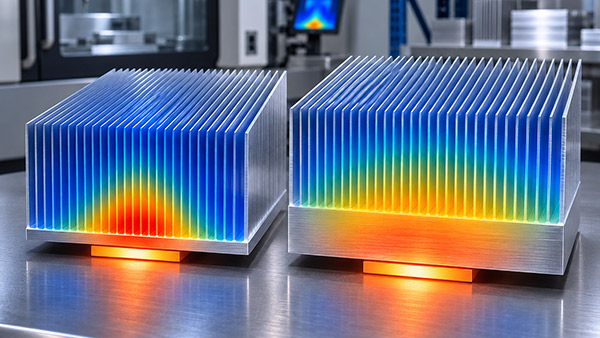
For applications involving CPUs, power semiconductors, industrial controllers and concentrated electronic heat sources, the thickness of the base can influence how effectively heat reaches the fin array.
Choosing the thinnest possible base may reduce weight and material cost, but it does not necessarily provide the best thermal performance.
1. Why Heat Spreading Matters in a skived heatsink
In many electronic assemblies, the heat source occupies only a small portion of the heat sink footprint.
For example, a semiconductor module may transfer heat through a localized mounting surface, while the skived fin array extends across a much larger area.
Heat must spread laterally through the base before all regions of the fin array can contribute effectively to cooling.
If heat remains concentrated near the source, fins located farther away may operate at lower temperatures and contribute less to total heat dissipation.
A suitable base design can help distribute heat across a larger portion of the available cooling surface.
2. How Does Base Thickness Affect Thermal Performance?
Thin Base Design
A relatively thin base offers lower material usage, reduced mass and potentially lower cost.
It may be suitable when the heat source occupies a large area relative to the heat sink footprint or when thermal spreading requirements are modest.
However, a thin base may provide less lateral conduction area for distributing concentrated heat.
Thicker Base Design
Increasing base thickness can provide additional cross-sectional area for lateral heat conduction and may improve structural stiffness.
This can be useful when a compact heat source must transfer heat into a larger fin array.
However, additional thickness also increases the conduction distance from the device to the fins and adds mass. Once spreading is sufficient, further increases may provide little benefit.
3. Copper vs Aluminum for Base Heat Spreading
Material selection is another important consideration.
Copper generally provides higher thermal conductivity than common aluminum heat sink alloys. This can make copper attractive for applications involving concentrated heat input.
However, copper also has greater density and typically higher material cost.
Aluminum may offer a more practical balance of thermal performance, weight and manufacturing cost for many OEM products.
The best material cannot be selected from conductivity alone. Engineers should evaluate total heat sink dimensions, weight restrictions, operating temperatures and required airflow.
4. Base Thickness and Mechanical Stiffness
The base also serves as the structural mounting surface.
Screw fastening, spring clips and other attachment systems can introduce mechanical loads into the heat sink.
If the base is too flexible for the mounting arrangement, it may deform under assembly pressure and influence the thermal interface.
For this reason, the heat sink design should account for:
Mounting-hole locations and fastener loads.
Required contact-surface flatness.
Thermal interface material thickness.
Available space beneath the fin array.
Mechanical stiffness around mounting features.
Base thickness should not be optimized for thermal performance without considering the installation method.
5. Does a Thicker Base Always Improve Cooling?
No. A thicker base may provide better lateral spreading in some designs, but additional metal does not automatically reduce the final component temperature.
The benefit depends on the original heat distribution and the resistance of the complete cooling system.
If airflow through the fin channels is inadequate, increasing the base thickness may have little effect on the dominant thermal limitation.
Similarly, if the heat source already covers most of the heat sink footprint, additional lateral spreading capacity may offer limited improvement.
6. How to Evaluate the Best Base Thickness
For a custom design, engineers can compare several base thickness options using thermal analysis and representative prototype testing.
Useful evaluation conditions include:
Actual or representative heat source dimensions.
Expected continuous and peak heat loads.
Thermal interface material and mounting pressure.
Selected aluminum or copper grade.
Fin dimensions and airflow conditions.
Maximum allowable component temperature.
Comparisons should use equivalent operating conditions so that the effect of base thickness can be evaluated separately from unrelated design changes.
7. Custom Skived Fin Heat Sink Manufacturing
KINGKA develops aluminum and copper skived heat sinks for custom electronics cooling applications.
OEM engineers can review the available options for a custom skived fin heat sink and provide their base dimensions, thermal requirements and installation drawings for manufacturing feasibility evaluation.
A useful drawing should identify the required base thickness and contact surface, rather than specifying only the fin dimensions.
Frequently Asked Questions
What is the ideal base thickness for a skived heatsink?
There is no universal value. The appropriate thickness depends on heat source dimensions, material, thermal load, mounting requirements and available space.
Is a copper skiving heat sink always better than aluminum?
No. Copper offers higher thermal conductivity, but aluminum may be more suitable where weight, cost and other design constraints are important.
Can base thickness affect component mounting?
Yes. It influences stiffness and can affect how the base responds to mounting forces and contact pressure.
Base thickness is an important design parameter in a skived fin heat sink, particularly when the heat source is much smaller than the cooling surface.
By evaluating lateral heat spreading, material selection and mounting stiffness together, engineers can choose a base configuration suited to the actual electronics assembly rather than relying on fin density alone.
Need a Custom Skived Fin Heat Sink?
Submit your thermal load, heat source footprint, base thickness requirements and CAD drawings for an OEM manufacturing review.
Explore KINGKA Skived Fin Heat Sinks