




Industrial power electronics frequently use several heat-generating devices within one assembly.
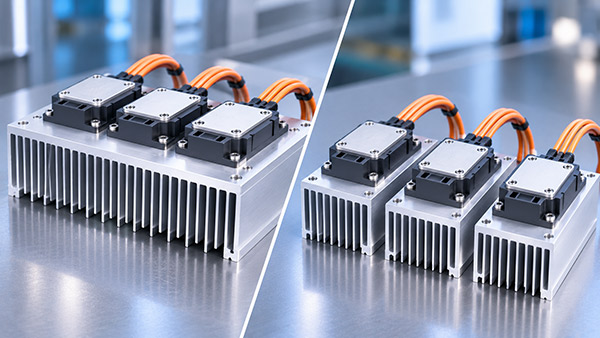
Depending on the layout, these components may be mounted to a single large extruded heat sink or cooled by separate aluminum heatsinks.
Both arrangements can be practical. However, choosing between them affects thermal coupling, mounting requirements, airflow and maintenance.
OEM engineers should make this decision using the complete power module layout rather than selecting the option with the fewest parts.
1. What Is a Shared heat sink?
A shared heat sink uses one metal cooling structure to remove heat from multiple components.
For example, several power semiconductor modules may be mounted along a common extruded aluminum base.
Heat from each module enters the same metal body and is transferred to the surrounding air through its fins.
This can create a compact mechanical arrangement, but the temperatures of the mounted devices may influence one another.
2. The Main Benefit: Fewer Mechanical Components
A shared extruded heat sink may reduce the number of separate cooling parts, brackets and mounting operations.
The design may also simplify alignment when several devices can use a common mounting surface.
For OEM production, fewer components can reduce certain assembly operations and inventory management tasks.
However, the size and weight of the shared heat sink may introduce other mechanical requirements.
The overall cost advantage should be evaluated rather than assumed.
3. What Is Thermal Coupling?
Thermal coupling occurs when heat produced by one component influences the temperature of another through a shared conductive structure.
If several devices are mounted on the same aluminum base, the temperature distribution depends on their positions, heat loads and the heat sink geometry.
For example, one high-power device may heat a section of the base close to another temperature-sensitive component.
This can create operating conditions that would not occur if the devices used separate heat sinks.
Engineers should evaluate simultaneous and uneven heat loads, not only the combined nominal power.
4. When Are Separate Heatsinks More Attractive?
Separate aluminum heatsinks may be useful when components have very different cooling requirements or when their locations make a shared structure impractical.
They may also allow individual components to be replaced without removing one large common heatsink, depending on the assembly design.
However, separate components require their own mounting arrangements and sufficient airflow.
Using several small heatsinks may also increase installation complexity or create unwanted airflow interference.
5. Electrical Isolation Is a Critical Consideration
Many power semiconductor packages have mounting surfaces or exposed metal regions with specific electrical characteristics.
Before several devices share a conductive heatsink, the electrical design must determine whether isolation is required.
Some assemblies use electrically insulating thermal interface materials or insulated device packages.
The correct approach depends on device specifications, operating voltages and applicable safety requirements.
Thermal performance and electrical safety must be considered together.
6. Compare Airflow and Heat Spreading
A large shared extrusion may provide a continuous fin array and a broad mounting surface.
However, the airflow must reach the relevant regions of the heatsink.
Depending on the fan and enclosure arrangement, the fins near one device may experience different cooling conditions from those near another.
Separate heatsinks may allow more targeted airflow, but they also require space for individual cooling paths.
Both designs should be evaluated under representative system conditions.
7. Shared vs Separate Heatsink Decision Matrix
| Factor | Shared Heatsink | Separate Heatsinks |
|---|---|---|
| Component count | Potentially fewer cooling parts | More individual components |
| Thermal coupling | Devices influence common base temperature | Usually less direct conductive interaction |
| Electrical isolation | Must evaluate each device on common metal | Still requires device-level evaluation |
| Assembly | Common mounting alignment | Independent mounting interfaces |
| Service | Removal may affect several devices | Some devices may be serviced separately |
| Airflow | Requires distribution across the fin array | Requires suitable flow to each heatsink |
8. What Should Be Tested Before Approval?
Useful prototype evaluation may include:
Each device operating at its maximum relevant heat load.
All devices operating together.
Uneven heating scenarios.
Actual enclosure and airflow conditions.
Thermal interface and mounting conditions.
Electrical isolation and safety requirements.
Temperature measurements should be taken at locations that represent the relevant device limits.
9. Custom Extruded Heat Sink Manufacturing
Custom aluminum extrusion can provide different profile lengths and mounting arrangements while maintaining a continuous base-and-fin structure.
KINGKA provides custom heat sink manufacturing solutions for industrial electronics and OEM thermal management applications.
Engineers can review available extrusion heat sink options and submit their complete component layout for design and manufacturing evaluation.
Frequently Asked Questions
Can several IGBT modules share one aluminum heatsink?
Potentially, if the thermal, electrical, mechanical and mounting requirements permit it. The design must be validated for the actual module configuration.
Does a shared heatsink always reduce cost?
No. It may reduce component count, but size, machining, mounting and assembly requirements can change the total cost.
Are separate heatsinks thermally independent?
Not completely. They may still interact through surrounding airflow, enclosure temperature and nearby structures.
The decision between one shared extruded heat sink and several individual aluminum heatsinks depends on the complete equipment design.
Shared cooling can simplify some mechanical arrangements, while separate heatsinks can provide greater independence for selected components.
Thermal coupling, electrical isolation, airflow and serviceability should determine the final choice.
Designing Cooling for Multiple Power Devices?
Share your power module layout, heat loads and mounting requirements for a custom thermal manufacturing review.
Explore KINGKA Thermal Solutions