




Industrial power electronics often contain several heat-generating modules that require liquid cooling. Rather than using a separate cooling system for every component, engineers may connect multiple cold plates to a shared coolant circuit.
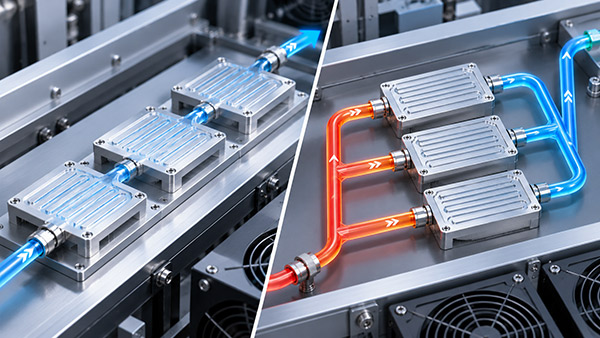
Two common arrangements are series and parallel connections. Both can support Cold Plate Liquid Cooling, but they produce different flow conditions, pressure-drop requirements, and coolant temperature distributions.
Understanding these differences helps OEM manufacturers select a circuit layout suited to their equipment.
What Is a Series Cold Plate Connection?
In a series arrangement, coolant flows through one cold plate and then continues directly into the next.
All plates in the series branch experience the same mass flow rate during steady operation, assuming no bypass paths or leaks.
However, the coolant absorbs heat as it travels through each plate.
Consequently, the coolant entering a downstream plate may be warmer than the coolant entering the first plate.
This temperature difference can affect the cooling performance of the later modules.
Advantages of Series Cooling
Relatively straightforward fluid routing.
No separate flow-balancing manifold is necessarily required.
Similar flow through each plate in the same branch.
Potentially fewer parallel branch connections.
These advantages can make series arrangements practical for selected equipment layouts.
Limitations of Series Cooling
The total pressure drop includes the losses of all cold plates and connecting components in the series path.
This can increase the pressure required to maintain the intended flow.
Furthermore, downstream plates receive coolant that has already absorbed heat from upstream equipment.
The resulting temperature increase must be included in the thermal design.
What Is a Parallel Cold Plate Connection?
In a parallel arrangement, a supply manifold distributes coolant into separate branches.
Each branch contains one or more cold plates, and the flows rejoin downstream.
This arrangement allows different modules to receive coolant from a common supply at relatively similar inlet temperatures, subject to manifold design and actual operating conditions.
However, equal inlet temperature does not automatically mean equal branch flow.
Why Does Flow Balancing Matter?
In a parallel network, coolant distribution depends on the hydraulic resistance of each branch.
A branch with lower resistance may receive more flow than a more restrictive branch.
If the difference is significant, some modules may receive insufficient cooling.
Engineers may need to adjust tube dimensions, routing, manifolds, or suitable flow-control elements to obtain the required distribution.
Series vs Parallel Cooling Comparison
| Factor | Series Cooling | Parallel Cooling |
|---|---|---|
| Coolant flow | Same flow through each component in one path | Total flow divided between branches |
| Inlet temperature | Usually increases downstream | Can be similar across branches |
| Pressure drop | Losses accumulate along the common path | Depends on branch and manifold resistance |
| Flow balancing | Usually not required between series components | May be necessary between branches |
| Plumbing | Potentially simpler | Requires supply and return distribution |
| Thermal design | Account for progressive coolant heating | Account for branch flow distribution |
Illustrative Coolant Temperature Rise
The coolant temperature rise through a cold plate can be estimated using:
ΔT = P / (m × Cp)
Where:
P = heat transferred to the coolant, W.
m = coolant mass flow rate, kg/s.
Cp = coolant specific heat, J/(kg·K).
Assume one cold plate transfers 200 W to water flowing at approximately 2 L/min.
Using a water density of approximately 1 kg/L and a specific heat of 4,180 J/(kg·K):
ΔT ≈ 200 / (0.0333 × 4,180)
ΔT ≈ 1.44°C
Under these simplified assumptions, the coolant warms by approximately 1.44°C through one plate.
If three identical plates are connected in series and the flow remains 2 L/min, the total coolant temperature rise from the three 200 W loads would be approximately 4.3°C.
This calculation estimates bulk coolant heating. It does not directly predict component temperature or account for heat exchange with the surroundings.
How to Select the Right Cooling Arrangement
Use Series Cooling When Appropriate
A series arrangement may be practical when the downstream coolant temperature rise is acceptable and the pump can overcome the combined hydraulic resistance.
Consider Parallel Cooling for Different Thermal Requirements
A parallel arrangement may be preferable when several modules require similar coolant inlet temperatures or when individual branches need different flow rates.
Evaluate Hybrid Cooling Systems
Some equipment uses parallel branches containing multiple cold plates in series.
Such hybrid designs can balance plumbing complexity, hydraulic resistance, and thermal requirements.
What Should OEM Buyers Specify?
Before selecting the final circuit arrangement, engineers should define:
Number of cold plates.
Heat load of each module.
Maximum allowable component temperatures.
Coolant supply temperature.
Available total flow and pump pressure.
Permitted pressure drop.
Required branch monitoring or flow control.
The complete circuit should be analyzed and tested at representative operating conditions.
Custom Cold Plate Liquid Cooling with KINGKA
KINGKA provides custom tube liquid cold plate solutions for industrial power electronics and other liquid-cooled equipment.
Plate dimensions, embedded tube routing, and coolant connection positions can be reviewed according to project requirements.
For equipment containing multiple cooling plates, customers should provide the complete flow arrangement and thermal specifications for manufacturing review.
Develop a Multi-Module Liquid Cooling System
Need several customized cold plates for one industrial cooling circuit? Share your system layout, flow requirements, and module heat loads with KINGKA.
Explore KINGKA Tube Cold Plate ManufacturingFrequently Asked Questions
Is parallel cooling always better than series cooling?
No. The preferred arrangement depends on thermal requirements, pressure losses, pump capacity, and the available system layout.
Do parallel cold plates always receive equal flow?
No. Flow distribution depends on the resistance of each branch and the manifold arrangement.
Can different-sized cold plates share one cooling loop?
Yes, when flow distribution, pressure losses, temperatures, and system compatibility are properly engineered.
Can a tube cold plate be used in both series and parallel circuits?
Yes. Suitability depends on the individual plate's hydraulic and thermal characteristics and the complete circuit design.
