

After choosing an extruded aluminum heatsink design, an OEM purchasing team faces another decision: should it buy the aluminum extrusion profile and complete the remaining operations internally, or order finished heatsinks ready for assembly?
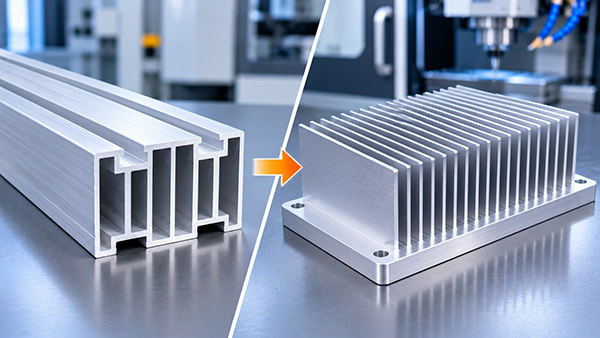
Both sourcing models are used in industrial manufacturing. The better option depends on machining capacity, quality requirements, inventory management and the total cost of the supply chain.
Comparing only the supplier's price per kilogram or price per extrusion length can lead to an incomplete purchasing decision.
1. What Is a Raw heat sink extrusion Profile?
A raw extrusion profile is the aluminum shape created through the extrusion process before all finishing operations required by the application are complete.
Depending on the supplier and order specification, it may be delivered as a long profile or cut into selected lengths.
Additional work may still be needed to create a usable thermal component.
Typical operations include drilling, tapping, machining the thermal contact surface, deburring, cleaning and applying a surface finish.
2. What Is a Fully Finished extruded heat sink?
A finished extruded heat sink is supplied in the agreed installation-ready condition.
For an OEM electronics application, this may include the final cut length, mounting holes, threads, precision surfaces and specified finishing.
However, the term "finished" must be clearly defined in the purchase specification.
For example, one buyer may expect an anodized component with clean machined mounting surfaces, while another may need an unfinished but fully machined part.
3. When Does Buying Raw Extrusion Make Sense?
Purchasing raw aluminum heatsinks or profiles may be appropriate when an OEM already has suitable machining equipment and established processes.
Advantages may include:
Greater control over local machining schedules.
Flexibility to produce multiple finished variants from one profile.
Ability to manage certain design changes internally.
Use of existing inspection and finishing capabilities.
However, these benefits depend on available capacity and process capability.
Internal machining still requires operators, tooling, fixtures, programming, inspection and management of scrap.
4. When Is Finished-Part Purchasing More Practical?
Finished-component sourcing can simplify the OEM's internal manufacturing flow.
Instead of purchasing a raw profile and moving it through several local processes, the buyer receives a component manufactured to the approved drawing.
This may be useful when the OEM does not specialize in aluminum machining or when assembly teams need parts with consistent mounting and surface requirements.
However, the supplier must be able to perform or coordinate the required secondary operations and demonstrate conformity to the finished-part specification.
5. Compare Total Processing Cost
A useful comparison should include all operations between raw material receipt and the point when a part is ready for installation.
| Cost Factor | Raw Profile Purchase | Finished Part Purchase |
|---|---|---|
| Extrusion material | Included in profile price | Included in finished price |
| Cutting and machining | Handled by buyer or subcontractor | Included if specified |
| Fixtures and tooling | Buyer may need additional equipment | Supplier quotation should define scope |
| Inspection | Buyer manages finished-part conformity | Supplier and buyer responsibilities agreed |
| Inventory | Raw and finished inventory may be needed | Typically managed as finished part numbers |
The lowest raw extrusion price may not result in the lowest cost per accepted, assembly-ready component.
6. Quality Responsibility Must Be Clear
When extrusion and secondary machining are performed by different organizations, quality responsibility can become more complex.
If a mounting hole is out of position, the parties must determine whether the issue came from raw profile variation, machining or the original drawing.
Controlled datums, inspection requirements and documented incoming material conditions help reduce disputes.
A finished-component supplier may simplify the responsibility structure, but the buyer still needs appropriate receiving and supplier qualification procedures.
7. Consider Production Flexibility
A raw-profile strategy may allow an OEM to machine different finished lengths or mounting patterns as demand changes.
However, this flexibility comes with inventory and process management responsibilities.
Finished-part sourcing may be preferable when the product configuration is stable and the OEM wants predictable incoming components.
8. Working with Heat Sink Manufacturers
KINGKA provides custom thermal manufacturing services, including aluminum heat sinks and precision CNC machining for OEM applications.
Buyers can review KINGKA's aluminum heat sink and CNC manufacturing capabilities before determining whether to source raw profiles or finished parts.
The exact manufacturing and inspection scope should be confirmed using the approved drawing and purchase requirements.
Frequently Asked Questions
Does an extruded aluminum heatsink always require CNC machining?
No. Some applications may use a simple cut profile, while others need precision mounting features or contact-surface machining.
Is buying raw extrusion always cheaper?
Not necessarily. Internal machining, inspection, equipment, scrap and inventory costs must be considered.
Can one extrusion profile produce several finished part numbers?
Potentially, if the required cross-section remains the same and the variations can be created through cutting or secondary operations.
Conclusion
Raw extrusion purchasing and finished heat sink sourcing serve different production strategies.
OEM buyers should base the decision on internal capability, quality control, production flexibility and total delivered cost.
A clearly defined finished-part specification is essential regardless of which sourcing model is selected.
Review Your Extruded Heat Sink Sourcing Options
Submit your drawings, machining requirements and order quantities to discuss manufacturing options for your thermal components.
Explore KINGKA OEM Manufacturing