

Selecting an OEM Liquid Cold Plate manufacturer requires more than comparing quotations. A custom friction stir welded cold plate must satisfy thermal, hydraulic, mechanical, welding, and inspection requirements before it can be approved for repeat production.
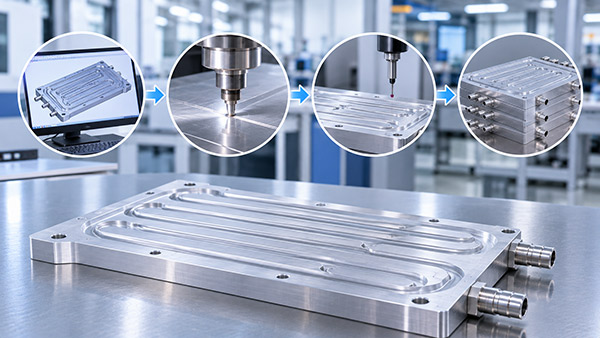
For procurement teams and engineering departments, a complete request for quotation (RFQ) helps the supplier understand the intended application and evaluate manufacturing feasibility.
It also reduces the risk of unexpected design changes after prototype development has begun.
1. Start with Complete Engineering Drawings
A liquid cold plate supplier needs enough information to identify the finished part and its functional requirements.
Typical drawing information includes:
Overall plate dimensions.
Base and cover material specifications.
Internal coolant channel geometry.
Mounting-hole and thread details.
Inlet and outlet connection positions.
Critical surface flatness requirements.
Relevant dimensional tolerances.
Specified surface finishing.
Where available, a STEP model can support manufacturing review, while a controlled 2D drawing defines critical tolerances and acceptance requirements.
The revision status of both files should be consistent.
2. Define Thermal Requirements
The cold plate must be evaluated against the actual heat-generating equipment.
Important data includes the heat load, heat-source footprint, coolant inlet temperature, and permitted component temperature.
If several components share one plate, their individual positions and thermal loads should be provided.
A statement such as "high-efficiency cooling required" is not enough to establish a measurable design target.
For demanding applications, engineers may also provide an allowable effective thermal resistance or a defined thermal test procedure.
3. Specify Coolant and Hydraulic Conditions
The internal channels must support the required coolant circulation.
Buyers should identify:
Coolant type and concentration.
Normal and extreme coolant temperatures.
Required operating flow rate.
Maximum allowable pressure drop.
Working pressure.
Relevant pressure transients.
Coolant cleanliness and compatibility requirements.
These parameters influence channel design, material compatibility, and qualification testing.
Providing the coolant specification early can help prevent unsuitable assumptions during design.
4. Identify FSW-Specific Manufacturing Requirements
An FSW cold plate differs from a simple machined aluminum block because it contains a welded pressure boundary.
Manufacturing review should consider the base and cover joint, welding access, channel clearance, and any required weld qualification.
The buyer and manufacturer should clarify which welding-related characteristics are controlled by the drawing and which are defined through the supplier's approved process.
If the application requires specific inspection or documentation, those requirements should be stated in the RFQ.
5. Agree on Prototype Acceptance Criteria
A prototype should not be approved only because its external dimensions appear correct.
Depending on the application, prototype verification may include:
Material and dimensional inspection.
Verification of mounting features.
Weld-related qualification checks.
Pressure and leak testing.
Pressure-drop testing.
Representative thermal testing.
Confirmation of the final drawing revision.
The actual acceptance plan depends on the project's functional requirements and risk level.
Some tests may be performed on representative qualification samples, while others may apply to every finished unit.
6. Plan for Repeatable Production
Once the prototype is approved, the manufacturing process must be capable of producing conforming parts repeatedly.
Potential production controls include material identification, machining records, approved welding procedures, inspection plans, and finished-product testing.
The appropriate level of traceability depends on the customer's requirements.
A liquid cold plate supplier should be able to explain how critical changes are controlled between prototype approval and production.
7. Control Engineering Revisions
Cold plate designs sometimes change after prototype testing.
Examples include adjustments to channel width, mounting-hole positions, connection geometry, or contact surfaces.
Even a small drawing revision can influence tooling, machining, welding, and inspection requirements.
The project team should clearly identify which revision is approved for production.
Where a change affects form, fit, function, safety, or qualified process conditions, appropriate review and requalification may be necessary.
8. Define Production and Commercial Requirements
Technical specifications should be accompanied by realistic purchasing information.
Useful details include:
Prototype quantity.
Expected annual demand.
Order batch size.
Target delivery schedule.
Packaging requirements.
Required inspection reports.
Confidentiality or NDA requirements.
Applicable quality and supplier approval requirements.
These details help the supplier evaluate capacity, manufacturing cost, and production planning.
OEM Liquid Cold Plate RFQ Checklist
| Category | Information to Provide | Purpose |
|---|---|---|
| 2D/3D drawings | Controlled dimensions, tolerances, channel model | Manufacturing review |
| Material | Alloy, temper, compatible joining materials | Process feasibility |
| Thermal | Heat load, source area, temperature limits | Performance evaluation |
| Hydraulic | Flow, pressure drop, coolant conditions | Channel and system design |
| Welding | Functional joining and qualification needs | FSW process planning |
| Quality | Leak, pressure, dimensional acceptance | Verification planning |
| Production | Prototype and annual quantities | Quotation and scheduling |
| Documentation | Reports, traceability, revision control | OEM supplier management |
What Makes a Good OEM Liquid Cold Plate Supplier?
A suitable supplier should be able to review the complete technical requirements and identify manufacturing constraints before production.
For friction stir welded cold plates, experience with both CNC machining and FSW processing is relevant because these processes directly influence one another.
The supplier should also be able to discuss inspection plans, prototype validation, and production consistency.
Price remains important, but quotations should be compared using the same drawings, material requirements, test specifications, and delivery assumptions.
KINGKA — OEM FSW Liquid Cold Plate Manufacturing
KINGKA provides OEM liquid cold plate manufacturing services using CNC machining and friction stir welding for customized industrial thermal management products.
Customers can submit mechanical drawings, coolant specifications, thermal requirements, and production quantities for feasibility review and quotation.
Early technical communication helps align the design with the manufacturing process before moving from prototype development to repeated production.
Request an OEM FSW Cold Plate Quotation
Looking for a liquid cold plate supplier for a new thermal management project? Send KINGKA your STEP/PDF drawings, thermal loads, operating conditions, and target quantity.
Explore KINGKA Custom FSW Liquid Cold PlatesFrequently Asked Questions
What files should be included in an FSW cold plate RFQ?
A controlled 2D drawing and suitable 3D CAD model are useful. Buyers should also provide thermal, coolant, pressure, and production requirements.
Should prototype testing requirements be defined before quotation?
Yes. Testing affects project scope, cost, timing, and the approval process.
Can one approved prototype guarantee future production quality?
No. Repeat production also requires appropriate process controls, inspection, and management of relevant changes.
Can an OEM FSW liquid cold plate be customized?
Yes, subject to manufacturing feasibility. Dimensions, channel layouts, mounting features, and coolant connections can be evaluated for customization.