




Modern electronic equipment may contain several components with different cooling requirements. High-power modules may require liquid cooling, while power supplies, controllers and auxiliary electronics can use air-cooled heat sinks.
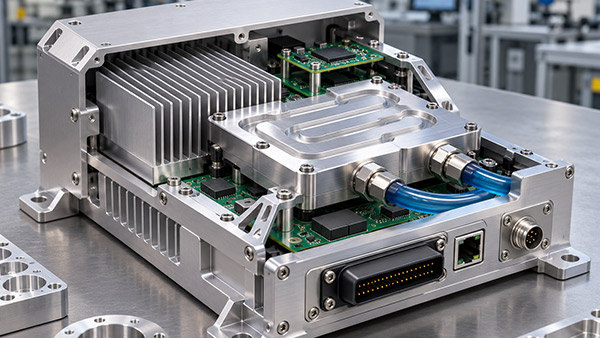
These thermal components share mechanical space with brackets, housings, connectors and other precision-machined parts.
For OEM engineers, the main challenge is ensuring that every component fits and functions within the complete assembly.
1. Select Cooling Methods According to the Heat Load
Not every electronic component requires the same cooling technology.
extruded aluminum heatsinks are often considered when a suitable finned profile can meet the thermal requirements through natural convection or forced airflow.
Liquid cold plates may be appropriate where heat loads, space restrictions or other system requirements make air cooling impractical.
The choice should be based on device temperature limits, heat-source locations, installation space and operating conditions.
2. Design extruded heat sink Profiles Around the Assembly
An extruded heat sink has a continuous cross-section containing the base and fins.
Its geometry should be compatible with the available enclosure space and airflow path.
Important design parameters include base thickness, fin height, fin spacing and the position of nearby components.
These parameters cannot be selected independently. Increasing fin density may improve geometric surface area but also affect airflow resistance and extrusion feasibility.
For a practical explanation of these trade-offs, see the aluminum heat sink extrusion design guide, which covers materials, thermal resistance, fin layout and OEM production considerations.
3. Account for Secondary CNC Machining
Many aluminum heat sink profiles require machining after extrusion.
Possible operations include drilling, tapping, base milling and cutting to the required length.
These operations allow the heat sink to be integrated with semiconductor modules, circuit boards and equipment brackets.
However, secondary machining should be considered before extrusion tooling is finalized.
Otherwise, the profile may not provide sufficient material around mounting holes or adequate access for machining tools.
4. Manage Tolerance Accumulation
Multiple components contribute to the final dimensions of an electronics assembly.
For example, variations in an aluminum bracket, heat sink base and semiconductor mounting surface may affect the quality of the thermal interface.
Similarly, changes in the position of an enclosure wall may reduce clearance around the cooling fins.
Engineers should identify critical datums and functional tolerances across the complete assembly.
Making every dimension extremely tight is not necessarily useful. Precision should be concentrated on features that influence fit and function.
5. Coordinate Air Cooling and Liquid Cooling
When an assembly uses both heat sinks and cold plates, their surrounding mechanical structures should be reviewed together.
For air-cooled components, the design must preserve appropriate airflow paths and avoid unnecessary restrictions.
For liquid-cooled components, adequate space is needed for coolant ports, hoses and service access.
The design must also address electrical safety and the risks associated with coolant leakage where relevant.
6. What Should Be Included in the Design Review?
Complete 3D assembly model.
Individual part drawings and revisions.
Heat source locations and thermal requirements.
Airflow and coolant connection information.
Mounting-hole patterns and tolerances.
Material and surface finish requirements.
Prototype inspection and validation plans.
7. Why Manufacturing Feasibility Matters
A design may look acceptable in a CAD model but still create manufacturing challenges.
For example, an aluminum extrusion with extremely thin fins and deep channels may be difficult to produce using the proposed tooling.
A heat sink base that provides insufficient support around mounting features may also require changes.
Early manufacturing review helps identify these limitations before production tooling and prototype work begin.
Frequently Asked Questions
Can air-cooled and liquid-cooled components operate in the same equipment?
Yes, provided their individual requirements and the complete assembly integration are properly evaluated.
Why is CNC machining important after aluminum extrusion?
It enables mounting holes, threads and precision surfaces that may not be created directly by the extrusion process.
Should heat sink geometry be finalized before the enclosure design?
Ideally, the cooling component and enclosure should be developed together so thermal and mechanical constraints can be addressed early.
Successful thermal hardware integration requires coordination between thermal engineering, mechanical design and manufacturing.
By considering aluminum extrusion geometry, CNC machining and system interfaces together, OEM teams can reduce unnecessary revisions and develop cooling assemblies that are more practical to manufacture.
