




For electronics manufacturers, aluminum heat sink extrusion is an important part of thermal component sourcing. As production volumes increase, some OEM companies consider bringing heat sink manufacturing or secondary machining in-house. Others prefer to purchase finished aluminum heatsinks from specialized manufacturers.
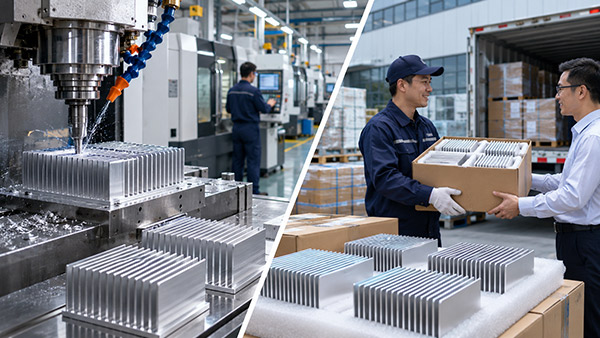
Both approaches can work. The right decision depends on production volume, available equipment, engineering resources, quality requirements and the long-term cost of managing the process.
1. What Does In-House Heat Sink Manufacturing Actually Involve?
Manufacturing an extruded aluminum heatsink involves more than cutting an aluminum profile to length. Depending on the component, the complete process may include extrusion tooling, profile production, CNC machining, surface finishing, inspection and packaging.
Most OEMs considering internal production are evaluating whether to bring secondary machining and finishing in-house, rather than establishing an aluminum extrusion facility.
This distinction matters because operating an extrusion press requires significantly different equipment, process knowledge and investment from performing CNC operations on purchased profiles.
2. Compare the Two Manufacturing Approaches
| Decision Factor | In-House Manufacturing | Outsourced Manufacturing |
|---|---|---|
| Equipment investment | Requires internal machinery and supporting resources | Uses supplier manufacturing capacity |
| Engineering control | Direct control over internal operations | Requires clear specifications and supplier coordination |
| Production flexibility | Depends on available equipment and staffing | Depends on supplier capacity and commercial terms |
| Quality responsibility | Managed by internal production teams | Managed through supplier qualification and acceptance |
| Operating costs | Includes labor, maintenance and equipment utilization | Included in the supplier's agreed pricing |
3. When Does In-House Processing Make Sense?
Internal processing may be appropriate when an OEM already operates CNC machines, maintains experienced manufacturing staff and requires frequent modifications to heat sink mounting features.
It may also be useful for development projects where rapid adjustments are needed and external production scheduling would slow engineering work.
However, equipment utilization should be considered. A machine dedicated to heat sink production may not be economical if demand is irregular.
4. When Is Outsourcing the Better Choice?
Outsourcing is often worth evaluating when the OEM needs custom extrusion profiles, specialized machining operations or manufacturing capacity that would be expensive to establish internally.
External production can also reduce the number of manufacturing processes that the OEM must manage.
For example, a supplier that coordinates extrusion and CNC machining may deliver a finished component ready for the buyer's assembly process.
Buyers should still review drawings, dimensional tolerances, inspection requirements and delivery schedules before placing an order.
5. Consider a Hybrid Purchasing Model
The choice does not have to be entirely internal or external. Some OEMs outsource aluminum heat sink extrusion while completing selected machining or assembly operations internally.
This approach may provide flexibility when product designs change frequently.
The main consideration is whether the additional handling and coordination cost is justified by the control gained over the finishing operations.
6. How KINGKA Supports Outsourced Heat Sink Manufacturing
KINGKA provides custom aluminum heat sink extrusion solutions for OEM thermal management applications. Its product offering includes standard and custom extruded heat sinks with secondary CNC machining options.
For companies comparing internal production with outsourced manufacturing, reviewing an integrated supplier's capabilities can help clarify which processes should remain internal and which could be purchased as finished components.
In-house manufacturing provides direct process control but requires equipment, technical resources and consistent demand. Outsourcing can reduce internal manufacturing responsibilities while providing access to specialized production capabilities.
OEM buyers should select the approach that offers reliable thermal performance, repeatable quality and an acceptable total cost across the expected product lifecycle.
Need Custom extruded aluminum heatsinks?
Explore KINGKA's extrusion heat sink manufacturing options for OEM projects requiring custom profiles and precision machining.
Explore Extrusion Heat Sink Solutions →