

A Liquid Cold Plate is designed to transfer heat from electronic components into circulating coolant. In a friction stir welded (FSW) cold plate, CNC-machined internal channels are enclosed by a metal cover joined to the base through a solid-state welding process.
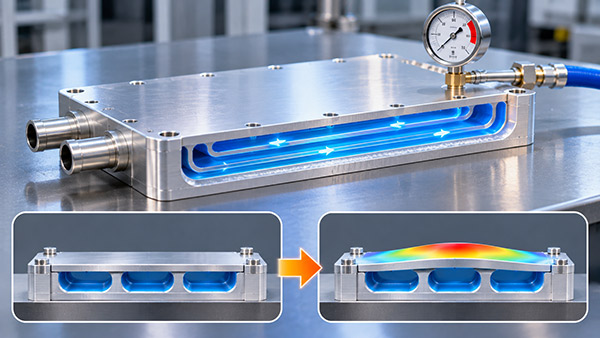
Although weld integrity is important, the cover itself must also withstand the mechanical loads created by coolant pressure. For plates containing relatively wide internal passages, pressure-induced cover deflection can become an important structural design consideration.
OEM engineers should evaluate the cover, channel support and welding layout together rather than assuming that a leak-tight joint automatically guarantees adequate structural stiffness.
1. Why Does Coolant Pressure Load the Cover Plate?
When coolant flows through an enclosed channel, internal pressure acts against the surfaces forming the pressure boundary.
For an FSW Liquid Cold Plate, this includes the channel walls and the underside of the cover. Where the cover spans an internal cavity, pressure creates a load that may cause local bending.
The resulting deformation depends on the geometry and the stiffness of the surrounding structure.
For example, two plates using the same aluminum alloy and operating pressure may experience different cover deformation if their channel widths and cover thicknesses differ.
2. Why Unsupported Channel Width Matters
The distance between structural supports influences how a cover responds to pressure.
A wide internal passage may leave a larger unsupported cover area than a narrow passage of similar depth.
Under otherwise comparable conditions, a wider span can increase bending demand. However, the exact response depends on the complete geometry and boundary conditions.
This means a channel design optimized only for low hydraulic resistance may not provide the most suitable mechanical structure.
Engineers should consider both coolant flow and pressure containment when selecting channel dimensions.
3. How Cover Thickness Influences Structural Stiffness
Increasing the thickness of a metal cover generally improves its resistance to bending.
However, additional thickness also increases weight and may influence the distance between the coolant and the heat source, depending on how the cold plate is oriented.
Cover thickness can also affect the friction stir welding process because the joint configuration must be compatible with the selected welding tool and material.
The design should therefore balance:
Operating and maximum internal pressures.
Unsupported channel dimensions.
Cover material and mechanical properties.
Required thermal conduction path.
Manufacturing and welding feasibility.
Component weight and available space.
4. Can Internal Ribs Help Support the Cover?
In selected channel designs, solid regions or structural ribs may provide additional support between larger cavities.
These features can reduce unsupported spans and help distribute mechanical loads.
However, adding internal ribs may change the hydraulic cross-section, flow distribution and thermal characteristics of the plate.
They may also introduce additional machining or welding considerations.
Therefore, internal support features should be evaluated as part of the complete thermal-fluid and structural design.
5. What Is the Difference Between Operating Pressure and Test Pressure?
Operating pressure describes the pressure expected during normal service, while a specified proof or validation test may use a different pressure to verify structural performance.
Pressure spikes, pump transients and abnormal operating conditions may also influence the maximum expected load.
Engineers should not select an arbitrary proof pressure without considering the actual system design and applicable requirements.
The cold plate specification should clearly distinguish normal operating limits, maximum expected conditions and the acceptance criteria for testing.
6. How Should Engineers Evaluate Cover Deflection?
Structural analysis, including finite element analysis where appropriate, can help evaluate displacement and stress in the cover and surrounding material.
The model should represent relevant channel geometry, pressure loads, material properties and structural constraints.
Results should be interpreted alongside manufacturing tolerances and the actual joint configuration.
For demanding applications, prototype testing may also be necessary to confirm the assumptions used in the analysis.
7. Why Leak Testing Alone Is Not Enough
A component can pass a leak test while still exhibiting undesirable deformation under pressure.
Leak testing addresses fluid containment under the defined test conditions. Structural qualification addresses deformation, stress and other mechanical acceptance requirements.
These are related but distinct aspects of product reliability.
If dimensional stability is critical, the inspection and testing plan should include appropriate structural requirements.
8. Information to Include in an OEM Drawing
When requesting a custom FSW cooling plate, engineers should specify:
Channel geometry and cover thickness.
Base and cover material grades.
Normal operating and maximum expected pressure.
Relevant pressure-test requirements.
Critical contact surfaces and dimensions.
Acceptable deformation or functional limits where necessary.
Relevant thermal and hydraulic operating conditions.
These details allow the manufacturer to review the design before manufacturing begins.
9. Custom FSW liquid cold plate Manufacturing
KINGKA provides custom cold plate solutions using CNC-machined channel structures and friction stir welding for industrial thermal management applications.
Engineers developing a custom FSW liquid cold plate can submit channel drawings, pressure requirements and installation details for a manufacturing feasibility review.
The final pressure boundary and structural acceptance criteria should be confirmed according to the actual project specification.
Frequently Asked Questions
Can a leak-tight FSW cold plate still deform under pressure?
Yes. Leak tightness and structural stiffness are different performance characteristics. Both may require evaluation depending on the application.
Does a thicker cover always improve cold plate cooling?
No. A thicker cover may improve stiffness but can also alter weight and thermal conduction distances.
Is structural simulation required for every liquid cold plate?
Not necessarily. The need depends on design complexity, pressure conditions, available qualification data and project requirements.
Cover deflection is an important consideration for FSW cold plates containing pressurized internal channels.
By evaluating channel support, cover thickness, structural loads and welding requirements together, OEM engineers can develop cold plate designs that satisfy both thermal and mechanical objectives.
Need a Custom Pressure-Resistant Cold Plate?
Share your operating pressure, channel geometry, cover material and engineering drawings for an FSW manufacturing review.
Explore KINGKA FSW Liquid Cold Plates