




Industrial laser equipment can generate heat under operating conditions that change significantly over time. Some systems operate continuously, while others produce repeated pulses or alternate between high-power operation and lower-power intervals.
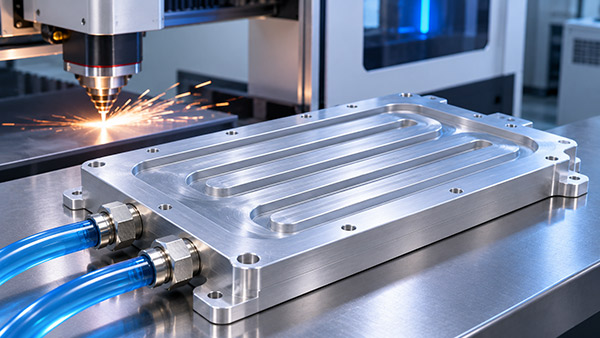
These changing thermal loads can create different cooling requirements from those encountered in systems with nearly constant heat generation.
For Cold Plate Liquid Cooling applications, the design must account for both the average heat removed by the coolant and the temperature changes occurring during short, high-power events.
FSW Liquid Cold Plates can be considered for industrial laser assemblies requiring machined coolant passages and custom mounting geometries. However, their suitability should be established through transient thermal analysis and representative testing.
1. Why Are Pulsed Heat Loads Different from Continuous Loads?
In a steady-state thermal analysis, the heat generated by a device is balanced by the heat removed through the cooling system after temperatures have stabilized.
For a pulsed system, heat generation changes over time.
During a short high-power event, the local heat input may temporarily exceed the rate at which heat can be transferred into the coolant.
Some energy is stored in the device, interface and cold plate materials, causing their temperatures to rise.
During lower-power intervals, part of that stored thermal energy can be removed.
The resulting temperature response depends on the duration and repetition of these events.
2. Peak Power vs Average Thermal Power
A laser system may have a comparatively high peak thermal load but a lower average load over a complete operating cycle.
For a simplified repetitive cycle with a high-power interval and an inactive interval, the average thermal power can be estimated from the energy produced during the cycle divided by the cycle duration.
Where:
Paverage is average thermal power.
Ecycle is the total thermal energy generated during a complete cycle.
tcycle is the duration of the cycle.
This relationship is useful for establishing the average thermal demand, but it does not directly predict the maximum device temperature.
Short-duration temperature peaks depend on the complete transient thermal response.
3. How Thermal Mass Influences Temperature Changes
The thermal mass of a component influences how much its temperature changes when energy is stored within it.
For a simplified lumped thermal mass, an approximate relationship is:
Where:
ΔT is the approximate temperature change.
Estored is the energy stored in the considered mass.
m is the mass of that region.
cp is its specific heat capacity.
This simplified calculation assumes approximately uniform temperature within the considered mass. Real devices and cold plates often have temperature gradients, and heat transfer continues during the pulse.
Therefore, detailed transient analysis may be required for accurate temperature predictions.
4. Does a Thicker Cold Plate Always Improve Pulsed Cooling?
Increasing the metal mass can increase thermal energy storage capacity, but a thicker plate does not automatically improve every transient cooling application.
Additional thickness may place coolant passages farther from the heat source or increase the conduction distance.
In a compact system, the extra weight and volume may also create mechanical constraints.
Engineers should evaluate thermal mass together with heat spreading, coolant-channel location and available installation space.
5. Why Channel Placement Matters
When heat is generated over a localized region, the position of the coolant passages relative to that region influences the thermal conduction path.
Channels located closer to the primary heat source may reduce some conduction resistance, subject to mechanical strength and manufacturing constraints.
However, placing channels excessively close to the mounting surface may leave insufficient material to satisfy the required structural and pressure conditions.
FSW cold plate design must also maintain appropriate geometry for the cover and welding operation.
Thermal optimization and manufacturing feasibility should be addressed together.
6. How Coolant Flow Affects Transient Behavior
Coolant removes heat from the plate as it circulates through internal channels.
Flow rate influences convection and the bulk coolant temperature rise, but it may not eliminate very short local temperature peaks.
For example, a brief pulse can heat the semiconductor or laser module faster than the complete cooling assembly can respond.
In such cases, reducing interface resistance or improving local heat spreading may be important alongside coolant-flow optimization.
The final design should consider both transient and steady-state behavior.
7. What Should a Laser Cooling Test Include?
For a pulsed application, a thermal qualification test should represent relevant operating cycles rather than using only a continuous average load.
Possible test conditions include:
Maximum expected heat-generating pulse.
Relevant pulse duration.
Repetition frequency and duty cycle.
Initial coolant temperature.
Nominal and minimum expected coolant flow.
Representative thermal interface and mounting conditions.
Repeated operation until a stable cyclic temperature response is observed, where applicable.
The test plan should reflect the actual equipment and temperature limits.
8. Where Should Temperature Be Measured?
Temperature measurement locations should be selected based on the engineering objective.
Potential locations include the laser module mounting surface, selected cold plate positions and the coolant inlet and outlet.
Measurement systems must have adequate response characteristics to capture the temperature changes of interest.
A slow temperature sensor may not accurately capture short thermal peaks.
Where direct junction measurement is not practical, an appropriate thermal model may be needed to relate accessible measurements to the critical internal temperature.
9. Can copper cold plates Improve Pulsed Heat Spreading?
Copper offers higher thermal conductivity than common aluminum alloys, making it attractive for certain localized heat loads.
However, the result depends on the complete thermal path and the relevant time scale.
A copper cold plate may improve local heat spreading, but it does not automatically guarantee adequate transient performance.
Material selection should also account for weight, cost, coolant compatibility and manufacturing feasibility.
10. Custom FSW Cold Plates for Laser Cooling
KINGKA provides custom Liquid Cold Plate manufacturing solutions for industrial thermal management applications, including equipment with demanding cooling requirements.
Engineers evaluating FSW liquid cold plate manufacturing can submit their laser module dimensions, heat-load profile, coolant conditions and mechanical drawings for a technical review.
The final cold plate should be validated against the actual operating cycle rather than selected solely from an average power value.
Frequently Asked Questions
Can a cold plate designed for continuous power handle pulsed heat loads?
Possibly, but average power alone is insufficient to establish suitability. Peak temperature and transient response must also be evaluated.
Does increasing coolant flow eliminate temperature spikes?
Not necessarily. Short temperature peaks may be dominated by local conduction and thermal storage effects.
Is an aluminum FSW cold plate suitable for industrial lasers?
It may be suitable depending on heat-source geometry, operating profile, material requirements and validated thermal performance.
Conclusion
Pulsed industrial laser applications require a cold plate cooling strategy that considers time-dependent heat generation.
By evaluating peak thermal loads, thermal mass, channel placement, coolant flow and transient temperature response, engineers can develop cooling solutions better matched to the actual equipment.
Developing a Cold Plate for Pulsed Laser Equipment?
Share your peak and average heat loads, pulse duration, mounting requirements and coolant conditions for an FSW cold plate manufacturing review.
Explore KINGKA FSW Liquid Cold Plate Solutions