

A custom heat sink may look correct when the first finished samples arrive, but appearance alone cannot confirm compliance with every engineering requirement.
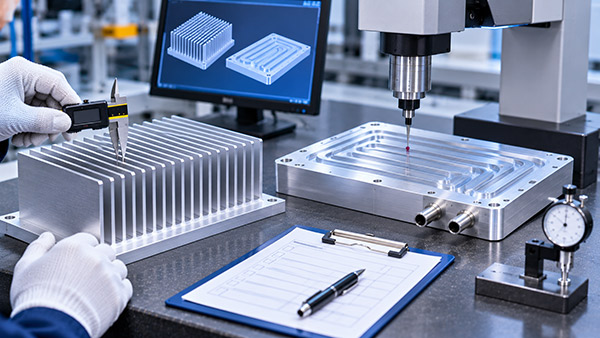
For OEM manufacturers, first article inspection provides a documented way to evaluate a representative production component against the approved drawing.
The inspection plan should reflect the manufacturing method. An extruded aluminum heatsink, a skived fin heat sink and a liquid cold plate may require different checks.
1. What Is First Article Inspection?
First article inspection, commonly abbreviated as FAI, evaluates a manufactured component against its specified requirements.
The results may include measured dimensions, material information, surface condition and functional test records where applicable.
The exact scope depends on the customer's requirements and any relevant industry standards.
FAI should not be confused with routine production inspection, which helps monitor continued conformity during manufacturing.
2. Start with the Correct Drawing Revision
A useful first article inspection report must reference the correct approved drawing and relevant specifications.
The drawing should identify the component's dimensions, tolerances, material and any special quality requirements.
When the drawing revision is unclear, even accurate measurement results may not demonstrate conformity to the intended product.
3. What Should Be Checked on an extruded aluminum heatsink?
Common inspection characteristics may include:
Profile width and height.
Overall component length.
Base thickness.
Fin height and spacing.
Fin straightness and relevant profile geometry.
Mounting-hole positions and thread specifications.
Contact-surface flatness where required.
Surface finishing and appearance.
Material identification.
The exact list should follow the actual drawing rather than a generic checklist.
4. Why Extrusion Geometry Needs Special Attention
Extrusion creates a continuous metal profile, but the final dimensions depend on the die design, material condition and manufacturing process.
Complex fin structures may require attention to fin thickness, profile geometry and straightness.
For example, a profile that meets its overall width requirement could still have an unacceptable fin-spacing variation if that dimension is functionally important.
Engineers who need more background on profile geometry and manufacturing constraints can refer to KINGKA's aluminum heat sink extrusion design and manufacturing guide.
The guide also explains material choices, extrusion processing, CNC finishing and the relationship between geometry and thermal performance.
5. Inspect Secondary Machining Features
An extruded heat sink may require additional CNC operations after the profile has been cut.
These may include drilling, tapping, pocket milling and machining of thermal contact surfaces.
Inspection should verify that the relevant features meet the specified requirements.
For parts mounted directly to electronic modules, the quality of the contact surface and mounting pattern may be especially important.
6. How Do Liquid Cold Plate Inspections Differ?
Liquid cold plates have different functional requirements because they contain enclosed coolant passages.
Depending on the product, inspection may cover port dimensions, flatness, material, joining condition and leak integrity.
Specified pressure or hydraulic performance testing may also be relevant.
These checks should not be applied automatically to ordinary air-cooled aluminum heat sinks.
Each product needs an inspection plan based on its actual design and intended use.
7. What Documentation Should an OEM Request?
| Document | Purpose |
|---|---|
| Approved drawing and revision | Defines the characteristics being inspected |
| Dimensional results | Records measured features against tolerances |
| Material records | Supports the specified material requirements |
| Surface finish information | Documents relevant coating requirements |
| Functional test records | Records applicable project-specific verification |
| Nonconformance records | Identifies deviations and approved disposition |
Documentation should be selected according to the purchase specification. More paperwork does not automatically mean better product quality.
8. What Happens When a Part Is Out of Tolerance?
If an inspected characteristic fails to meet its specified requirement, the issue should be recorded and reviewed.
The resulting action may involve rework, additional inspection, an approved concession or rejection.
A supplier should not treat a dimensional deviation as acceptable simply because the component can still be physically assembled.
9. When Is a New First Article Inspection Needed?
A new or partial FAI may be appropriate after introducing a new design or implementing significant manufacturing changes.
For an extruded aluminum heatsink, this could include a new profile die, relevant geometry modifications or other changes requiring renewed approval.
The actual requirement depends on the customer's quality system and the agreed manufacturing process.
Frequently Asked Questions
Is first article inspection necessary for every heat sink order?
Not universally. The requirements depend on the project, customer quality system and relevant standards.
Can an extruded profile pass overall dimensional inspection but fail fin inspection?
Yes. Individual fin dimensions or other functional characteristics may be outside their specified tolerances even when the overall profile dimensions are acceptable.
Does a first article inspection report guarantee future quality?
No. It documents the evaluated component and conditions. Continued production still requires suitable process and inspection controls.
First article inspection gives OEM buyers a structured basis for evaluating custom thermal components.
For extruded aluminum heatsinks, inspection should cover the relevant profile geometry, secondary machining features, material and finishing requirements.
Clear acceptance criteria and controlled drawings help manufacturers and buyers establish a more reliable basis for repeat production.