




Weight is an important consideration in many electronic cooling applications. Industrial controllers, communication equipment, portable instruments and some transportation electronics must balance thermal performance with mechanical loading and overall equipment mass.
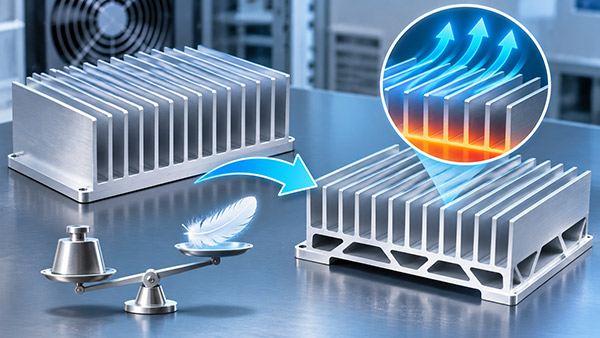
Aluminum heat sink extrusion provides considerable flexibility in profile geometry, but simply removing metal does not guarantee an efficient lightweight design.
For OEM engineers, weight optimization requires understanding which parts of the heat sink contribute most to heat transfer and which dimensions are needed for mechanical reliability.
Why Does Heat Sink Weight Matter?
A heavier heat sink may increase loads on mounting brackets, circuit boards and equipment housings.
Additional weight may also affect shipping costs, handling and installation, particularly when large quantities are produced.
However, removing material indiscriminately can increase thermal resistance or reduce structural stiffness.
The objective should be to meet defined cooling and mechanical requirements with appropriate material usage.
Understanding the Weight of an extruded aluminum heatsink
The approximate mass of an extruded aluminum heatsink depends on the cross-sectional area, profile length and material density.
A simplified relationship is:
Mass = Cross-sectional Area × Length × Density
For a constant extrusion profile, the mass generally increases with length.
Reducing the cross-sectional area can reduce material usage, but the removed material may affect heat transfer and strength.
Any final calculation should account for machining operations, additional components and the specified alloy.
Five Opportunities for Weight Optimization
1. Review Base Thickness
The base distributes heat from the electronic component toward the fins.
A thicker base may help spread concentrated heat loads, but unnecessary material can increase weight.
Reducing base thickness can be considered when thermal and structural analysis shows adequate performance remains.
The decision should account for heat source location, mounting forces, flatness and possible deformation.
2. Evaluate Fin Height
Increasing fin height creates additional exposed surface area, but the benefit depends on fin efficiency and airflow.
Very tall fins may contribute less effective heat transfer near their tips because of conduction resistance along the fin.
For some applications, a shorter profile with suitable fin spacing may meet the thermal requirement while using less material.
3. Optimize Fin Thickness
Thicker fins provide greater conduction cross-section and may offer improved mechanical stiffness.
Thinner fins reduce material mass and may allow different fin arrangements.
However, reducing thickness can affect extrusion feasibility, fin efficiency and damage resistance.
The acceptable geometry should be reviewed with the manufacturer before changing the profile.
4. Remove Nonfunctional Material Carefully
Some profiles contain material for mounting, fastening or installation purposes.
Where appropriate, these regions may be redesigned or machined to reduce unnecessary mass.
Material removal should not weaken mounting points or compromise required mechanical and electrical clearances.
5. Match Profile Length to the Actual Heat Load
Using an unnecessarily long heat sink may add material without providing a proportional improvement in cooling.
Profile length should be selected according to heat source position, available airflow and thermal performance.
For repeated OEM production, different length options can be evaluated using the same cross-sectional profile when appropriate.
Weight Optimization Trade-Offs
| Design Change | Potential Weight Benefit | What Must Be Verified |
|---|---|---|
| Reduce base thickness | Less aluminum in the base | Heat spreading, flatness and stiffness |
| Reduce fin height | Less fin material | Heat transfer area and fin efficiency |
| Reduce fin thickness | Lower fin mass | Extrusion feasibility and conduction |
| Shorten the profile | Lower total material volume | Cooling performance and mounting compatibility |
| Machine selected pockets | Local material removal | Machining cost and structural integrity |
Why Thermal Performance Must Be Evaluated First
Weight reduction should begin with a documented thermal requirement.
A simplified sink-to-ambient thermal resistance target is:
RθSA = (Ts - Ta) / P
Where Ts is the permitted heat sink reference temperature, Ta is the local ambient temperature and P is the heat transferred through the heat sink.
The formula provides a preliminary target when the relevant measurement boundaries are clearly defined.
Actual design performance depends on the heat source, thermal interface, airflow and surrounding enclosure.
The engineer should compare proposed lightweight profiles under consistent thermal conditions.
Does the Lightest Heat Sink Have the Lowest Cost?
Not necessarily.
Reducing aluminum mass may lower material consumption, but a more complex extrusion die or additional CNC machining may increase manufacturing cost.
A lighter design may also require more detailed inspection or mechanical validation.
For high-volume manufacturing, the preferred solution should balance material cost, tooling, processing, thermal performance and production consistency.
How Should OEM Engineers Validate a Lightweight Profile?
A practical evaluation may include:
Define maximum operating heat load.
Establish the available profile dimensions.
Determine component temperature limits.
Identify important mounting and structural loads.
Compare alternative geometries through analysis.
Produce representative prototypes.
Verify thermal and mechanical performance.
For critical applications, weight optimization should be followed by testing in the completed equipment.
Custom Aluminum Heat Sink Extrusion from KINGKA
KINGKA provides aluminum heat sink extrusion manufacturing for OEM industrial and electronic cooling applications.
Customization options include aluminum profiles, fin dimensions, base geometry, CNC machining and mounting features.
For weight-sensitive projects, customers should provide their maximum weight requirement together with thermal, dimensional and mechanical specifications.
Optimize Your Custom Aluminum Heatsink
Need a lightweight heat sink for industrial electronics? Submit your thermal targets, weight restrictions, drawings and expected production quantities.
Explore Custom Extrusion Heat Sink SolutionsFrequently Asked Questions
Does reducing aluminum heat sink weight always reduce cooling performance?
Not always. Some geometry changes may remove unnecessary material while maintaining the required performance, but the design must be validated.
Are thinner fins always better for lightweight heatsinks?
No. Fin thickness affects thermal conduction, manufacturing feasibility and mechanical reliability.
Can 6063 aluminum be used for lightweight extruded heat sinks?
Yes. Aluminum 6063 is commonly used for extrusion, but the specified alloy and temper should satisfy the complete application requirements.
Can CNC machining reduce heat sink weight?
Yes, material can be removed through suitable machining operations. Additional processing cost and structural effects must be evaluated.
