




OEM manufacturers often face changing production forecasts. Customer orders may increase unexpectedly, planned equipment launches may be delayed, and existing products may undergo design revisions before reaching stable production.
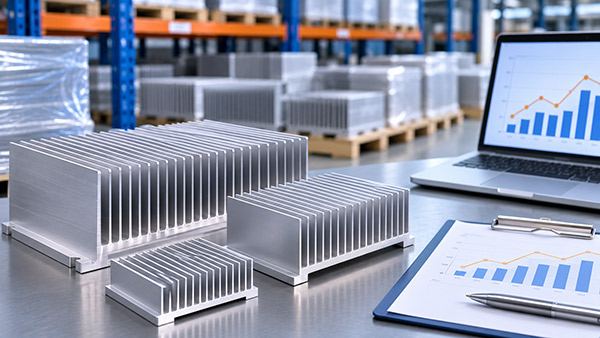
These uncertainties affect how buyers should purchase aluminum heatsinks. Ordering too many components can create excess inventory, while ordering too few may interrupt equipment assembly.
For a custom extrusion heat sink, the purchasing strategy should balance manufacturing economics, product availability and the risk of design changes.
1. Separate Forecast Demand from Confirmed Demand
A sales forecast is not the same as a committed manufacturing requirement. Before establishing a purchasing schedule, OEM buyers should distinguish between confirmed production orders and expected future demand.
Confirmed orders can provide the basis for initial material and production commitments. Forecast quantities can help suppliers understand possible future capacity requirements without automatically becoming binding purchase orders.
This distinction is especially important for customized extruded heat sinks that cannot easily be reassigned to another product.
2. Understand the Cost of Small and Large Orders
Aluminum heat sink extrusion may involve setup activities, material preparation, cutting and secondary machining. These operations can influence the economics of different batch sizes.
Large orders may reduce certain recurring setup costs per piece, but they also increase inventory exposure. Smaller orders may offer greater purchasing flexibility but can result in higher unit prices.
| Purchasing Strategy | Potential Advantage | Main Risk |
|---|---|---|
| Large single order | May improve unit economics | Higher inventory exposure |
| Small repeated orders | Lower immediate inventory commitment | Possible higher setup and purchasing costs |
| Scheduled releases | Aligns deliveries with production demand | Requires clear supplier agreements |
| Forecast-based planning | Supports earlier capacity discussions | Forecasts can change |
3. Evaluate Scheduled Delivery Agreements
Instead of receiving an entire annual quantity at once, an OEM may negotiate separate deliveries against an agreed purchasing arrangement.
Whether this is available depends on the supplier's production model, material purchasing requirements and commercial terms.
Before selecting this approach, buyers should clarify minimum release quantities, production lead times, inventory ownership and the consequences of forecast changes.
A scheduled delivery arrangement should not be interpreted as a guarantee of unlimited production flexibility.
4. Consider Product Revision Risk
Inventory risk becomes more significant when a heat sink design is still evolving.
A minor change to a mounting hole, contact surface or equipment enclosure may make previously manufactured parts unsuitable for the revised assembly.
For projects with an uncertain final design, buyers may prefer smaller initial production commitments even if the unit price is higher.
Once the design is stable and demand becomes predictable, larger production batches may become more economical.
5. Agree on Lead-Time Assumptions
Buyers should request separate lead-time information for tooling, samples and repeat production where applicable.
An existing extruded aluminum heatsink profile may follow a different production schedule from a new custom design.
Lead-time discussions should also cover secondary machining, surface finishing, inspection and transportation.
These details help purchasing teams determine how early an order must be released to support the equipment assembly schedule.
6. Discuss Production Requirements with KINGKA
KINGKA provides extrusion heat sink manufacturing for custom thermal management applications.
OEM buyers can submit their drawings, expected order quantities and anticipated production schedules for quotation and manufacturing review.
When discussing a project, buyers should identify which quantities are confirmed and which remain estimates so that commercial arrangements can be evaluated appropriately.
Uncertain demand does not necessarily justify purchasing the smallest possible quantity or committing to the lowest unit price.
The better approach is to coordinate engineering readiness, purchase commitments and production schedules. For custom aluminum heatsinks, a purchasing strategy built around realistic demand can reduce both inventory risk and supply interruptions.
Planning OEM Heat Sink Production?
Review KINGKA's extruded aluminum heat sink solutions and discuss custom manufacturing requirements for your next project.
View Extruded Heat Sink Manufacturing →