




Long extruded heat sinks are frequently mounted to industrial equipment frames, electrical enclosures, and power electronics assemblies. When the equipment heats up, the aluminum profile expands. If the supporting structure is made from a different material, it may expand by a different amount.
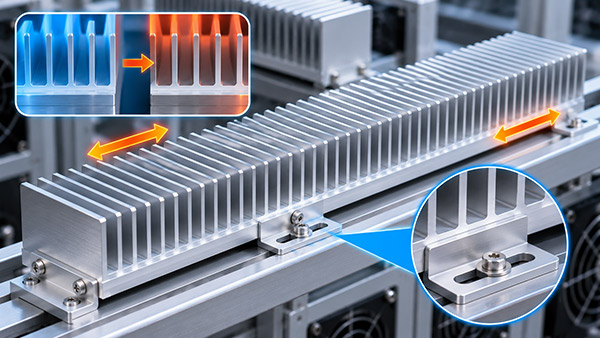
This difference can introduce mechanical loads at mounting locations, especially when several rigid fasteners prevent relative movement.
For OEM equipment manufacturers, thermal expansion should be reviewed as part of the mounting design rather than considered only during thermal testing.
Why Does Aluminum heat sink Expansion Matter?
Metals change dimensions as temperature changes.
The amount of thermal expansion depends on material properties, original dimensions, and temperature difference.
Aluminum generally has a higher coefficient of linear thermal expansion than common carbon steels.
If an aluminum heat sink and a steel frame experience the same temperature increase, the aluminum component may expand more along the same original length.
The difference becomes important when the components are constrained by mounting hardware.
Understanding Linear Thermal Expansion
A simplified relationship is:
ΔL = α × L × ΔT
Where:
ΔL: Change in length.
α: Coefficient of linear thermal expansion.
L: Original length.
ΔT: Temperature change.
For an illustrative aluminum profile 250 mm long, assume an expansion coefficient of 23 × 10⁻⁶/K and a uniform temperature increase of 60 K.
ΔL = 23 × 10⁻⁶ × 250 × 60
ΔL ≈ 0.345 mm
Under these simplified conditions, the profile would expand by approximately 0.35 mm.
The calculation does not account for mechanical restraint, nonuniform temperature, or the expansion of the supporting structure.
1. Consider the Mounting Structure
A heat sink may be connected to aluminum, steel, plastic, or composite components.
Each supporting material has its own thermal expansion behavior and mechanical properties.
The assembly should be reviewed using the relevant material data and operating temperature range.
Particular attention may be needed when the heat sink is attached at widely separated mounting points.
2. Avoid Unintended Overconstraint
When several rigid joints prevent expansion, changing temperatures can create stresses within the assembly.
These loads may affect fasteners, mounting brackets, electronic packages, or other connected components.
Depending on the application, the design may require controlled accommodation of differential movement.
However, thermal expansion should not be addressed by simply loosening every mounting fastener.
The heat sink must remain mechanically secure and maintain appropriate thermal contact.
3. Evaluate Slotted or Floating Mounting Features
Some mechanical assemblies use locating features and controlled sliding or compliant connections to accommodate differential movement.
For example, a fixed locating point may establish the assembly position while another connection permits a defined amount of movement.
This is a possible engineering strategy, not a universal solution.
The design must account for vibration, mechanical retention, electrical bonding, and any required contact pressure.
4. Protect Critical Thermal Interfaces
An extruded heat sink often connects to a power module or another heat-generating component through a thermal interface material.
Relative movement and changing mechanical loads can influence this interface.
Where the heat sink supports sensitive packages, mounting features should be designed according to the component manufacturer's limits.
Expansion accommodation must not compromise the pressure or alignment required for heat transfer.
5. Include Thermal Cycling in Qualification
A mounting arrangement that fits correctly at room temperature may behave differently at the upper and lower operating temperature limits.
Repeated thermal cycles can also expose weaknesses in joint design.
For demanding applications, qualification may include dimensional checks, fastener inspection, thermal measurements, and appropriate mechanical testing after cycling.
Thermal Expansion Design Checklist
| Design Factor | Potential Concern | Recommended Evaluation |
|---|---|---|
| Heat sink length | Greater total dimensional change | Calculate expansion over the relevant length |
| Supporting material | Differential expansion | Compare material properties |
| Mounting positions | Unintended mechanical restraint | Review joint layout and loads |
| Thermal interface | Contact variation | Verify component mounting requirements |
| Operating range | Temperature-dependent movement | Evaluate maximum and minimum conditions |
| Reliability | Repeated joint loading | Qualify under representative cycles |
What Should OEM Buyers Include in Their Drawings?
Design documents should identify the Heat Sink Material, overall length, mounting positions, operating temperature range, and relevant mechanical constraints.
Where differential expansion is significant, the assembly drawing should define the intended locating and movement strategy.
Fastener and mounting requirements should be established by the equipment designer, with manufacturing feasibility reviewed by the supplier.
Custom Extruded Heat Sink Manufacturing with KINGKA
KINGKA supplies custom extruded heat sink manufacturing solutions for industrial electronics and OEM equipment.
Profile dimensions, CNC-machined mounting holes, and other mechanical features can be reviewed based on customer specifications.
For long profiles, buyers should provide both the heat sink drawing and relevant information about the supporting assembly.
Discuss a Custom Long-Profile Heat Sink
Developing an aluminum heat sink for an industrial chassis or power electronics assembly? Share your dimensions, temperature range, mounting requirements, and expected production quantity.
Frequently Asked Questions
Does an aluminum heat sink expand more than a steel chassis?
Under comparable temperature changes, common aluminum alloys generally expand more than common carbon steels over the same original length.
Are slotted mounting holes always required?
No. Their suitability depends on length, temperature range, joint design, and mechanical requirements.
Can thermal expansion affect component temperatures?
It may affect interface loading or mounting alignment, which can influence thermal contact under certain conditions.
Should thermal expansion be evaluated for short heat sinks?
It depends on the application. Shorter profiles may experience smaller dimensional changes, but sensitive assemblies can still require evaluation.
