

Long extruded aluminum heat sinks are commonly used in industrial power modules, communication equipment, and other electronic assemblies requiring a large cooling surface. While engineers often focus on fin height, spacing, and thermal resistance, the straightness and twist of the extrusion profile can be equally important during assembly.
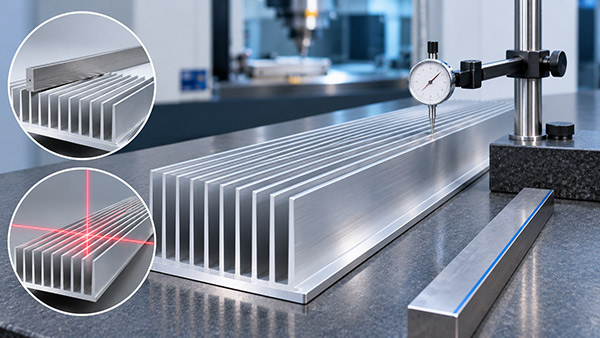
An aluminum heat sink extrusion profile may meet its cross-sectional dimensions but still create installation difficulties if it contains excessive bow or rotational distortion.
For OEM manufacturers, these geometric characteristics should be evaluated according to the final application instead of relying only on nominal profile width and length.
What Is Straightness in Heat Sink Extrusion?
Straightness describes how closely a specified line or longitudinal feature follows an ideal straight line.
In a long extruded heat sink, the base or another defined feature may deviate from its intended longitudinal alignment.
This deviation can appear as bowing along the profile length.
It is important to distinguish longitudinal straightness from the flatness of the thermal contact surface. These are different geometric characteristics and may require different inspection methods.
What Is Profile Twist?
Twist occurs when the orientation of the extrusion cross-section changes along its length.
For example, one end of a long aluminum heatsink may have a slightly different rotational orientation from the other end.
This can make the part difficult to position against a flat mounting structure.
Twist may also affect the clearance between tall fins and nearby enclosure components.
Why Can extruded heat sinks Develop Geometric Distortion?
1. Uneven Metal Flow
An extrusion profile with an asymmetric cross-section or complex fin geometry can experience differences in material flow during manufacturing.
These differences may contribute to dimensional variation and profile distortion.
2. Cooling and Handling Conditions
Temperature changes during production and subsequent handling can influence the shape of a long profile.
Manufacturing controls should consider both the extrusion process and the condition of the material before final machining.
3. Cutting and Secondary Operations
Long stock is often cut into individual heat sinks and may undergo additional milling or drilling.
Fixturing, material removal, and dimensional variation can influence the final geometry.
Inspection of raw extrusion stock does not necessarily demonstrate that the finished part meets every assembly requirement.
How Do Straightness and Twist Affect OEM Assembly?
Excessive distortion may create several problems:
Difficulty aligning mounting holes with the enclosure.
Uneven contact against a supporting structure.
Interference between fins and protective covers.
Inconsistent positioning during CNC machining.
Unexpected loads when fasteners pull the profile into position.
Forcing a distorted heat sink into the assembly may introduce mechanical stress instead of correcting the underlying dimensional issue.
How Should Straightness and Twist Be Specified?
The drawing should identify the feature being controlled, the relevant length, the inspection condition, and the allowable deviation.
Where geometric tolerancing is used, the datum structure and characteristic should follow the applicable drawing standard.
Buyers should avoid specifying an arbitrary universal straightness tolerance without considering profile length and manufacturing feasibility.
Inspection Requirements for Long Aluminum Heatsinks
| Inspection Item | Purpose | Recommended Approach |
|---|---|---|
| Longitudinal straightness | Identify bowing along the length | Measure the specified reference feature |
| Profile twist | Identify cross-section rotation | Compare orientation at defined locations |
| Base flatness | Verify thermal contact geometry | Inspect the defined contact region |
| Fin-tip envelope | Prevent enclosure interference | Check maximum occupied space |
| Mounting features | Support repeatable assembly | Verify positions relative to functional datums |
Should Every Surface Use a Tight Tolerance?
No. Functional requirements should determine the tolerance strategy.
A long heat sink attached to a rigid chassis may need controlled mounting geometry, while individual fin tips may not require the same precision.
Applying unnecessarily restrictive tolerances to noncritical features can increase manufacturing and inspection cost.
Working with an Aluminum Heat Sink Manufacturer
For long or complex extruded profiles, engineers should review thermal requirements and dimensional constraints together.
KINGKA provides custom aluminum heat sink extrusion solutions with profile manufacturing and secondary CNC machining for OEM applications.
Customers can submit the required overall length, critical datums, mounting arrangement, and geometric inspection requirements for manufacturing review.
Develop a Long extruded aluminum heatsink
Need a customized extrusion profile with defined assembly dimensions? Provide your drawings, heat load, material specification, and expected quantities for a manufacturing assessment.
Frequently Asked Questions
Is profile straightness the same as base flatness?
No. Straightness controls a defined line, while flatness controls a surface. The requirements should be specified separately where necessary.
Can extrusion twist affect heat sink performance?
It can affect mounting, clearances, and contact conditions. The actual thermal effect depends on how the heat sink is installed.
Does cutting a long extrusion eliminate twist?
Not necessarily. Shorter sections may show less total deviation, but the final geometry must still be inspected.
Should finished heat sinks be inspected after CNC machining?
Yes, when subsequent operations may affect critical dimensions or the finished assembly requirements.