




Industrial controllers, power conversion equipment and communication systems may remain in service long after the original production program has ended.
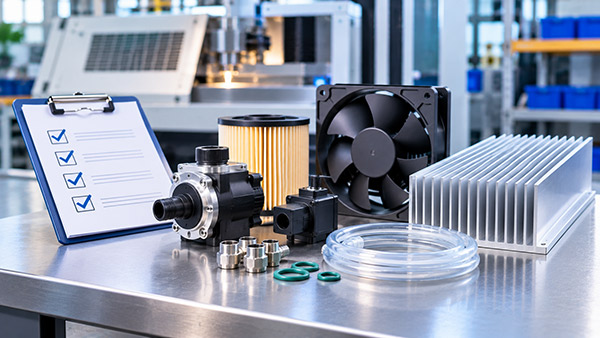
For OEM manufacturers, this creates a purchasing responsibility that is easy to overlook during initial product development: ensuring that compatible replacement components can be obtained when the equipment requires maintenance or repair.
Although an extruded aluminum heatsink is often a durable passive component, it can still require replacement after physical damage, corrosion, assembly modifications or service-related incidents.
Spare parts planning should therefore be considered before the original product reaches the end of production.
1. Identify Whether the Heat Sink Is a Standard or Custom Component
The replacement strategy depends partly on how the original heat sink was manufactured.
A standard aluminum heatsink may have alternative supply options if the profile remains commercially available.
A custom extruded heat sink can be more difficult to replace because its mounting geometry, dimensions or fin arrangement may have been designed specifically for one equipment assembly.
OEM buyers should identify which components rely on dedicated tooling or proprietary geometry and document the associated supply risks.
2. Preserve the Approved Manufacturing Information
Reliable replacement production requires more than an old purchase order number.
The OEM should retain the approved drawing, material specification, machining requirements, surface finish and applicable inspection criteria.
Where thermal performance is critical, the original validation conditions should also be retained.
This information becomes valuable if a replacement batch is needed several years after the initial production run.
3. Determine Appropriate Spare Parts Quantities
Not every equipment program requires a large spare heat sink inventory.
The required quantity depends on the installed equipment population, service commitments, expected failure or damage rates and the availability of replacement manufacturing.
| Planning Factor | Purchasing Consideration |
|---|---|
| Installed equipment population | Number of units potentially requiring replacement |
| Service commitment | Duration of the manufacturer's support obligation |
| Replacement lead time | Time required to obtain an approved component |
| Tooling availability | Ability to reproduce the original extrusion profile |
| Design revisions | Compatibility between different equipment versions |
These factors help determine whether it is preferable to retain a limited spare parts stock or maintain the ability to restart manufacturing when required.
4. Control Replacement Part Compatibility
Two aluminum heatsinks with similar overall dimensions are not necessarily interchangeable.
Differences in fin geometry, base thickness, mounting hole locations or surface treatment may affect thermal performance and installation.
When replacement parts are purchased, the OEM should confirm compatibility with the intended equipment revision.
If a replacement uses a different design, appropriate engineering verification should be completed before approval.
5. Consider the Final Production Order
When an equipment model is being discontinued, the final production order presents an opportunity to review future service requirements.
Purchasing teams should discuss whether additional spare components are needed and whether the supplier expects to retain the relevant manufacturing capability.
Important commercial details include tooling ownership, storage arrangements, minimum production quantities and any conditions affecting future repeat orders.
6. Evaluate Manufacturing Support for Future Reorders
When selecting an extruded aluminum heatsink manufacturer, OEM buyers should consider whether the supplier can support documented repeat production requirements.
KINGKA provides custom extruded aluminum heatsink manufacturing and secondary machining services for thermal management applications.
For long-life equipment programs, buyers should discuss future replacement requirements, drawing control and repeat-order conditions during supplier qualification.
Spare parts availability is an important part of total product lifecycle management.
By controlling technical documentation, understanding tooling requirements and planning replacement quantities, OEM manufacturers can reduce the risk of unavailable cooling components during the equipment's service life.
A reliable spare parts strategy begins before production ends, not after a replacement becomes urgent.
Need a Custom Heat Sink for an OEM Project?
Explore KINGKA's aluminum extrusion heat sink manufacturing capabilities for new equipment and repeat production requirements.
Explore Custom Aluminum Heatsinks →