




Forced-air cooling is commonly used with extruded aluminum heatsinks in industrial computers, communication equipment, and electronic power systems. While fan noise is expected in many applications, some assemblies produce an additional high-pitched whistle or tonal sound under particular operating conditions.
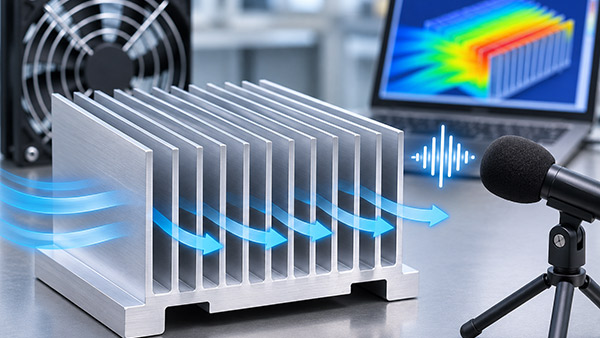
This noise is not necessarily caused by a defective fan. The interaction between airflow, fin channels, enclosure openings, and nearby structures can contribute to the acoustic behavior of the complete cooling system.
What Is Tonal Airflow Noise?
Airflow noise can contain a broad range of frequencies. Tonal noise occurs when a relatively narrow frequency component becomes prominent.
Depending on the system, this may be perceived as whistling, humming, or another distinctive sound.
Potential causes include periodic aerodynamic interactions, resonances, and flow through restrictive or sharp-edged passages.
It is important to distinguish these effects from electrical motor noise and mechanical vibration before changing the heat sink design.
Why Can Heat Sink Fin Channels Contribute to Noise?
An extruded aluminum heatsink contains multiple channels between its cooling fins.
When a fan forces air through these passages, local flow velocity and turbulence depend on fin spacing, channel length, inlet conditions, and system resistance.
Under certain conditions, a specific airflow arrangement can excite an acoustic response in the surrounding structure.
However, not every narrow fin channel generates audible whistling, and the presence of a tone does not prove that the heat sink is its source.
1. Check Fan Speed Dependence
Engineers can begin by recording the operating condition at which the sound appears.
For example, the tone may be most noticeable within a limited fan-speed range.
This information helps distinguish speed-dependent aerodynamic behavior from noise that occurs regardless of airflow.
Any investigation should preserve safe component temperatures and comply with equipment operating limits.
2. Inspect the Inlet and Outlet Geometry
Air entering or leaving the fin channels may encounter abrupt edges, protective grilles, or nearby brackets.
These features can affect flow separation and pressure fluctuations.
The resulting noise depends on the complete geometry, not just the fin pitch.
Before modifying the extrusion profile, inspect whether the cover, duct, or grille introduces a localized restriction.
3. Review Airflow Bypass and Recirculation
Uncontrolled airflow around the heat sink may create complex flow patterns near the fin entrances and exits.
Recirculation can also affect local velocity and temperature distribution.
Suitable airflow guides may improve system behavior, but adding a duct can introduce new aerodynamic or acoustic effects.
Design changes should therefore be validated in the complete assembly.
4. Separate Aerodynamic Noise from Mechanical Vibration
A fan can transmit vibration through its mounting structure.
Thin sheet-metal covers and other enclosure surfaces may respond to this vibration and create audible sound.
In some cases, changing mechanical support or isolating an appropriate component may reduce the problem without altering the heat sink fins.
The selected solution must preserve mechanical reliability and thermal performance.
5. Evaluate Fin Geometry Carefully
Fin spacing, height, thickness, and channel length influence airflow resistance and local flow behavior.
Changing one of these dimensions can affect both thermal and acoustic performance.
For example, increasing spacing may reduce some restrictions but also changes the available heat transfer area.
There is no universal fin pitch that eliminates whistling in every forced-air system.
Acoustic Troubleshooting Checklist
| Observation | Possible Source | Recommended Investigation |
|---|---|---|
| Tone changes with fan speed | Fan or flow interaction | Record speed and acoustic behavior |
| Tone appears after installing a cover | Changed airflow or enclosure response | Compare representative configurations |
| Noise near a narrow grille | Local flow restriction | Inspect grille and inlet geometry |
| Hum with noticeable vibration | Mechanical transmission | Review mounting and supporting structures |
| Noise after fin changes | Different hydraulic resistance or flow pattern | Repeat thermal and acoustic tests |
How Should Acoustic Performance Be Tested?
For meaningful comparison, acoustic measurements should use consistent operating conditions.
Record the fan speed, equipment load, microphone position, surrounding noise, and enclosure configuration.
Where tonal noise is an important concern, frequency-domain measurements may help identify the dominant frequency.
Thermal measurements should be taken alongside acoustic measurements to confirm that noise-reduction changes do not compromise cooling performance.
Custom Extruded Aluminum Heatsink Design
KINGKA provides extruded aluminum heatsink manufacturing solutions for OEM electronic cooling applications.
Custom fin profiles, mounting features, and machining requirements can be reviewed against the intended thermal and mechanical conditions.
For noise-sensitive products, engineers should supply enclosure information, fan data, operating conditions, and acoustic targets alongside the heat sink drawing.
Develop a Heat Sink for Noise-Sensitive Electronics
Planning an industrial computer or compact forced-air cooling assembly? Share your fin geometry, fan operating data, space restrictions, and thermal requirements with KINGKA.
Frequently Asked Questions
Can extruded aluminum heatsinks cause whistling?
Their fin channels may contribute to tonal airflow noise under certain conditions, but the complete cooling assembly must be investigated to identify the source.
Does wider fin spacing always reduce noise?
No. Noise depends on airflow, fan behavior, enclosure geometry, and possible resonances. Thermal performance must also be considered.
Can a protective grille create a whistle?
Yes, certain restrictions and flow interactions may contribute to tonal noise. The effect should be evaluated under actual operating conditions.
Should acoustic testing be performed with the final enclosure?
Yes. The complete assembly can produce different noise characteristics from the heat sink and fan tested separately.
