




A custom skived fin heat sink is usually specified for applications that require relatively thin, dense cooling fins within a limited footprint. However, the supplier cannot evaluate manufacturing cost and feasibility from the fin count alone.
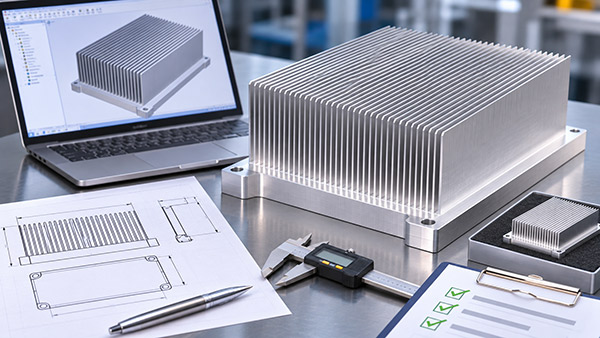
A complete request for quotation (RFQ) should include the skiving geometry, material requirements, thermal operating conditions, mounting features and expected production quantity.
For OEM engineers and purchasing teams, accurate technical information helps reduce unnecessary design revisions between quotation, prototyping and production.
1. Provide Complete 2D and 3D Drawings
The most useful starting point is a controlled engineering drawing.
A 3D model can help the supplier understand the overall geometry, while a 2D drawing should identify critical dimensions, datums, tolerances and other acceptance requirements.
Relevant dimensions may include:
Overall heat sink length and width.
Base thickness.
Fin height and thickness.
Fin pitch or clear gap.
Required fin count.
Specified fin orientation.
Mounting-hole locations.
Thermal contact surface dimensions.
Important features should be clearly identified rather than relying on the supplier to infer them from a rendered image.
2. Specify the Material
skiving heat sinks can be produced from suitable aluminum or copper materials.
Aluminum may be selected where low weight, cost and thermal performance need to be balanced.
Copper provides higher thermal conductivity but is heavier and generally more expensive.
Material selection should also account for the ability to manufacture the proposed fin geometry.
For repeatable production, buyers should specify the alloy or grade and relevant material condition rather than requesting "high thermal conductivity metal" without further details.
3. Define Fin Geometry for Manufacturing Review
Skiving equipment forms fins by cutting and raising material from the workpiece.
The achievable fin height and thickness are affected by material properties and the selected process.
Very thin and tall fins may create additional manufacturing or handling requirements.
Therefore, customers should not assume that every combination of fin height, pitch and width is feasible simply because the individual dimensions appear within a general capability range.
A complete cross-sectional review is necessary.
4. Identify Thermal Operating Conditions
An OEM RFQ should include the actual heat load and relevant temperature requirements.
Useful information includes:
Continuous and relevant transient heat dissipation.
Heat source footprint and location.
Maximum permitted component temperature.
Maximum intended inlet air temperature.
Natural or forced convection requirements.
Fan information, where applicable.
Installation orientation.
Available enclosure space.
A statement such as "cooling capacity of 300 W" is incomplete unless the operating conditions and acceptable temperature rise are defined.
5. Review Secondary CNC Machining
The heat sink may require additional features after the skiving operation.
These can include drilled or tapped holes, mounting steps, contact-surface finishing or other mechanical details.
Manufacturing planning should identify where the part can be supported without damaging the thin fins.
Engineers should also ensure that secondary machining does not interfere with the finished cooling array.
6. Define Inspection and Acceptance Requirements
A finished Skived Fin Heat Sink may need dimensional inspection of both the fin array and the mounting base.
Not every cosmetic feature requires a tight numerical tolerance.
However, fin pitch, minimum clearances, base flatness and mounting-hole positions may be functionally important.
Buyers should define acceptance criteria according to how the heat sink will be assembled and used.
7. Plan Prototype Approval
A prototype should be evaluated against the drawing and the actual cooling requirement.
Depending on the application, approval may include:
Material verification.
Fin geometry inspection.
Base flatness and mounting checks.
Representative thermal performance testing.
Airflow and acoustic evaluation.
Confirmation of surface finish and appearance.
Approval of the final drawing revision.
Some projects may require additional testing based on environmental or equipment reliability requirements.
8. Prepare for Repeat Production
After the prototype is approved, manufacturing should follow controlled specifications.
Changes to the material, fin geometry, machining sequence or inspection plan may affect the finished product.
These changes should be reviewed against the approved design and customer requirements.
Order quantity, batch size, expected schedule and packaging requirements should also be communicated clearly.
Custom skived fin heat sink RFQ Checklist
| Category | Information to Provide | Purpose |
|---|---|---|
| Drawings | 2D PDF and 3D STEP files | Geometry and tolerance review |
| Material | Aluminum or copper grade and condition | Manufacturing feasibility |
| Fin design | Height, pitch, thickness, count and orientation | Skiving process evaluation |
| Thermal | Heat load, source location and temperature targets | Cooling performance assessment |
| Airflow | Fan data, orientation and enclosure conditions | Fin array evaluation |
| Mechanical | Mounting holes, contact surface and tolerances | Assembly compatibility |
| Inspection | Critical dimensions and test requirements | Prototype and production acceptance |
| Commercial | Quantity, schedule and packaging | Quotation and supply planning |
How to Compare Different Supplier Quotations
Two quotations may not cover the same technical scope.
For example, one supplier may include finished CNC machining and inspection, while another may quote only the skived metal component.
Before comparing prices, confirm the material specification, finished dimensions, tooling assumptions, quantity, surface finish, inspection requirements and delivery conditions.
This helps purchasing teams compare equivalent manufacturing scopes.
KINGKA Custom Skived Fin Heat Sink Manufacturing
KINGKA provides OEM custom skived fin heat sink manufacturing with aluminum and copper material options and application-specific machining.
Customers can submit CAD drawings, fin dimensions, thermal requirements and purchasing quantities for manufacturing feasibility review.
Request a Custom Skived Fin Heat Sink Quotation
Looking for an OEM skived fin heat sink supplier? Share your drawings, material specifications, thermal requirements and production targets with KINGKA.
Explore KINGKA Custom Skived Fin SolutionsFrequently Asked Questions
What drawings are useful for a custom skived fin heat sink RFQ?
A controlled 2D drawing and suitable 3D model help define dimensions, tolerances, mounting features and fin geometry.
Can skived fin heat sinks be manufactured from copper?
Yes. Copper is a common skiving material, subject to the required fin geometry and manufacturing constraints.
Does a skived heat sink require a custom extrusion die?
No. Conventional skiving forms fins through a cutting process rather than extrusion through a profile die, although specialized manufacturing setup and tooling are still required.
Should prototype testing be completed before production approval?
For applications with important thermal or mechanical requirements, representative prototype qualification is recommended before repeat production.
