




A conventional extruded aluminum heatsink normally contains continuous parallel fins. This geometry can provide effective cooling when air moves along the fin channels. However, some electronic enclosures expose the heat sink to airflow arriving from multiple directions or require more flexible air movement around nearby components.
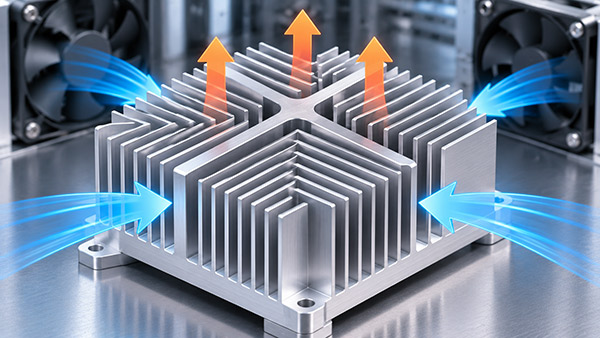
In these situations, engineers may consider cross-cutting the fins of an extruded heat sink. Transverse slots divide continuous fins into shorter segments, potentially changing airflow distribution and local heat transfer behavior.
Although this approach offers additional design flexibility, it also introduces trade-offs involving surface area, fin strength, machining cost, and pressure drop.
What Is a Cross-Cut extruded heat sink?
A cross-cut heat sink begins with a conventional aluminum extrusion profile containing a solid base and integrated cooling fins.
After extrusion, selected slots are machined across the fin structure, usually perpendicular to the original fin channels.
These cuts divide the fins into separate segments while leaving the underlying base intact.
Depending on the spacing and depth of the cuts, the finished structure may resemble an array of rectangular posts rather than continuous fins.
This is a secondary machining operation, not a separate extrusion process.
Why Consider Cross-Cutting?
1. Multidirectional Airflow
Continuous straight fins favor airflow along their channels. When incoming air travels across the fins, the structure may create substantial resistance.
Cross-cutting introduces transverse openings that can provide additional paths for air redistribution.
However, the resulting performance depends on slot geometry, fan placement, and enclosure conditions.
2. Local Flow Redistribution
In compact electronic systems, surrounding components may block part of the airflow path.
Cross-cut slots can help redistribute air between adjacent fin regions under suitable conditions.
They should not be assumed to eliminate all airflow restrictions.
3. Alternative Fin Arrangements
Cross-cut machining allows manufacturers to create segmented fin structures from an existing extrusion profile.
This may be useful when a standard straight-fin design cannot meet specific mechanical or airflow requirements.
Cross-Cut vs. Continuous-Fin Heat Sinks
| Design Factor | Continuous Fins | Cross-Cut Fins |
|---|---|---|
| Airflow direction | Generally suited to flow along fin channels | May accommodate more complex airflow paths |
| Surface area | Continuous fin surfaces | Some surface removed, additional cut faces created |
| Manufacturing | Extrusion and standard finishing | Requires additional machining |
| Structural behavior | Continuous fin structure | Shorter fin segments |
| Thermal performance | Depends on fin and airflow design | Requires application-specific validation |
| Cost | Generally fewer processing steps | Additional CNC operations and inspection |
Four Critical Cross-Cut Design Parameters
Slot Width
Slot width affects the space available for cross-flow and the amount of fin material removed.
Very narrow slots may offer limited airflow redistribution, while wide slots can remove excessive heat transfer area.
Slot Spacing
Closer slot spacing creates more fin segments. Wider spacing preserves longer continuous fin sections.
The correct arrangement depends on thermal requirements and manufacturing constraints.
Cut Depth
Cross-cut depth should be specified carefully so the machining process does not compromise the heat sink base or mounting surfaces.
The remaining material must provide adequate structural support and heat conduction.
Fin Height and Thickness
Thin, tall fins may require special fixturing during cross-cutting to prevent deformation.
The profile should be reviewed for both extrusion feasibility and secondary machining requirements.
Does Cross-Cutting Always Improve Thermal Performance?
No. Cross-cutting changes both airflow behavior and heat transfer geometry.
Under some conditions, improved air distribution may compensate for the reduction in continuous fin area.
Under other conditions, the removal of fin material and changes in flow resistance may reduce cooling effectiveness.
Therefore, a cross-cut heat sink should be compared with an unmodified profile under equivalent heat load, airflow, ambient temperature, and mounting conditions.
Manufacturing and Inspection Considerations
Cross-cutting adds manufacturing operations that must be considered during OEM production planning.
Important requirements include:
Controlled slot width, location and depth.
Appropriate fixturing for thin aluminum fins.
Prevention of excessive fin deflection.
Removal of chips and burrs after machining.
Inspection for damaged fin segments.
Verification of functional mounting dimensions.
Where surface treatment is required, the process sequence should be reviewed to avoid undesirable exposed edges or coating damage.
When Should OEM Engineers Choose This Structure?
Cross-cut fins may be worth evaluating for compact electronics with complex airflow, restricted enclosure geometry, or a need for flow redistribution between fin channels.
For equipment with strong, predictable longitudinal airflow, a conventional extrusion profile may remain simpler and more economical.
The decision should follow thermal analysis and prototype testing rather than appearance alone.
Custom Extruded Aluminum Heat Sink Manufacturing
KINGKA provides custom extruded aluminum heatsink manufacturing solutions for electronic and industrial thermal management applications.
Manufacturing options include aluminum extrusion, customized profiles and secondary CNC machining based on customer drawings and project requirements.
For cross-cut designs, customers should provide the intended airflow conditions, slot geometry, thermal targets and inspection requirements for manufacturing review.
Discuss Your Custom Extrusion Heat Sink
Need a custom fin structure for compact electronic equipment? Share your thermal requirements, profile drawing and machining details with KINGKA.
Explore KINGKA Extrusion Heat Sink SolutionsFrequently Asked Questions
Can an existing extruded heat sink be cross-cut?
Potentially, yes. The feasibility depends on fin geometry, base thickness, workholding and the required slot dimensions.
Is a cross-cut heat sink better for every airflow direction?
No. Its performance depends on the specific airflow pattern and thermal conditions. A continuous-fin profile may perform better in some applications.
Does cross-cutting increase manufacturing cost?
It normally adds machining operations, tool usage and inspection requirements. The cost impact depends on the number and complexity of cuts.
Can cross-cut fins be used for CPU cooling?
They can be evaluated for suitable CPU cooling assemblies, but the final design must meet processor thermal and mechanical requirements.
