




Choosing the material for a Liquid Cold Plate is an important engineering decision, particularly when the heat source occupies only a small portion of the cooling surface.
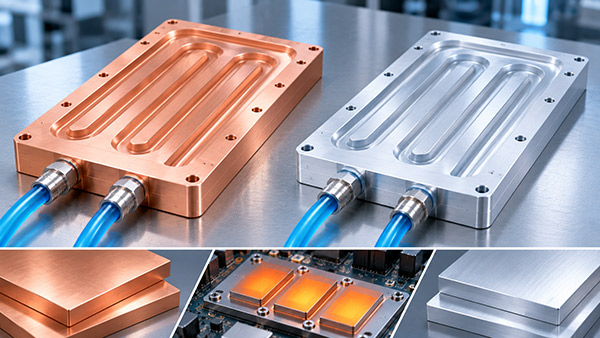
Both copper and aluminum can be considered for cold plate manufacturing, but their thermal and mechanical characteristics differ.
For an FSW cold plate, material selection also affects the welding process and the manufacturing feasibility of the completed structure.
Engineers should therefore evaluate copper and aluminum according to the actual heat-source geometry, operating conditions and production requirements rather than assuming that higher thermal conductivity always produces a better cooling solution.
1. Why Does Localized Heat Flux Matter?
Electronic devices do not always distribute heat evenly across their mounting surfaces.
A power semiconductor, processor or laser assembly may generate a concentrated thermal load over a relatively small area.
This creates a need to spread heat from the device into a larger region of the cold plate where circulating coolant can remove it.
The effectiveness of this process depends on the material conductivity, base thickness and distance between the heat source and internal channels.
2. How Copper Improves Heat Spreading
Copper generally has higher thermal conductivity than common aluminum alloys used for cold plates.
This can reduce conduction resistance when heat must travel laterally through the metal.
For example, if a small semiconductor package transfers heat into a much larger plate, copper may help distribute heat toward channels located away from the immediate contact area.
However, the magnitude of the improvement depends on the specific geometry.
If coolant channels are already located directly beneath the heat source and the conduction distance is short, the benefit may be smaller than in a plate requiring substantial lateral heat spreading.
3. Why Aluminum Remains a Practical Choice
Aluminum is widely used in industrial cold plate manufacturing because it provides useful thermal conductivity together with relatively low density and good machinability.
For large cooling plates, the weight difference between aluminum and copper may be especially important.
Reduced component weight can benefit equipment mounting, handling and structural design.
Aluminum also offers practical manufacturing advantages for many FSW configurations, although suitability depends on the alloy, joint geometry and production equipment.
4. FSW Manufacturing Differences Between Copper and Aluminum
Friction stir welding joins suitable metal materials through a controlled solid-state process.
The rotating tool generates heat and mechanically stirs the material along the intended joint path.
Copper and aluminum respond differently during this operation because of their thermal and mechanical properties.
Copper's relatively high thermal conductivity can increase the heat removed from the immediate welding zone, influencing process control.
Tool selection, process parameters, fixturing and material condition may therefore require a different approach from those used for aluminum.
Successful FSW manufacturing should be verified for the specific material and joint rather than treating copper and aluminum as directly interchangeable.
5. Does a copper cold plate Always Operate at a Lower Temperature?
No. The completed cold plate includes more than the metal body.
Its thermal performance may depend on:
Thermal interface material.
Heat source dimensions and location.
Distance to the coolant passages.
Channel cross-section and routing.
Coolant inlet temperature.
Coolant flow rate and distribution.
Total cooling-system operating conditions.
If the dominant limitation is insufficient coolant flow or high thermal interface resistance, changing the plate material alone may produce limited improvement.
6. Material Weight and Structural Considerations
Copper is considerably denser than aluminum, so a copper plate with the same volume is substantially heavier.
For assemblies using a large cold plate, this difference may influence fastener design, support brackets and transportation weight.
The mechanical properties of the selected material and temper should also be considered when evaluating mounting loads and pressure containment.
Thermal conductivity is not a substitute for structural qualification.
7. Coolant Compatibility and Corrosion Control
Both copper and aluminum require consideration of the cooling system's wetted materials and coolant chemistry.
When different metals are present within the same coolant loop, electrochemical compatibility should be evaluated.
Appropriate coolant formulation, material selection and maintenance practices may be necessary to control corrosion risk.
For this reason, switching to a copper cold plate should not be treated as an isolated component decision when the rest of the cooling loop contains aluminum or other metals.
8. Copper vs Aluminum Cold Plate Comparison
| Factor | Copper | Aluminum |
|---|---|---|
| Thermal conductivity | Generally higher | Lower than copper, but useful for many applications |
| Weight | Higher density | Lower density |
| Heat spreading | Attractive for concentrated loads | Often sufficient for distributed loads |
| Material cost | Generally higher | Often more economical |
| FSW manufacturing | Requires material-specific process qualification | Common option for qualified aluminum FSW processes |
| Cooling-loop compatibility | Requires suitable coolant chemistry | Requires suitable coolant chemistry |
9. When Is a Copper Cold Plate Worth Considering?
Copper may be worth evaluating when the equipment contains concentrated heat sources, limited thermal margin or significant lateral heat-spreading requirements.
Aluminum may remain preferable for larger components, weight-sensitive assemblies or designs with adequate thermal performance at lower manufacturing cost.
Engineers should compare realistic candidate designs rather than selecting material based on a single property.
10. Custom Copper and Aluminum FSW Cold Plate Manufacturing
KINGKA provides custom FSW cold plate manufacturing solutions for Industrial Liquid Cooling applications.
OEM engineers considering a copper or aluminum FSW liquid cold plate can submit their material requirements, channel drawings and thermal specifications for technical feasibility evaluation.
The final material, welding configuration and performance requirements should be qualified for the specific application.
Frequently Asked Questions
Is copper always the best material for a liquid cold plate?
No. Copper may improve heat spreading, but cost, weight, coolant compatibility and cooling-system performance must also be considered.
Can copper be joined using friction stir welding?
Yes, copper FSW is technically possible, but suitable tooling, process control and joint qualification are important.
Can copper and aluminum be used in the same cooling system?
They may be used within a properly engineered system, but galvanic corrosion risk and coolant chemistry must be evaluated.
Conclusion
Copper and aluminum provide different advantages for FSW cold plate manufacturing.
The better material is the one that meets the application's thermal, hydraulic, mechanical and manufacturing requirements with an appropriate balance of cost and reliability.
Need a Custom Copper or Aluminum Cold Plate?
Provide your heat-source dimensions, material preferences, cooling requirements and technical drawings for a manufacturing review.
Explore KINGKA FSW Liquid Cold Plates