




An OEM engineer may receive several extruded aluminum heatsink datasheets showing different thermal resistance values.
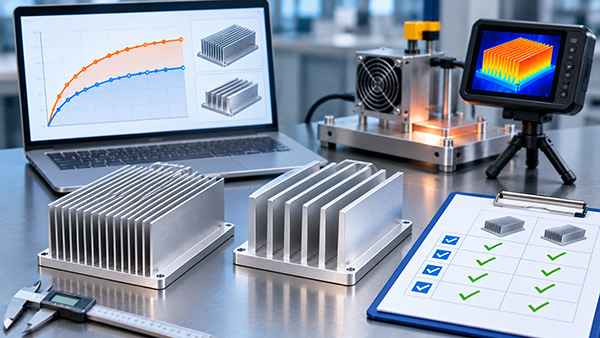
At first glance, the component with the lowest reported thermal resistance appears to be the strongest choice.
However, thermal ratings from different heat sink manufacturers are not necessarily measured under equivalent conditions.
Before selecting a supplier, buyers need to understand how the values were obtained and whether they apply to the actual electronics assembly.
1. What Does a heat sink Thermal Resistance Rating Mean?
Thermal resistance describes the temperature difference between two defined locations divided by the heat flowing through the corresponding thermal path.
For a sink-to-ambient rating, a simplified relationship is:
RθSA = (Tsink - Tair) / Q
Where the sink and air temperature measurement locations must be defined, and Q is the relevant heat transferred through the sink.
The equation does not explain the entire test setup by itself.
Two suppliers may report values under different airflow or mounting conditions.
2. Check the Airflow Conditions
An air-cooled heat sink may be tested under natural convection or forced airflow.
For a forced-air test, the reported result depends on the airflow arrangement.
A heatsink tested in a controlled duct may perform differently when installed in an enclosure with air bypass and nearby obstructions.
Buyers should determine:
Whether airflow was natural or forced.
How the airflow was measured.
Whether velocity or volumetric flow is reported.
Whether the test used a duct or unrestricted air.
How the fan or blower was positioned.
A thermal resistance value without a defined cooling condition is difficult to compare meaningfully.
3. Heat Source Size Can Change the Result
A small power semiconductor concentrates heat over a different area than a large, distributed heating surface.
When heat enters through a small contact region, lateral heat spreading through the base becomes more important.
As a result, two thermal tests using the same heatsink but different heat source footprints may produce different temperature distributions and reported performance.
For an OEM comparison, the test heat source should represent the intended application wherever practical.
4. Understand the Temperature Reference Point
Some tests measure temperature at the base near the heat source, while others may use a different sink location.
Device junction-to-ambient performance includes additional thermal resistance from the device package and mounting interface.
These values are not directly interchangeable.
When a datasheet reports a thermal resistance number, buyers should ask which temperatures define that number.
5. Why Physical Size Is Not Enough
Two aluminum heatsinks may have similar external dimensions yet use different fin heights, fin spacing or base thickness.
Such differences can change convection, heat spreading and airflow resistance.
Even a heatsink with more visible fin area may perform worse under some conditions if the airflow cannot use that area effectively.
Therefore, length, width and height are necessary comparison data, but they do not replace thermal performance information.
6. A Datasheet Comparison Checklist
| Item | Question for the Supplier |
|---|---|
| Thermal resistance | What are the temperature reference points? |
| Heat load | At what power was the rating determined? |
| Airflow | What cooling arrangement was used? |
| Heat source | What was the contact area and location? |
| Mounting | Which interface material and pressure were used? |
| Environment | What were the air temperature and orientation? |
| Evidence | Is the figure simulated, measured or estimated? |
7. How to Choose Between Two Candidate Heatsinks
When the available supplier ratings are not directly comparable, the purchasing team should avoid declaring a winner based on the smallest published number.
Instead, establish a common test or analysis specification.
Where appropriate, evaluate the candidates using the same heat source, ambient conditions, airflow, thermal interface and measurement method.
Performance should also be considered alongside manufacturing feasibility, weight, cost and mechanical fit.
8. Working with a Heat Sink Manufacturer
KINGKA provides custom heat sink manufacturing services for electronics and industrial thermal management applications.
Engineers can review KINGKA's OEM heat sink manufacturing solutions when evaluating product specifications and custom cooling requirements.
For a meaningful technical discussion, provide the expected heat load, mounting geometry, ambient temperature and airflow conditions.
Frequently Asked Questions
Can two heat sinks have the same thermal resistance but different geometry?
Yes. Different geometries can produce similar performance under a particular test condition, while behaving differently under other conditions.
Is a published thermal rating always measured?
Not necessarily. It may be based on simulation, testing or estimation. Buyers should confirm how the value was established.
Should an OEM repeat thermal tests after installing the heatsink?
Representative system-level validation is advisable when thermal performance is important to reliability or compliance.
Comparing aluminum heatsinks requires more than finding the lowest thermal resistance value in a supplier catalog.
By checking the test setup, temperature references and heat source conditions, OEM engineers can make more reliable comparisons and avoid selecting a component based on misleading assumptions.
Evaluate Custom Heatsink Requirements
Provide your operating conditions and engineering drawings to discuss suitable heat sink manufacturing options.
Explore KINGKA Heat Sink Manufacturing