

When OEM buyers request quotations for custom heat sinks, suppliers may return significantly different prices for what appears to be the same component.
However, a lower quotation does not always represent the same material, manufacturing process, inspection scope or finished-part requirements.
For extruded aluminum heatsinks in particular, tooling costs and secondary machining can create differences between quotations that are easy to overlook.
1. Start with the Same Engineering Specification
Before requesting prices, buyers should ensure that manufacturers receive the same approved drawing and operating requirements.
The specification should identify material grade, heat sink dimensions, mounting features, surface finish and required tolerances.
If thermal performance is important, the heat load and cooling conditions should also be provided.
A quotation based on a different fin geometry or material is not directly equivalent, even when the finished components have similar overall dimensions.
2. Separate Extrusion Tooling from Unit Cost
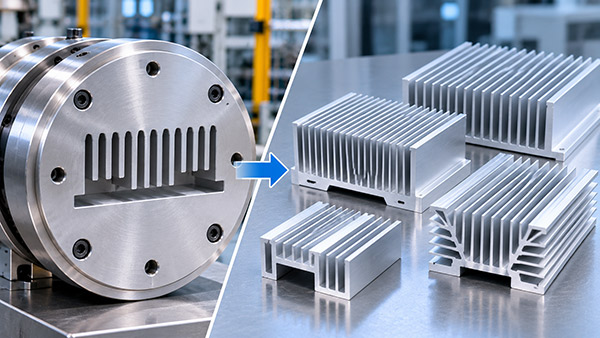
Custom extruded aluminum heat sinks may require a dedicated extrusion die.
The die determines the cross-sectional geometry of the profile, including the base and fins.
Some projects may be able to use an existing profile and avoid new die development. Others require a completely new cross-section.
Buyers should confirm:
Whether new extrusion tooling is required.
Whether the tooling charge is separate from the unit price.
Who owns the tooling after payment.
Whether the die can be reused for future orders.
What changes would require tool modification or replacement.
Tooling and manufacturing feasibility are closely related to fin geometry. KINGKA's aluminum heat sink extrusion process and design guide explains the relationship between material selection, extrusion dies, fin dimensions and secondary machining.
3. Compare Material Grades and Conditions
The broad description "aluminum heatsink" is not sufficient for a technical quotation.
Different aluminum alloys and tempers have different mechanical and manufacturing characteristics.
For example, 6063 may be considered for complex extruded profiles, while other alloys may be selected where specific mechanical properties are required.
Manufacturers should quote according to the specified material requirements or clearly explain any proposed substitutions.
4. Secondary CNC Machining Can Change the Price
An extruded aluminum profile often requires additional operations before it becomes a finished OEM component.
These may include:
Cutting to the required length.
CNC drilling and tapping.
Milling a thermal contact surface.
Machining pockets or special mounting features.
Deburring and cleaning.
Each operation adds manufacturing time and may require fixturing or inspection.
Buyers should confirm whether the quotation covers a basic extrusion or a completely machined component.
5. Surface Treatment and Inspection Are Part of the Scope
Aluminum heat sinks may require anodizing or another surface treatment.
The required finish should be identified in the engineering specification, including any areas that need masking or special contact-surface conditions.
Inspection may cover profile dimensions, mounting positions, base flatness, coating appearance and other project-specific requirements.
A quotation that includes additional inspection documentation should not be compared directly with one that excludes those activities.
6. Compare Equivalent Production Quantities
Custom heat sink pricing can vary with production volume.
A small prototype order may carry a different unit cost from a repeat production order because of setup and manufacturing efficiency.
Buyers should request separate quotations for prototype quantities and expected production volumes when appropriate.
International purchasing teams should also confirm packaging, freight terms and other delivery responsibilities.
7. Practical Quotation Comparison
| Quotation Item | What Buyers Should Check |
|---|---|
| Extrusion profile | Dimensions, fin geometry and manufacturing feasibility |
| Material | Alloy, temper and approved specification |
| Tooling | New die, ownership and reuse conditions |
| CNC machining | Holes, threads, milling and precision features |
| Finishing | Anodizing, cleaning and surface requirements |
| Inspection | Measurements and required documentation |
| Delivery | Lead time, packaging and agreed shipping terms |
Frequently Asked Questions
No. Existing profiles may be suitable for some projects. A new cross-section typically requires a tooling feasibility review.
Why does CNC machining increase heat sink cost?
Secondary machining adds operations, machine time, setup and potentially additional inspection requirements.
Is the lowest quoted price always the best choice?
No. The quotation must meet the functional, dimensional, quality and delivery requirements of the OEM project.
Effective procurement begins with equivalent technical specifications.
For extruded aluminum heatsinks, buyers should evaluate tooling, material selection, secondary machining, inspection and delivered cost rather than comparing unit prices alone.
Understanding these factors can improve supplier communication and reduce unexpected changes after a purchase order is issued.